
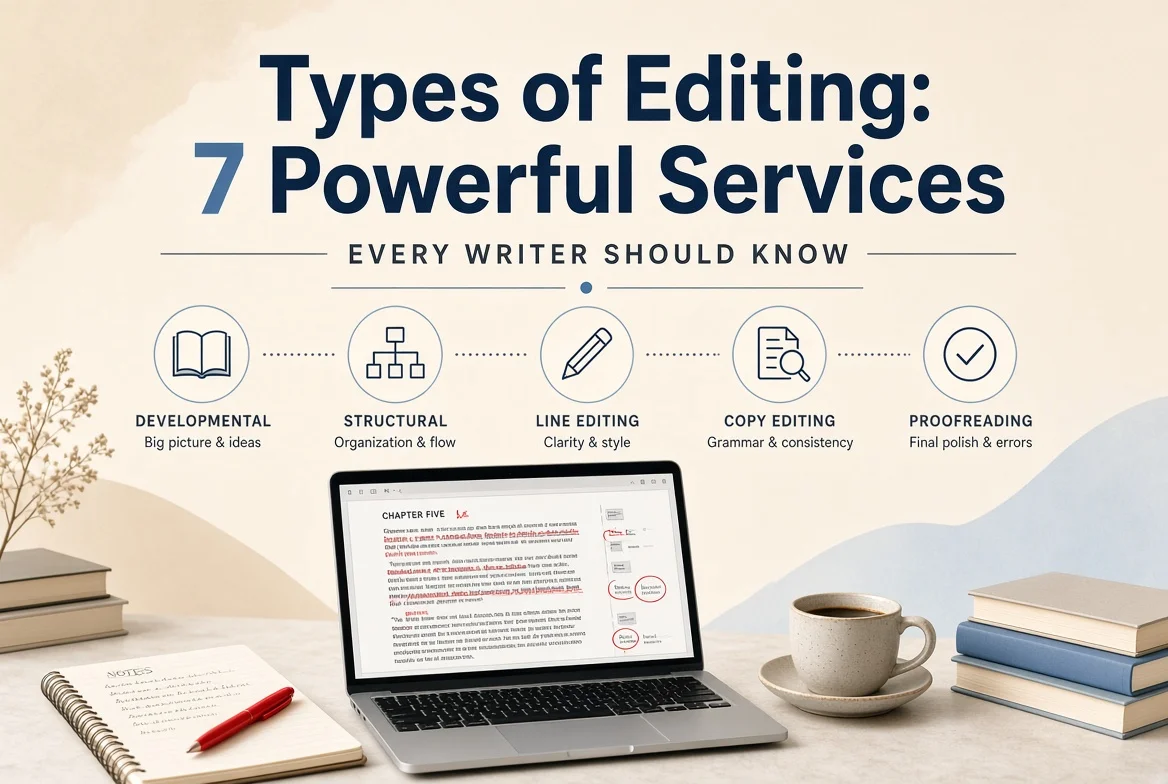
Types of Editing: 7 Powerful Services Every Writer Should Know
Introduction: Why Understanding the Types of Editing Matters for Every Writer
Writing a book is an exciting journey filled with ideas, emotions, and creativity. Many writers spend months or even years creating their stories, guides, or educational books. However, finishing the first draft is only the beginning. A strong manuscript needs careful improvement before it reaches readers. This is where understanding the types of editing becomes important for every author.
Many new writers believe editing only means fixing spelling mistakes. However, professional editing is much more than checking grammar. Editing improves the message, structure, flow, clarity, and overall quality of a book. A skilled editor helps writers transform simple drafts into polished and professional publications.
The editing process includes different stages, and each stage has a specific purpose. Some editors focus on the big picture, while others improve sentence quality or correct small errors. Learning about the types of book editing helps authors choose the right service for their writing needs.
Whether you are writing a novel, memoir, business book, children’s book, or self-help guide, professional editing can make a major difference. Readers expect books that are easy to understand, enjoyable to read, and free from distracting mistakes.
In today’s publishing world, authors have many options. They can publish independently through platforms like Amazon KDP or work with traditional publishers. In both cases, quality matters. A well-edited book creates trust and shows readers that the author cares about their experience.
This guide explains the seven essential editing services every writer should know. We will explore different editing stages, common styles of editing, and how each service improves a manuscript.
What Are the Types of Editing?
The types of editing are different methods used to improve a written work before publication. Each editing stage focuses on a specific area of the manuscript. Some stages improve the story and organization, while others focus on grammar, consistency, and final presentation.
A manuscript usually goes through several editing steps before becoming a finished book. The process begins with larger improvements and gradually moves toward smaller details. This approach helps writers create a strong foundation before correcting minor issues.
The first stages often focus on content quality. Editors review the purpose of the book, the target audience, chapter organization, and overall message. Later stages focus on language, sentence structure, spelling, punctuation, and formatting.
Understanding the different types of editing helps authors avoid unnecessary expenses. For example, a writer with a complete first draft may need developmental editing before proofreading. Correcting grammar too early may not help if the story structure still needs improvement.
Professional editors use different methods depending on the writer’s goals. A fiction author may need help with character development and storytelling. A business writer may need support with clarity and professional tone. A children’s book creator may need help with simple language and age-appropriate content.
Every book is different, so every editing project requires a personalized approach. Choosing the right editing service can improve the quality of a manuscript and increase its chances of connecting with readers.
1. Developmental Editing: Improving the Big Picture of Your Book
Developmental editing is one of the most important stages in the editing process. It focuses on the overall quality, structure, and direction of a manuscript. Instead of correcting individual sentences, a developmental editor examines the complete book.
This type of editing helps writers understand whether their ideas are clear and effective. The editor looks at the organization of chapters, the strength of the message, pacing, character development, and reader engagement.
For fiction books, developmental editing focuses on elements like plot, characters, conflict, and storytelling flow. The editor checks whether the story keeps readers interested from beginning to end.
For nonfiction books, developmental editing focuses on the accuracy of ideas, chapter arrangement, explanations, and learning value. The editor helps ensure that information is presented in a logical order.
Many first-time authors benefit from developmental editing because they are often too close to their own work. Writers may miss problems because they already understand their ideas. A professional editor provides an outside perspective and identifies areas that need improvement.
Developmental editing is also useful for identifying missing information. Sometimes a writer has a great concept but does not explain important points clearly. An editor can suggest where more details, examples, or explanations are needed.
This stage creates a strong foundation for the remaining types of editing. When the structure is improved first, later editing stages become easier and more effective.
2. Structural Editing: Creating Better Organization and Flow
Structural editing focuses on the arrangement and organization of a book. While developmental editing looks at the overall concept, structural editing examines how each section works together.
A structural editor reviews chapter order, transitions, headings, and the logical movement of ideas. The goal is to make the reading experience smooth and natural.
A book may contain valuable information, but poor organization can confuse readers. For example, important topics may appear too early or repeated ideas may appear in different sections. Structural editing helps solve these problems.
For nonfiction writers, structure is especially important. Readers expect guides, courses, and educational books to follow a clear path. Each chapter should build on the previous one and lead readers toward a useful conclusion.
For fiction writers, structure affects storytelling. A novel needs proper pacing, emotional development, and well-planned scenes. Structural editors help authors identify slow sections, unnecessary scenes, or missing connections.
Among the various different edit styles, structural editing plays a major role because it improves how readers experience the entire book.
A strong structure keeps readers engaged and helps them understand the author’s message. It also makes the book appear more professional and carefully planned.
3. Line Editing: Improving Sentence Quality and Writing Style
Line editing focuses on the way words and sentences are written. It improves readability, tone, and communication without changing the author’s original voice.
A line editor reviews sentence flow, word choices, paragraph transitions, and writing style. The goal is to make every sentence clearer and more enjoyable.
Many writers have great ideas but struggle to express them smoothly. Line editing helps remove confusing sentences and improves the connection between thoughts.
This stage is especially helpful for authors who want their writing to sound professional while still feeling personal. A good editor does not replace the writer’s voice. Instead, the editor helps that voice become stronger.
Line editing is one of the valuable editorial edits because it focuses on the reader’s experience. It ensures that sentences are easy to follow and that the message feels natural.
A skilled line editor also checks consistency in tone. For example, a business book should maintain a professional style, while a children’s book should use simple and friendly language.
The best styles of editing always respect the author’s purpose. Editing should improve writing, not remove the personality behind it.
Why Writers Need Different Types of Editing Services

Every manuscript has different needs. Some books require major changes, while others only need final corrections. This is why understanding the different kinds of editing is important.
A writer who skips editing may face problems such as unclear ideas, grammar mistakes, poor organization, or negative reader reviews. Professional editing helps prevent these issues before publication.
The right editing process also improves credibility. Readers are more likely to trust a book that looks professional and carefully prepared.
Authors should think of editing as an investment in their book’s success. A quality manuscript has a better chance of attracting readers, receiving positive feedback, and building the author’s reputation.
4. Copy Editing: Fixing Grammar, Accuracy, and Consistency
Copy editing is one of the most important stages in the types of editing process. It focuses on improving the accuracy, consistency, and correctness of a manuscript. While developmental editing works on the bigger picture, copy editing looks closely at the details that affect reading quality.
A copy editor checks grammar, spelling, punctuation, sentence structure, and word usage. They make sure the writing follows proper language rules while keeping the author’s original message clear.
Many writers create excellent content but make small mistakes during the writing process. These mistakes can happen because authors become familiar with their own work. A fresh professional review helps identify problems that may be difficult for the writer to notice.
Copy editing also improves consistency throughout a book. For example, an editor checks whether the same terms, names, capitalization styles, and formatting choices are used correctly from beginning to end.
For nonfiction books, copy editing helps maintain accuracy and professionalism. For fiction books, it helps create a smooth reading experience without distracting errors.
Among the many types of book editing, copy editing is the stage that gives a manuscript a cleaner and more polished appearance. It prepares the book for the final review before publication.
A professional copy editor also checks unclear sentences and awkward phrases. They make sure every sentence communicates the intended meaning without confusion.
5. Proofreading: The Final Quality Check Before Publishing
Proofreading is the final step among the major types of editing services. It happens after all major changes have been completed. The purpose of proofreading is to find small mistakes that remain before the book becomes available to readers.
A proofreader checks spelling errors, punctuation problems, missing words, formatting issues, and typing mistakes. Even professionally edited books can contain small errors, so this final review is very valuable.
Proofreading is different from other different types of editing because it does not focus on rewriting or improving the content. Instead, it focuses on making sure the final version is clean and ready.
A proofreader carefully reviews every page to ensure consistency. They check chapter titles, page numbers, headings, spacing, and other small details that affect the reader’s experience.
For self-publishing authors, proofreading is especially important. Platforms like Amazon KDP allow authors to publish independently, but readers still expect professional-quality books.
A book with many mistakes can reduce reader trust. A carefully proofread book creates a stronger impression and shows attention to detail.
Professional proofreading is one of the most valuable editorial edits because it protects the final reputation of the author and the book.
6. Fact-Checking Editing: Making Information Reliable

Fact-checking editing focuses on checking the accuracy of information presented in a book. This service is especially useful for nonfiction writers, researchers, business authors, and educational content creators.
A fact-checking editor reviews statistics, dates, names, references, and other important details. Their goal is to make sure the information is reliable and trustworthy.
Readers depend on books for accurate knowledge. Incorrect information can damage an author’s credibility and create confusion among readers.
Fact-checking is an important part of professional styles of editing because it improves trust and authority. A well-researched book provides more value to its audience.
For example, a health book should include accurate information from reliable sources. A history book should present correct dates and events. A business book should include dependable examples and research.
Fact-checking does not change the author’s opinions or ideas. Instead, it helps ensure that supporting information is correct.
When combined with other different edit styles, fact-checking creates a stronger and more dependable manuscript.
7. Formatting and Final Editing: Preparing Your Book for Readers
Formatting and final editing prepare a manuscript for its final publishing stage. This process focuses on how the book looks and feels when readers open it.
A well-written book can lose quality if the formatting is poor. Incorrect spacing, inconsistent headings, or improper page layouts can create a negative reading experience.
Book formatting includes adjusting margins, fonts, chapter layouts, page breaks, images, and other design elements. This is especially important for print books, e-books, and Amazon KDP publishing.
Final editing also includes reviewing the complete book after formatting. This ensures that no errors appeared during the design process.
Among the various types of editors for books, formatting specialists play an important role in creating a professional final product.
A properly formatted book looks more trustworthy and provides a better experience for readers. Professional formatting is often the final step that transforms a manuscript into a finished publication.
Different Types of Editors for Books Explained

Authors often wonder which editor they need for their project. The answer depends on the current condition of the manuscript and the writer’s goals.
There are several different types of editors who specialize in different areas. Each editor provides specific skills to improve a book.
A developmental editor focuses on ideas, structure, and content direction. A structural editor improves organization and flow. A line editor improves writing style and readability.
A copy editor focuses on grammar, consistency, and accuracy. A proofreader checks the final version for small mistakes. A formatting specialist prepares the book layout.
Understanding these roles helps writers choose the right professional support. Hiring the correct editor saves time and improves the final result.
The best editing process usually combines multiple services. A manuscript may need several editing stages before it reaches professional publishing standards.
How to Choose the Right Editing Service for Your Book
Choosing the right editing service can feel confusing, especially for new authors. The first step is understanding what your manuscript needs.
If your book has problems with structure or ideas, developmental editing may be the right choice. If your writing is complete but needs improvement in clarity, line editing may help.
If your manuscript is already polished, copy editing or proofreading may be enough. Each stage solves different problems.
Authors should also consider their target readers. A children’s book requires a different approach compared to a technical guide or business book.
Reviewing an editor’s experience is also important. A professional editor with knowledge of your genre can provide better guidance.
Good communication between the writer and editor creates better results. The editor should understand your goals and respect your creative vision.
Common Mistakes Writers Make Without Professional Editing

Many writers publish their books without proper editing. This can create several problems that affect reader satisfaction.
One common mistake is believing that self-editing is always enough. While reviewing your own work is helpful, writers often miss mistakes because they already know the content.
Another mistake is choosing only proofreading when deeper editing is needed. Small grammar corrections cannot fix problems with structure, flow, or unclear ideas.
Some writers also avoid editing because they consider it an unnecessary expense. However, professional editing can increase the quality and value of a book.
A well-edited book shows readers that the author values quality. It can also improve reviews, recommendations, and long-term success.
Frequently Asked Questions About Types of Editing
What are the main types of editing?
The main types of editing include developmental editing, structural editing, line editing, copy editing, proofreading, fact-checking, and formatting editing. Each stage improves a different part of a manuscript.
Which type of editing does my book need first?
Most books begin with developmental editing. However, the right choice depends on the condition of your manuscript and your publishing goals.
What is the difference between copy editing and proofreading?
Copy editing improves grammar, consistency, and accuracy. Proofreading focuses on finding final mistakes after editing and formatting are complete.
Why are different types of editing important?
Different editing stages improve different areas of a book. Using the right service helps create a professional and reader-friendly publication.
How many types of editors for books are available?
There are several types of editors for books, including developmental editors, copy editors, line editors, proofreaders, and formatting specialists.
What are the different types of editing in publishing?
The different types of editing in publishing include developmental editing, structural editing, line editing, copy editing, proofreading, fact-checking, and formatting editing. Each stage improves a different part of a manuscript. Some editors focus on the overall story or message, while others focus on language, accuracy, and final presentation.
What is the most important type of editing for a new writer?
For many new writers, developmental editing is one of the most valuable services. It helps improve the foundation of a book before smaller corrections are made. However, the best choice depends on the current condition of the manuscript and the writer’s publishing goals.
Can one editor handle all types of book editing?
Some professional editors offer multiple services, but many editors specialize in specific areas. The types of book editing required for a project may involve more than one expert. A developmental editor, copy editor, and proofreader may each contribute different skills to create a polished book.
How are styles of editing different from each other?
Different styles of editing focus on different improvements. Some editing styles focus on story structure and content, while others improve sentence flow, grammar, consistency, and formatting. Choosing the correct editing style helps writers get better results from the editing process.
Do self-published authors need professional editing?
Yes, professional editing is highly valuable for self-published authors. Publishing platforms allow writers to release books independently, but readers still expect high-quality content. Professional editing helps improve readability, credibility, and the overall quality of a book.
Final Thoughts
Understanding the types of editing helps writers make better decisions during the publishing journey. A great book is not only created through writing. It is improved through careful review and professional support.
Each editing stage has a unique purpose. Developmental editing strengthens ideas. Structural editing improves organization. Line editing improves style. Copy editing fixes accuracy. Proofreading removes final mistakes.
The right editing approach depends on your manuscript, goals, and readers. Whether you are a first-time writer or an experienced author, professional editing can help your book reach its full potential.
Investing in quality editing creates a better reading experience and builds trust with your audience. A polished book represents your hard work and gives readers a reason to return to your future publications.

We help authors bring their stories to life through professional online book publishing services. From manuscript formatting and cover design to Amazon KDP publishing and global distribution, we make self-publishing simple, affordable, and successful.
