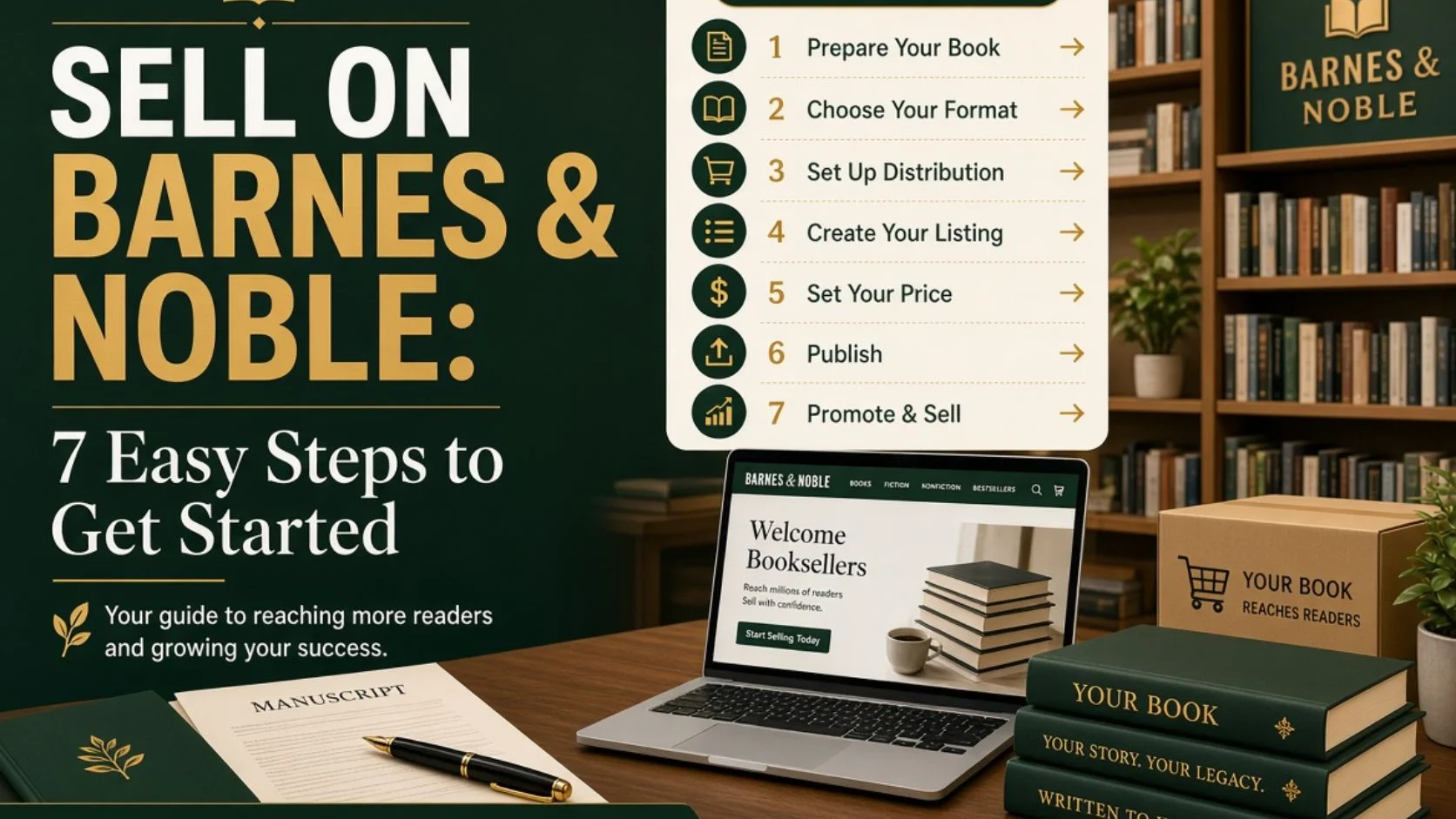
Sell on Barnes and Noble: 7 Easy Steps to Get Started
If you are an author, selling your book through a trusted retailer can feel exciting. Barnes & Noble is one of the best-known book retailers in the United States. Many independent authors want their books available to its readers. If you have the same goal, you may wonder where to begin.
The good news is that the process does not need to feel difficult. You can start by preparing your book correctly. Then, you can choose the right publishing option. You also need accurate book information and professional files. After that, you can focus on publishing and promotion.
This guide explains how to sell books on Barnes and Noble step by step. It also explains what authors should know before publishing. You will learn about book preparation, B&N Press, ISBNs, formatting, pricing, and book descriptions. We will also discuss some common mistakes that new authors should avoid.
What Does It Mean to Sell on Barnes and Noble?
When authors search for ways to sell on Barnes and Noble, they often have different goals. Some authors want their books listed online. Others want their books displayed inside physical stores. These goals are related, but they are not exactly the same.
Barnes & Noble Press provides a self-publishing option for independent authors. Authors can use the platform to publish eligible print books and eBooks. Their books can become available through Barnes & Noble’s online channels. This gives authors another place to reach potential readers.
However, publishing through B&N Press does not automatically place your book on store shelves. This is an important point for new authors. Online availability and physical bookstore placement follow different paths. Understanding this difference can save you time and confusion.
If your main goal is online sales, B&N Press may be useful. If you want physical stores to carry your book, more steps may be needed. Your strategy should match your actual publishing goal.
Step 1: Prepare Your Book Before Publishing
Before you upload your book, make sure it is complete and polished. Proofread the manuscript for spelling, grammar, and formatting errors. Check headings, page numbers, images, margins, and spacing.
Your cover also needs careful attention. Make sure the title and author name are clear. The design should match your book and target readers.
Why Book Formatting Matters

Good formatting makes your book easier and more enjoyable to read. Keep fonts, headings, margins, and page breaks consistent. Check the correct trim size, bleed, and cover requirements before uploading.
A final review can help prevent costly mistakes and give readers a professional experience.
Step 2: Create Your Barnes & Noble Press Account
After preparing your book, create your Barnes & Noble Press account. Enter your author and book information carefully. Make sure your title, subtitle, and author name match your book files.
Prepare your book description and other details before starting. Accurate information makes the publishing process smoother and helps avoid mistakes.
Understanding ISBN Requirements
An ISBN is an important part of book publishing. It helps identify a specific book edition and format.
B&N Press currently requires authors to provide a unique ISBN for their projects. The ISBN should not have been previously used for another book.
You should therefore prepare your ISBN information carefully. Make sure it belongs to the correct edition and format.
For example, a paperback and an eBook may have different publishing requirements. You should not assume that one ISBN works for every format.
ISBN rules can also differ between publishing platforms. Always check the current requirements before uploading your book.
This is especially important for new authors. Publishing information can change over time. Following current instructions is safer than relying on an old blog post.
Step 3: Upload Your Manuscript and Cover
Once your account is ready, you can prepare your book project.
This is where your manuscript and cover become part of the publishing process. You should upload the correct files for your chosen format.
Before uploading, check your manuscript one more time.
Yes, one more time.
It may feel repetitive, but it is worth doing. Authors often discover small problems during their final review. A missing page or incorrect heading can be easy to fix before publishing.
It becomes more frustrating when you discover it afterward.
Your cover also deserves careful attention. Make sure the correct version is uploaded. Check the title and author’s name. Look at the cover at different sizes.
Sometimes a cover looks perfect on a large computer screen. However, small text may become difficult to read. Your book may appear as a small thumbnail online. Important words should remain clear at that size.
The cover should also represent your book honestly. Avoid designs that confuse readers about your genre. A reader should have a general idea about your book from its presentation.
Check Your Interior Before Publishing

Your interior file should receive a careful review.
Look at chapter openings first. Then check regular pages. Look for unusual spaces or strange page breaks. Check images and tables if your book contains them.
Pay special attention to the first few pages.
These pages can include your title page, copyright page, dedication, contents, and introduction. Make sure everything appears in the correct order.
Then review the final pages.
Check your references, author information, acknowledgments, and other closing material. Your book should feel complete from beginning to end.
A preview tool can be very helpful here. Use it before approving your project. Look at the pages as a reader would see them.
Do not only check the text.
Look at the overall appearance.
Step 4: Write a Strong Book Description
Your book description is one of your most important marketing tools. It helps potential readers understand your book.
Think of it as your book’s introduction.
A good description should answer an important question.
“Why should I read this book?”
You do not need complicated language. In fact, simple language often works better. Tell readers what the book offers. Explain the main problem, topic, story, or benefit.
If you write nonfiction, explain what readers can learn. If you write fiction, create curiosity about the story. If you publish a children’s book, explain what makes it enjoyable or useful.
Avoid giving away everything.
Your goal is to create interest.
For example, instead of explaining every chapter, focus on the main value. Tell readers what they can expect. Give them enough information to understand the book.
Your description should also sound natural.
Do not write for search engines alone. Write for real people first. Search engines are increasingly good at understanding natural language and user intent.
Use Keywords Naturally
Keywords can help your content target relevant searches. However, keyword stuffing can make your writing difficult to read.
For example, the phrase how to sell books on Barnes and Noble can be useful. You can use it naturally when discussing the publishing process.
The same applies to Barnes and Noble book selling.
These phrases should support your topic. They should not take over your article.
You should never force a keyword into every sentence. Readers can notice unnatural writing very quickly. Search engines can also understand repeated patterns.
Instead, use related phrases naturally throughout your content.
You can discuss:
- self-publishing
- book distribution
- independent authors
- book publishing
- print books
- eBooks
- book marketing
- bookstore placement
- online book sales
- author promotion
These related terms help create a complete topic.
Step 5: Choose the Right Book Price
Pricing is another important part of publishing.
You want your price to make sense for your audience. You also need to consider your production costs and potential royalties.
Start by researching similar books.
Look at books in your genre. Check their formats and page counts. Notice their general price ranges. You do not need to copy their prices.
Instead, use the information as a reference.
For example, a short paperback may have different pricing from a large hardcover. A specialized professional book may also have a different audience. A children’s picture book can have different costs due to its illustrations.
Your book’s production cost matters too.
Print books have physical production costs. Your final earnings depend on several factors. Therefore, do not choose a price based only on what competitors charge.
Think about your readers.
Would your target audience consider the price reasonable? Does the price match the quality of the book? Does it fit your overall publishing strategy?
These questions can help you make a better decision.
What Is Barnes and Noble Book Selling?

The term Barnes and Noble book selling can cover several different activities. It may refer to selling new books through Barnes & Noble. It can also refer to authors publishing books through B&N Press.
For independent authors, the publishing route is particularly useful. It provides a way to make eligible books available to Barnes & Noble customers.
However, authors should understand that publishing does not guarantee high sales.
Getting your book listed is only the beginning.
You still need to market it.
Readers need to discover your book. They also need a reason to choose it. Your cover, title, description, reviews, subject, and marketing can all influence reader interest.
That is why publishing and marketing should work together.
What About Buy Back Books Barnes and Noble?
You may also see searches for buy back books Barnes and Noble while researching book sales.
This phrase can cause confusion for new authors.
A book buyback service is different from publishing your own book. Buying or selling used textbooks is not the same as publishing a new title.
If your goal is to publish your own book, focus on B&N Press and book distribution. Do not confuse a used-book process with self-publishing.
This distinction is especially important when researching online.
Search engines may show several different Barnes & Noble services together. Always read the page carefully before following its instructions.
If your goal is author publishing, focus on information specifically related to B&N Press.
How to Get Your Book Sold at Barnes and Noble Stores
Many authors dream of seeing their books on physical shelves.
That dream is understandable.
Walking into a bookstore and seeing your own book can be an amazing experience. However, there is an important difference between online availability and store placement.
Publishing through B&N Press does not automatically guarantee placement inside Barnes & Noble stores.
Some stores may consider local authors for special opportunities. These can include local events or consignment arrangements. However, authors should contact the relevant store and ask about its current process.
Do not assume that an online listing means physical store placement.
This is one of the biggest points authors should understand.
If you are researching how to get your book sold at Barnes and Noble, first decide what type of availability you want.
Do you want online sales?
Do you want store placement?
Do you want both?
Once you answer that question, your next steps become much clearer.
Step 6: Publish Your Book After a Final Review
Before you officially publish, take one final look at everything. This is your last chance to catch simple mistakes. Check your title, subtitle, author name, description, price, cover, and manuscript.
Do not rush this step.
Many authors feel excited when their book is almost ready. They want to click publish immediately. That excitement is understandable. However, spending extra time on your final review can prevent avoidable problems.
Open your manuscript preview and read several pages. Check the beginning, middle, and ending. Look at pages containing images, tables, or special formatting. Make sure everything appears where you expect it.
Your cover should also be reviewed carefully. Check the title spelling and author name. Make sure the design looks good when displayed as a small thumbnail. Online shoppers may first see your book at a small size.
After reviewing everything, you can move forward with publication. Barnes & Noble Press provides tools that allow independent authors to publish eligible books. Print books and eBooks can be offered through supported Barnes & Noble channels.
Step 7: Promote Your Book After Publication
Getting published is only half the journey.
Now you need to get people interested in your book.
This is where many authors struggle. They believe publishing automatically brings readers. Unfortunately, simply making a book available does not guarantee sales.
Think about your book as a product.
People need to discover it before they can buy it. They also need a reason to choose it. Your job is to make that discovery easier.
Start with the audience you already have. Tell friends, readers, followers, and professional contacts about your book. If you have an author website, create a dedicated book page.
You can also use social media.
Share useful information connected to your book. Talk about the reason you wrote it. Show parts of your writing process. Introduce important ideas from the book. Share your publishing journey.
Avoid making every post a sales message.
People generally respond better to useful and interesting content. Build a relationship first. Then mention your book naturally.
Build an Author Platform

An author platform can support your long-term publishing goals. It does not need to be complicated.
A simple website can be enough to start.
Your website can include your author biography, books, contact information, and useful articles. You can also add links to your book listings.
If you write several books, your website becomes even more valuable. Readers can discover your other work in one place.
An email list can also be helpful. You can invite interested readers to receive updates. These readers may become part of your long-term audience.
Social media can support this strategy too.
Choose platforms where your target readers spend time. You do not need to use every social network. Focus on the ones that fit your audience and content style.
The goal is not simply to collect followers.
The goal is to build genuine reader interest.
Improve Your Book Listing
If you want better results from Barnes and Noble book selling, your book listing deserves attention.
Think about what a reader sees before buying.
The title should be clear. The cover should look professional. The description should explain the book quickly. The price should make sense for the target audience.
Your book information should also be accurate.
Avoid making claims that your book cannot support. For example, do not call your book a bestseller without evidence. Do not promise guaranteed results.
Honest information builds trust.
Your description should also match the actual book. A reader should know what they are getting before purchasing.
This is especially important for nonfiction books.
If your book teaches a skill, explain what readers can learn. If your book solves a problem, explain the problem clearly. If your book tells a story, create curiosity without revealing everything.
Use Keywords Naturally
Keywords can support discoverability when used correctly.
For example, people may search for how to sell books on Barnes and Noble. Others may search for self-publishing information or bookstore distribution.
Your content should cover these topics naturally.
Do not repeat one keyword in every paragraph. That can make your writing sound robotic. Instead, use related terms and natural variations.
For example, you can discuss self-publishing, book distribution, author marketing, bookstore sales, print books, eBooks, and book promotion.
These terms help explain the subject more completely.
Your main goal should always be helping the reader.
Good SEO starts with useful content.
How to Get Your Book Sold at Barnes and Noble Stores
Many authors dream of seeing their books on Barnes & Noble shelves. However, online publishing and physical store placement are different. Publishing through B&N Press does not guarantee bookstore placement.
If you want physical placement, contact your local Barnes & Noble store. Ask about current opportunities for local authors, events, or consignment. Be professional and provide your book cover, description, and publishing details.
Understanding Consignment Opportunities
Consignment allows stores to sell books and pay based on sales. Terms can vary by store, so always ask about pricing, returns, payments, and book quantities. Keep your presentation professional and your communication friendly.
How to Sell Books on Barnes and Noble Successfully
Learning how to sell books on Barnes and Noble involves more than publishing. You also need to promote your book and reach the right readers.
Share useful content through your website, social media, email, and videos. Talk about your book’s topic and share helpful ideas. Consistent promotion can help more readers discover your work.
Create Content Around Your Book
Create blog posts, videos, and social posts related to your book. Answer common reader questions and share useful information. This can build trust and naturally introduce readers to your book.
Use Social Media Wisely
Social media can help independent authors reach readers without a large budget. Share book updates, helpful tips, behind-the-scenes content, and short videos. Focus on useful content instead of making every post a sales pitch.
Avoid Promises About Guaranteed Sales
Be careful with services promising guaranteed sales or bookstore placement. No legitimate strategy can guarantee book sales. Results depend on your audience, cover, price, topic, competition, and marketing.
Before paying for a service, ask what it includes. Check the company’s claims carefully. Also, keep your publishing account information secure.
What About Buy Back Books Barnes and Noble?
Buy back books Barnes and Noble usually refers to used-book services. This is different from publishing and selling your own book.
If you want to publish your book, focus on B&N Press and distribution options. Always check current Barnes & Noble information before making decisions.
Barnes and Noble Book Selling vs. Store Placement
Barnes and Noble book selling can happen through online channels. Physical store placement is a separate opportunity.
An online listing does not guarantee shelf placement. If you want store placement, contact individual stores about their current requirements.
Track Your Results
After publishing, monitor your sales and marketing efforts. See which channels bring the most attention. Use this information to improve your strategy.
Make small changes and track the results. This helps you understand what works for your book.
Keep Your Book Information Updated
Keep your manuscript, cover, ISBN, description, and marketing files organized. Update your information when needed.
Good organization makes future changes much easier, especially when you publish multiple books.
Common Mistakes New Authors Should Avoid
Avoid publishing without proofreading your book. Check your formatting, cover, description, and pricing carefully.
Do not depend on one marketing channel. Use your website, social media, email, and useful content to reach more readers.
Final Thoughts
Learning to sell on Barnes and Noble can open new opportunities for independent authors. Start with a polished manuscript, professional cover, and accurate book details.
After publishing, focus on promoting your book and reaching the right readers. Build your author platform, share useful content, and track your results.
Remember, publishing is only the beginning. Stay patient, keep improving, and continue connecting with readers. Every book can help you grow as an author.
Frequently Asked Questions
Can I sell my self-published book through Barnes & Noble?
Yes. Eligible independent authors can use B&N Press to publish books. The platform supports print books and eBooks. Availability depends on the current publishing requirements and supported markets.
Does publishing through B&N Press guarantee store placement?
No. Online availability does not automatically mean physical store placement. Authors interested in local opportunities should contact the relevant Barnes & Noble store.
How can I improve my chances of selling more books?
Start with a professional book. Create a strong cover and useful description. Choose an appropriate price. Then promote the book consistently to your target readers.
How to get your book sold at Barnes and Noble?
First, decide whether you want online availability or physical store placement. For online publishing, explore B&N Press and its current requirements. For physical stores, contact individual locations about their current opportunities.

We help authors bring their stories to life through professional online book publishing services. From manuscript formatting and cover design to Amazon KDP publishing and global distribution, we make self-publishing simple, affordable, and successful.
