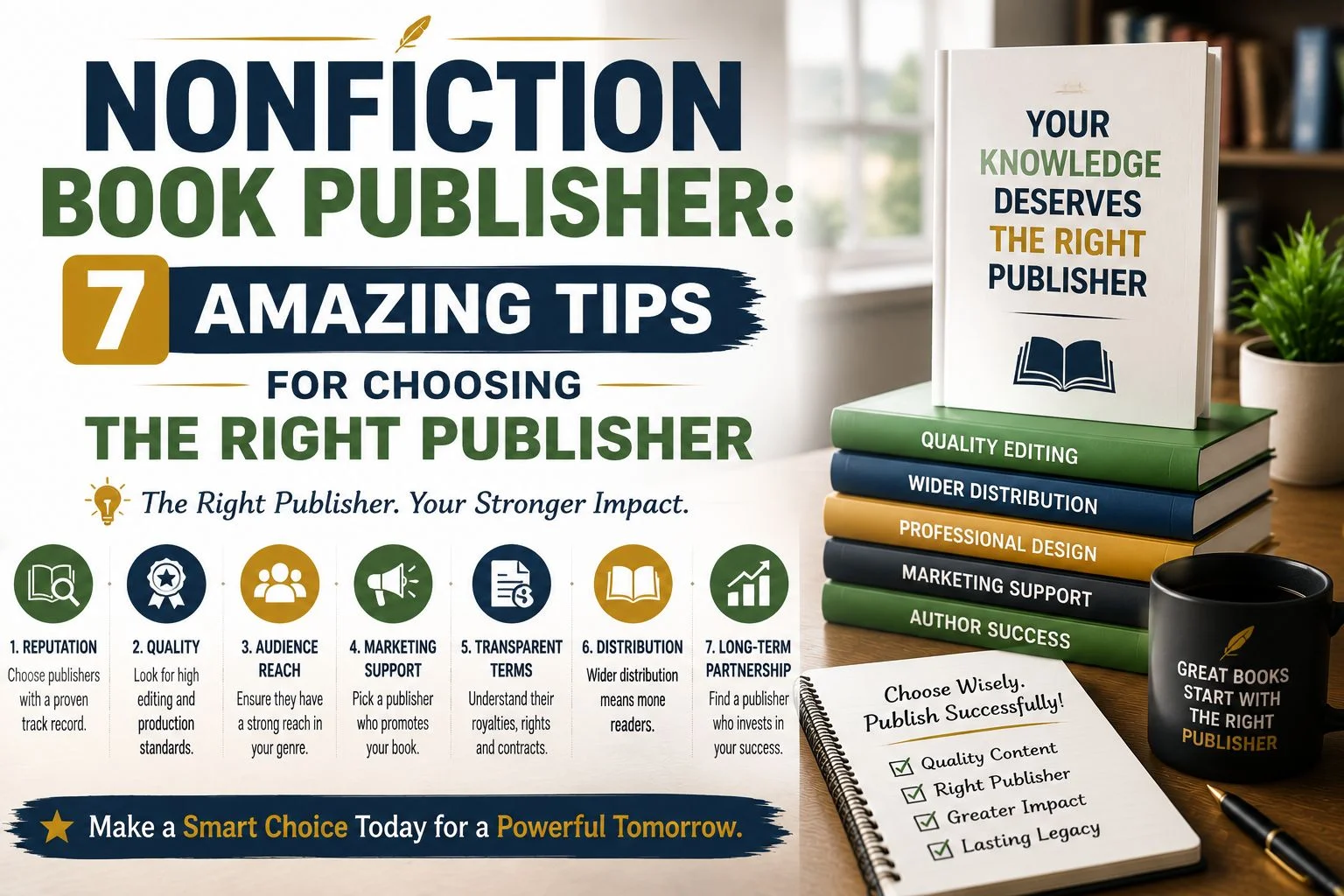
Nonfiction Book Publisher: 7 Ultimate Guide
What Is a Nonfiction Book Publisher?
A nonfiction book publisher is a company that helps authors publish factual manuscripts and professionally published books. Unlike fiction publishers, a nonfiction book publisher publishes books that feature factual content, such as real-life experiences, research, education, history, science, business, health, self-help, biographies, memoirs, and much more.
It’s not just a matter of printing pages when it comes to publishing a nonfiction book. A good publisher will read your manuscript, edit it professionally, create a good cover, format the interior pages, run a print run, place books with retailers, and do some marketing. Whether you are a first-time book writer or an experienced one, the choice of publisher is a key factor in the success of your book.
There are a number of ways to publish these days, such as traditional publishers, university presses, hybrid publishers, and independent publishing houses. Each option has its own submission and publication process, as well as benefits.
A professional nonfiction book publisher knows what is happening in the market and how to help authors create high-quality books. Their experience can enhance your writing and boost its chances of getting more eyes.
How Does a Nonfiction Book Publisher Work?
Typically, the first step in the publishing process is to submit the manuscript. Authors can submit a book proposal, a query letter outlining the book idea, or a complete manuscript.
After submission, the editors appraise the project for originality, target audience, market demand, writing quality, and commercial potential. Once accepted, the manuscript undergoes developmental editing, copyediting, proofreading, cover design, interior formatting, printing, scanning, and worldwide distribution, among others.
Many also organise marketing, media, online promotion, and bookstore distribution to ensure maximum visibility after the book has been published.
Each publishing house has its own submission guidelines, so it is always best for authors to read the guidelines before submitting a piece of work.
Types of Nonfiction Book Publishers
Not all publishers are made equally. Reviewing the various publishing options will assist authors in making informed decisions.
Traditional Publishers
Traditional publishers invest in selected manuscripts and usually pay advances to authors based on future royalties. They include the costs of production, editing, design, printing and distribution.
These publishers receive thousands of submissions annually, and competition is very high.
Penguin Random House, HarperCollins, Simon & Schuster, Macmillan and Hachette Book Group are among the world’s most recognized traditional publishers.
Independent Publishers
Independent publishers are typically independent and have a niche or specialty readership. They publish less, so they are able to communicate more personally during the publishing process.
There are numerous independent publishers that accept new talent and ideas for nonfiction work that may have a niche appeal that is not commercial.
University Presses
University presses specialize in scholarly and educational publications. They are famous for their publications on academic research, history, political science, archaeology, economics, sociology, and cultural studies.
For works of original research or educational material, a university press might be the better option.
Hybrid Publishers
Hybrid Publishing is a mixture of traditional and self-publishing. Generally, authors will contribute money towards production costs and in exchange receive professional publishing services.
It is an alternative that gives greater creative freedom, while retaining editorial skills, professional design and worldwide distribution.
Why Choosing the Right Nonfiction Book Publisher Matters

Writing is a career-long commitment. An inappropriate publisher can restrict the book’s reach, lower profits, or otherwise cause you problems.
The right publisher will provide a great deal more than printing services.
Professional publishers provide:
- Experienced editorial teams
- High-quality book design
- Worldwide print distribution
- eBook production
- Marketing guidance
- Metadata optimization
- ISBN registration assistance
- Sales reporting
- Royalty management
Cooperation with a trusted nonfiction book publisher can boost your reputation as an author and give you more chances of getting published again.
How to Choose the Right Nonfiction Book Publisher
The key to choosing the right publisher is not to send your manuscript to the biggest company out there, but to research them.
Each publisher will have different objectives, a different reader base, submission guidelines, and publishing priorities.
Before making your decision, compare publishers based on:
- Genres they publish
- Submission acceptance rate
- Distribution network
- Editorial quality
- Marketing support
- Author royalties
- Publishing timeline
- Personal requirements and contractual conditions
By spending time looking into these aspects, you will have a better likelihood of finding a publishing house that fits in with your long-term writing objectives.
Traditional vs. Independent Publishers
Authors’ first choice is between traditional publishers and self-publishing.
Traditional publishers tend to be larger in size and have better brands and marketing capabilities. But acceptance rates are extremely competitive, and some are seeking literary agents.
Independent publishers tend to publish fewer books, but offer more individualized communication and flexibility during the publishing process. Numerous accept submissions from authors without representation.
It depends on the publishing goals, the type of manuscript, and career goals.
Academic vs. Commercial Publishers
The major interest of academic publishers is publishing educational content, scholarly research, textbooks, and professional reference materials.
On the other hand, commercial publishers are aimed toward larger audiences with an interest in practical knowledge, memoirs, business, health, personal development, travel, history, and lifestyle.
Knowing your audience is key to finding out which option has the best chance for success.
Publishers That Accept Unagented Submissions

Submit Your Manuscript Directly and Turn Your Story Into a Published Book
There’s a belief among many budding writers that literary agents are always necessary. Although agents are useful for many big publishing companies, many publishers are willing to accept direct submissions.
Manuscripts are submitted to publishing houses regularly and are considered by independent publishers, regional presses, and some specialty publishers.
Please read each publisher’s specifications carefully before submitting, as they vary from publication to publication in terms of formatting, length of the proposal, sample chapters, and how to submit a proposal.
Questions to Ask Before Submitting
Do everything you can to learn more about the publisher before you send your manuscript.
Important questions include:
- Does the publisher specialize in your subject?
- Who is the target audience?
- What marketing support is provided?
- How are royalties calculated?
- Will you retain publishing rights?
- How long is the publishing process?
- What editorial services are not included?
- Is worldwide distribution available?
When authors know the answers to these questions, they can steer clear of misunderstandings and select publishing partners that better suit their needs.
Nonfiction Book Publisher: 7 Ultimate Guide
7 Best Nonfiction Book Publishers
Selecting a good nonfiction book publisher will make a huge difference in your publishing career! Each publisher has their own set of strengths, genre preferences, submission guidelines, and distribution channels. Some publish commercial nonfiction for the general public; others publish academic, educational, or professional books.
Here are seven of the most trusted nonfiction publishers and their distinguishing characteristics.
1. Penguin Random House
Penguin Random House is one of the world’s largest publishing firms and has a proud history of bestselling nonfiction books in virtually every genre. The company has published thousands of successful books on a wide variety of topics including biographies, memoirs, business, politics, history, science, and self-improvement.
Best For
● Memoirs
● Business books
● Self-help
● History
● Politics
● Science
● Health and wellness
Popular Nonfiction Books
It is a great choice for authors whose commercially viable manuscripts are written by internationally recognized journalists, researchers, historians, entrepreneurs, and public figures.

Submission Guidelines
The majority of Penguin Random House imprints will accept only literary agent submissions. Before preparing a proposal, authors should thoroughly investigate the suitable imprint.
2. HarperCollins
Known for its high-quality nonfiction books that educate, inspire, and entertain readers, HarperCollins has earned a global reputation. The company publishes books on leadership, finance, faith, personal development, biographies, education, health, and current affairs.
Best For
● Leadership
● Business
● Christian nonfiction
● Personal development
● Biography
● Memoirs
Popular Titles
HarperCollins is the publisher of many bestselling motivational speakers, business leaders, and influential public figures.
Submission Process
Literary representation is the preferred way to submit manuscripts for most divisions, but not all imprints (publishing houses) will accept them.
3. Simon & Schuster
Simon & Schuster releases nonfiction titles in fields of business, psychology, politics, health, history, personal finance, parenting, and social issues.
The company collaborates with seasoned editors to polish authors’ manuscripts prior to publication.
Best Categories
● Business
● Leadership
● Personal finance
● Health
● Memoirs
● Politics
Submission Details
Each imprint has its own requirements: many divisions mandate agent submissions.
4. Hachette Book Group
Established and emerging nonfiction writers are published by Hachette Book Group in many genres. Their wide international distribution makes it possible to get their books to bookstores, libraries, and online retailers around the world.
Publishing Strengths
● Business
● Lifestyle
● Health
● Self-help
● Memoirs
● Current affairs
Author Requirements
The quality of the submission is enhanced with a polished manuscript, a compelling proposal and a clear understanding of the target audience.
5. Macmillan Publishers
Macmillan has built up a good reputation for publishing and printing textbooks, professional and commercial non-fiction.
The publisher collaborates closely with the authors to produce manuscripts that have high editorial standards and are accessible to the general public.
Popular Genres
● Science
● Technology
● Business
● Medicine
● History
● Politics
Submission Tips
Get to know the right imprint before submitting and adhere to all proposal requirements diligently.
6. Bloomsbury Publishing
Bloomsbury publishes thought-provoking nonfiction books on such subjects as culture, history, politics, education, philosophy and social studies.
Bloomsbury enjoys a good reputation among academics, journalists and experts.
Best Nonfiction Categories
● History
● Politics
● Education
● Society
● Philosophy
● Arts
Publishing Process
Prior to acquiring manuscripts, they are checked for originality, quality of research, writing style, and market demand.
7. Oxford University Press
Oxford University Press (OUP) is among the world’s oldest academic publishers and particularly known for academic non-fiction.
It has a catalogue of books for researchers, educators, students, professionals, and policymakers.
Academic Publishing
Oxford specializes in:
● Academic research
● Educational resources
● History
● Law
● Medicine
● Economics
● Social sciences
Proposal Requirements
Usually, a book proposal will be submitted by authors and will include a detailed description of the manuscript, the intended audience, any other books in the market that are similar to the one being written, and the contribution to that field.
Best Nonfiction Publishers by Category

Each publisher has their own strengths and weaknesses. When you find a publisher who has a history of publishing books in your niche, it’s much easier to be successful.
Business Book Publishers
Business publishers are interested in entrepreneurship, leadership, management, investing, productivity, startups, marketing, and innovation books. They appreciate hands-on information based on experience and credible research.
Memoir Publishers
Memoir publishers are looking for stories with emotional, meaningful, and engaging content that offers a compelling personal narrative. Originality and originality of point of view are a must.
Self-Help Publishers
Self-help publishers focus on books that offer readers solutions to problems they face in their daily lives and help them take steps to improve their lives, careers, relationships, health, or finances.
Biography Publishers
Biography publishers are interested in a well-researched biography about an influential figure. Good documentation, historical correctness, and good writing are essential.
History Book Publisher Options
For historical nonfiction writers, the key to success is finding the right history book publisher. Some publishers focus on military history, world history, archaeology, cultural history, political history, and historical biographies.
A pro book writer appreciates correct research, reliable sources, interesting stories, and good organization. Authors are advised to thoroughly read the submission guidelines, as this will help them ensure that their work is in line with the publisher’s editorial focus.
Science Publishers
Science publishers are looking for books that convey information that is not too high-level. Popular subjects include medicine, biology, astronomy, environmental science, technology, and engineering.
Christian Publishers
Christian nonfiction publishers publish books on theology, devotionals, ministry, inspirational, biblical studies, and topics of Christian living and Christian leadership.
Occult Book Publishers
Some authors work in the realm of spirituality, esoteric traditions, mysticism, symbolism, folklore, astrology, tarot, or metaphysical studies. Occult book publishers might be the best option in these instances.
Occult book publishers have a niche market, and they may publish books on spiritual philosophy, historical traditions, ceremonial practices, mythology, alternative belief systems, etc. As this type is geared toward a certain audience, it is vital that authors conduct extensive research into each publisher’s editorial preferences before submitting the manuscript.
Nonfiction Book Publisher: 7 Ultimate Guide
What Services Does a Nonfiction Book Publisher Provide?
It is not enough to simply print a manuscript to become a successful author of a nonfiction book. There are a variety of services that a professional nonfiction book publisher can provide authors when it comes to turning their ideas into a book that is not only well written, but ready for the market. Publishers are essential contributors at every stage of the publishing process, from editing and polishing the manuscript to getting it out into the world.
It’s important to know what these services are about so that authors can select their publishing partner that is best suited for their goals and expectations.
Nonfiction Book Editing
Nonfiction book editing is one of the most valuable services that a publisher can provide. Professional editors can help even seasoned writers improve their writing by enhancing clarity, structure, grammar, consistency, and readability.
Generally, editing happens in a few stages.
Developmental Editing
Developmental editors are concerned with the text’s structure. They assess the structure of chapters, progression, timing, and the extent to which the material fulfills the reader’s expectations. This can involve reworking parts, reorganizing chapters, or adding emphasis to key points.
Line Editing
Line editing fine-tunes sentence structure, tone and style. Each paragraph is clearly written and has a voice that is consistent through the book, provided by the editors.
Copyediting
Copyediting fixes grammatical, spelling, punctuation, capitalization, and formatting errors. It also checks factual consistency and ensures professional writing standards are maintained.
Proofreading
The last review prior to publishing is proofreading. It identifies any remaining spelling errors, inconsistencies in formatting, and minor mistakes that might not have been picked up by previous stages of editing.
Hiring a top-notch editor for non-fiction books is a tremendous benefit to the reader and makes your writing more believable.
Cover Design
The front page of a book is what makes the first impression. Professional designers produce beautiful covers that convey the subject of the book and appeal to the target audience.
The following are all important elements of effective cover design:
- Professional typography
- Balanced layouts
- Genre-appropriate imagery
- Strong visual branding
The print and eBook versions are compatible. Print and eBook versions agree.
A good cover can make all the difference when it comes to buying.
Interior Formatting
Your manuscript will be professionally formatted, ensuring it looks polished both in print and electronic format. Publishers format files to industry standards for paperbacks, hardcovers, and eBooks.
Formatting typically includes:
- Chapter layouts
- Headings and subheadings
- Margins and spacing
- Page numbering
- Tables and illustrations
- Footnotes and references
A well-formatted book makes it easier to read and looks professional.
Printing
Most publishers collaborate with print-on-demand and offset printing suppliers to create top-quality books. Authors have the choice of what they want to have printed and how they want to use it.
Professional printing ensures:
- Durable binding
- High-quality paper
- Accurate color reproduction
- Consistent print quality
Global Distribution
A good non-fiction book publisher makes the book available at a number of sales points like:
- Online bookstores
- Physical bookstores
- Libraries
- Educational institutions
- International distributors
- eBook platforms
The more widely distributed, the more visible it will be, and the more times readers will be offered the chance to buy your book.
Marketing
Creating a great book is just the beginning. It is discovered with the help of marketing.
Publishers can help with:
- Press releases
- Media outreach
- Social media campaigns
- Author interviews
- Book launch planning
- Email marketing
- Online advertising
- Retail promotions
Marketing support is different for each publisher, but it’s easier for the author to make his or her book sell if the author promotes it.
Nonfiction Author Services
Many publishers offer specialized nonfiction author services, such as beyond publishing.
They can encompass:
- Author branding
- Website guidance
- ISBN registration
- Metadata optimization
- Keyword research
- Book launch strategy
- Distribution consultation
- Promotional planning
- Speaking engagement support
Author services for nonfiction professionals help authors develop a strong brand and long-term credibility in their industry.
How to Submit Your Nonfiction Manuscript

When preparing a manuscript for submission, attention must be given to certain aspects. A structured approach increases your chances of getting some positive answers from the publishers.
Prepare a Strong Book Proposal
Many nonfiction publishers are looking for a proposal rather than a book manuscript. A professional proposal will contain the following:
- Book overview
- Target audience
- Market analysis
- Competing titles
- Chapter outline
- Sample chapters
- Author biography
- Marketing plan
A good proposal is an expression of the value of your book, as well as an insight into the publishing market.
Write a Winning Query Letter
Your query letter is your introduction to a publisher or literary agent.
A good query letter should contain a short description of:
- Your book’s topic
- Why it matters
- Who the intended readers are
- Your qualifications
- Why you selected that publisher
Keep the letter professional, succinct, and personal.
Follow Submission Guidelines
Each publisher will have their own submission guidelines.
Before submitting, verify:
- Accepted genres
- Formatting requirements
- File formats
- Proposal length
- Sample chapter requirements
- Submission method
- Response times
Failure to follow the guidelines for submission means rejection, no matter how good the manuscript is.
Track Your Submissions
Keeping records organized allows you to keep track of your publishing activities.
Track information such as:
- Publisher name
- Submission date
- Contact information
- Response deadline
- Feedback received
- Current status
Good organization ensures that entries are not duplicated and subsequent communication is easy to follow.
Common Mistakes Authors Should Avoid
Many manuscripts are rejected due to mistakes that could have been avoided.
Choosing the Wrong Publisher
Research publishers carefully. It’s a waste of time for you and the editorial staff to submit a manuscript to a company that doesn’t publish your topic.
Ignoring Submission Guidelines
Failure to format correctly or respond to the directions of the proposal will give an unprofessional appearance and will almost always result in rejection of the proposal.
Poor Editing Before Submission
Failing to edit content before submission. Submitting content that is not well edited.
Credibility can be diminished when a manuscript is submitted without professional editing. Revision helps you to present your ideas clearly and professionally.
Weak Book Proposal
If your book is not well presented, it may not show its value. Take time to develop a strong, well-organized proposal.
Final Thoughts
One of the most critical choices an author can make is to find the right nonfiction book publisher. A publisher is not just a book maker, but also a means to help improve your manuscript, get it ready for publication, introduce it to readers, and assist you in your writing career.
When you are ready to submit your work to a publisher, study them thoroughly, learn their submission guidelines, and make sure your manuscript is professionally put together. If you invest in quality nonfiction book editing, choose the right occult book publishers or history book publisher for your niche subject, and avail yourself of the nonfiction author services, then you have a better chance of having your book published.
From a new to published author, thoughtful planning and strategic publishing choices can make a huge difference in ensuring your material is viewed in the light it was meant to be.
Frequently Asked Questions
What kind of book is being published that is not fiction?
A book publisher that specializes in publishing nonfiction books like biographies, memoirs, history, business, science, education, self-help, and other informational books.
Is it possible to get published without a literary agent?
Yes. Authors can submit their works directly to a number of independent publishers and specialty presses. But some larger traditional publishers will want submissions through literary agents.
How much does it cost to publish a nonfiction book?
Depends on the publishing model. Typically, traditional publishers will pay for the production, whereas self-publishing and hybrid publishing models might need authors to pay for editing, design, formatting, and marketing.
What is Nonfiction book editing?
Nonfiction Editing is the professional task of improving a manuscript by developmental editing, line editing, copyediting, and proofreading for accuracy, clarity, and readability.
Which history book publisher is best?
The publisher for the best history book will rely to a large extent on the focus of your manuscript. University presses are good for academic scholarship; commercial publishers will look for books for the general public on History subjects.
Does anyone work for an occult book publisher who is looking for submissions?
Certain publishers of books on the esoteric market will accept direct submissions, and others will need to review your proposal or have it read by a literary agent. Be sure to read the submission instructions for each manuscript.
What services do you expect from a nonfiction author?
Services of a professional nonfiction author can entail editing, cover design, formatting, ISBN registration, distribution, marketing assistance, metadata optimization, and branding help.
.

We help authors bring their stories to life through professional online book publishing services. From manuscript formatting and cover design to Amazon KDP publishing and global distribution, we make self-publishing simple, affordable, and successful.
