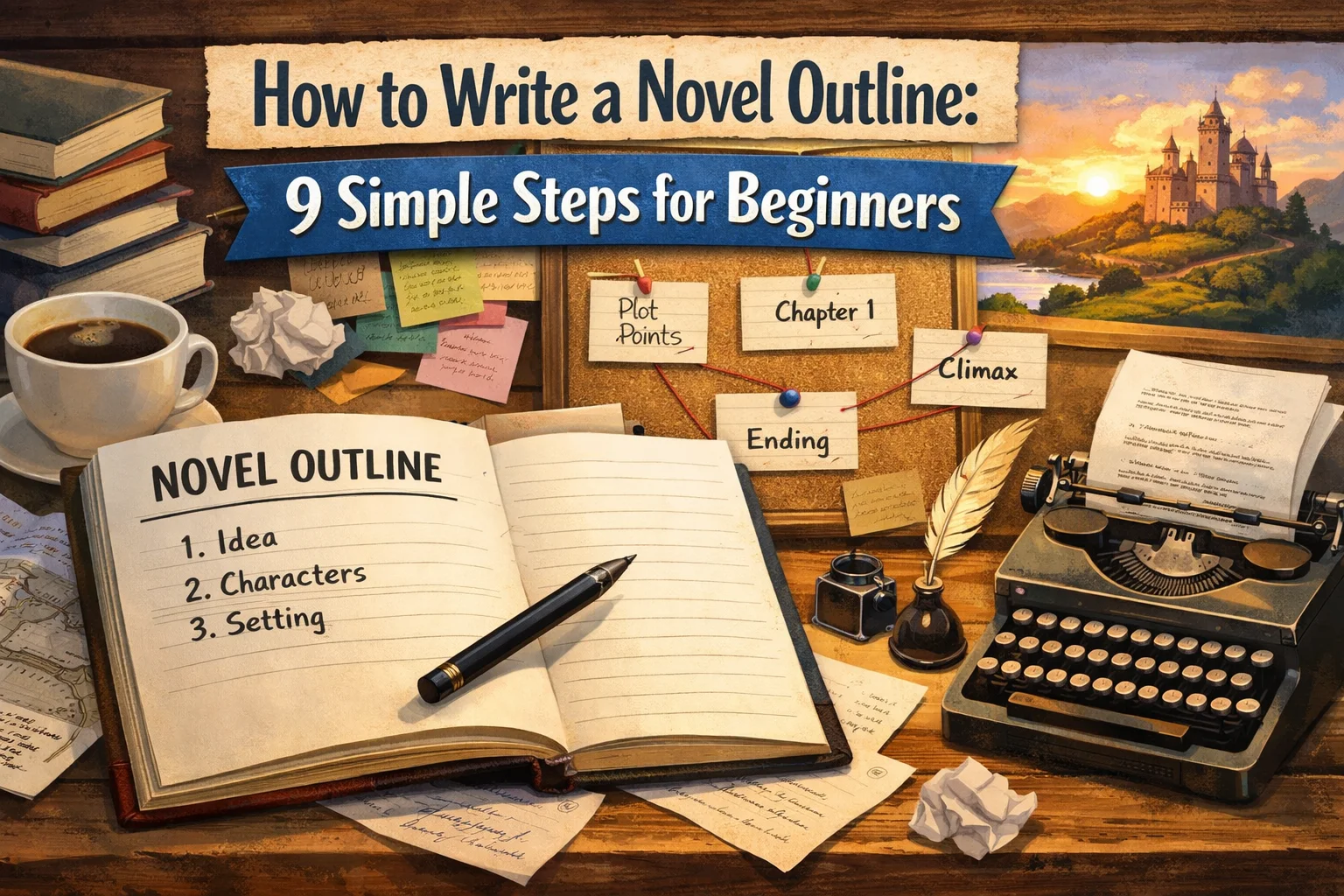
How to Write a Novel Outline? Writing a novel without an outline excites many writers at first. They love the freedom of discovery writing. Yet, excitement often fades halfway through the book. The story turns messy. Characters act out of character. Plot lines confuse. The ending seems impossible to reach. Writers experience this more often than they admit. A strong Novel outline fixes this problem early.
It directs your story, organizes your ideas, and maps the path from beginning to end. Treat your outline as a simple roadmap. You still enjoy the journey, but you stay on course. Many new writers think outlining limits creativity. In truth, the opposite happens. When your structure stands clear, your creativity grows. You spend less time guessing what happens next and more time writing strong scenes.
In this guide, we walk you through each step to create the best novel outline using a simple method. No complicated theory or confusing writing terms. Just clear, effective steps. By the end, you will know how to:
· plan your story idea
· organize your plot
· build strong characters
· structure your chapters
· finish your novel with confidence
Many successful authors outline their novels first. Some create simple plans. Others build detailed chapter maps. Both methods work. The important thing is having a plan. And the good news is this. You can create a powerful outline in a short time. With that in mind, let’s begin with the first step.
Step 1: Start With a Clear Story Idea
Every great novel starts with one simple thing: a strong story idea. You do not need to perfect your idea. You only need to clarify it. Many writers try to outline a novel before they understand their idea. This habit often leads to confusion later. Instead, describe your story in simple words. Ask yourself one question.
What is this story about?
Try writing the answer in one or two sentences. This is often called the story premise. Your premise becomes the foundation of your outline. Here are a few simple examples. A detective tries to solve a mysterious murder in a quiet town. A teenager discovers she can travel through time. A struggling musician finds a notebook that predicts the future. Each idea introduces a character and a situation. That is all you need to start. You can also use a helpful formula.
A character must achieve a goal, but something blocks them. For example, A young doctor must stop a dangerous virus before it spreads across the city. This sentence already creates tension. It hints at a story that readers want to explore. Take a few minutes and write your story idea. Do not worry about perfection. Focus on clarity. Once your idea feels clear, outlining becomes easier. Now it is time to understand the person at the center of the story. Your main character.
Step 2: Define Your Main Character
Characters drive stories. Readers connect with people more than events. That is why you must clearly define your main character in your novel outline. Before you build the plot, understand who leads the story. Start by asking simple questions. Who is the main character?
What do they want? What problem do they face? These answers shape the direction of the entire story. Every protagonist needs a goal. The goal gives them motivation.
Motivation creates action. Action moves the story forward. Your outline should include three important details about the protagonist. First, their goal. Second, the problem standing in their way. Third, what they might lose. This third element is called story stakes. Readers care more when something important is at risk. Maybe the character risks losing their job. Maybe they risk their family. Maybe they risk their freedom. Whatever the risk is, make it clear in your outline. Your character should also have a weakness. Perfect characters are not interesting. Readers enjoy watching characters grow. Maybe the hero fears failure. Maybe they avoid responsibility.
Maybe they struggle to trust others. This weakness creates the character arc. Over the course of the story, the character changes. They learn something new. That transformation gives the story emotional depth. When you understand your main character well, writing becomes easier. You know how they will react to challenges. You know what decisions they might make. And you know how their journey should end. Now that the protagonist is clear, it is time to introduce the problem they must face.
Step 3: Identify the Main Conflict
Conflict is the heart of every story. Without conflict, nothing interesting happens. Characters need obstacles. They need challenges that force them to act. This is called the central conflict. The central conflict is the main struggle in the story. Your outline should define it clearly. Think about the biggest challenge your character faces. Sometimes the conflict comes from another person. Sometimes it comes from society. Sometimes it comes from nature.
In some stories, the conflict even comes from the characters themselves. For example, A detective hunts a dangerous criminal. A student fights against a corrupt school system. A traveler struggles with fear as they explore the unknown. Each conflict creates tension. Tension keeps readers engaged. But conflict alone is not enough. You also need stakes. Stakes answer one important question.
What happens if the character fails?
Maybe the hero loses someone they love, their dream, or everything they worked for. High stakes raise excitement in stories. When readers recognize risk, they invest in the outcome. Write a short main conflict description in your outline. Keep it simple and focused on the main challenge. Add more detail later. For now, ensure the core struggle is clear.
Step 4: Build the Core Story Structure
Once your idea and conflict are clear, you can build your story structure. Structure organizes your story. It smooths the plot’s movement. Most novels follow a simple pattern. Writers often call this the three-act structure. Do not worry about the technical name. The idea stays simple. Every story begins, develops, and ends. The beginning introduces the world and shows the main character’s normal life. Then something unexpected happens, driving the story forward.
In the middle section, the character faces challenges, tries to solve the problem, fails, learns, and watches the tension grow. The ending pulls everything together, brings the main conflict to its final moment, and forces the character to make an important decision. Briefly describe these three sections in your outline. Just write a few sentences for each part. This simple structure directs your story.
Step 5: Plan the Major Plot Points
major part of writing novel outline
Plot points are the big moments in your story—they shift the narrative’s direction and keep readers curious. In your outline, start with the inciting incident, which launches the story and disrupts the character’s normal life. Then, the character decides to face the problem, which drives the story forward.
At the midpoint, a major event changes the character’s understanding of the situation. Next, in the darkest moment, everything seems to fail, and the hero feels defeated. Finally, the climax resolves the main conflict and delivers the emotional payoff. By writing short descriptions of these plot points in your outline, you will guide your story from beginning to end.
Step 6: Break the Story Into Chapters
Now is the time to organize your story into chapters. Chapters guide readers smoothly through the story and help writers stay organized. To begin, give each chapter a purpose: reveal something new and move the story forward. For example, start by listing possible chapters. While most novels include between twenty and forty chapters, they remain flexible; they prioritize advancing the story.
For each chapter, write a brief description that states what happens, describes the character’s goal in the scene, mentions the obstacle they face, and explains how the scene ends. This straightforward chapter outline keeps your story clear. If you ever feel stuck while writing, consult your outline to keep going.
Step 7: Develop Subplots
Subplots add depth to your novel. They explore relationships and emotions. They also enrich the story world. But subplots must support the main story. They should never be distracted from it. Think of subplots as smaller stories inside the main story. For example, a mystery novel might feature a romance subplot.
A fantasy story might involve political tension. A drama might depict family conflicts. Choose one to three subplots. Too many can confuse readers. For each subplot, write a short description. Show how it begins, how it develops, and how it ends. Ensure each subplot connects to the main plot. This keeps the story balanced.
Step 8: Track Character Growth
A good story shows change. Readers love watching characters grow. Your outline should reveal this journey. Ask yourself how your character changes. What do they believe at the beginning? What do they believe at the end? Something must shift. Maybe they learn courage. Maybe they learn to trust.
Maybe they accept responsibility. Plan moments that challenge the character. These moments force them to grow. Sometimes they fail. Sometimes they succeed. Each experience shapes who they become. When this journey feels natural, readers connect emotionally.
Step 9: Review and Improve Your Outline
Your outline is almost complete. Before you start writing, review everything. Read your outline from beginning to end. Ask yourself simple questions. Does the story make sense? Does the conflict grow stronger over time? Do the events connect logically? If something feels weak, adjust it. Outlines are flexible.
You can change them anytime. Pay special attention to the middle of the story. Many novels become slow here. If the middle feels dull, add stronger challenges. Increase the stakes. Create harder decisions for your character. Finally, check the ending. The climax should resolve the main conflict. It should also show the character’s growth. Once everything feels clear, your outline is ready. Now you can begin writing your novel with confidence.
Frequently Asked Questions (FAQ)
What is a novel outline?
A novel outline is a plan that organizes your story before writing. It includes the main idea, plot points, character goals, and major events. An outline helps writers structure their story and avoid confusion later.
Why is outlining a novel important?
Outlining saves time and prevents writer’s block. It gives your story direction and keeps the plot organized. Many professional authors outline their books before writing.
How detailed should a novel outline be?
A novel outline can be simple or detailed. Some writers prefer a short summary of each chapter.
Others create detailed scene plans. The best outline is the one that helps you write consistently.
Can I change my outline while writing?
Yes, outlines are flexible. Writers often adjust them during the drafting process. As the story grows, new ideas may appear.
How long should a novel outline be?
There is no fixed length. Some outlines are only one page. Others are several pages long. What matters most is clarity.
Do all writers use outlines?
Not all writers outline in the same way. Some writers prefer discovery writing. However, most successful authors use at least a basic story plan.
Final Thoughts
Writing a novel is a long journey. But a strong outline makes the journey easier. It helps you organize ideas. It keeps your story focused. It also helps you finish what you start. By following these 9 easy steps, you can create the best novel outline for your story. Once your outline is ready, writing becomes much more enjoyable.
You know where the story begins. You know where it ends. And you know how your characters grow along the way. Now it is your turn. Open your notebook. Start outlining your story. Your novel begins with that first idea.
We help authors bring their stories to life through professional online book publishing services. From manuscript formatting and cover design to Amazon KDP publishing and global distribution, we make self-publishing simple, affordable, and successful.


 Subplots add depth to your novel. They explore relationships and emotions. They also enrich the story world. But subplots must support the main story. They should never be distracted from it. Think of subplots as smaller stories inside the main story. For example, a mystery novel might feature a romance subplot.