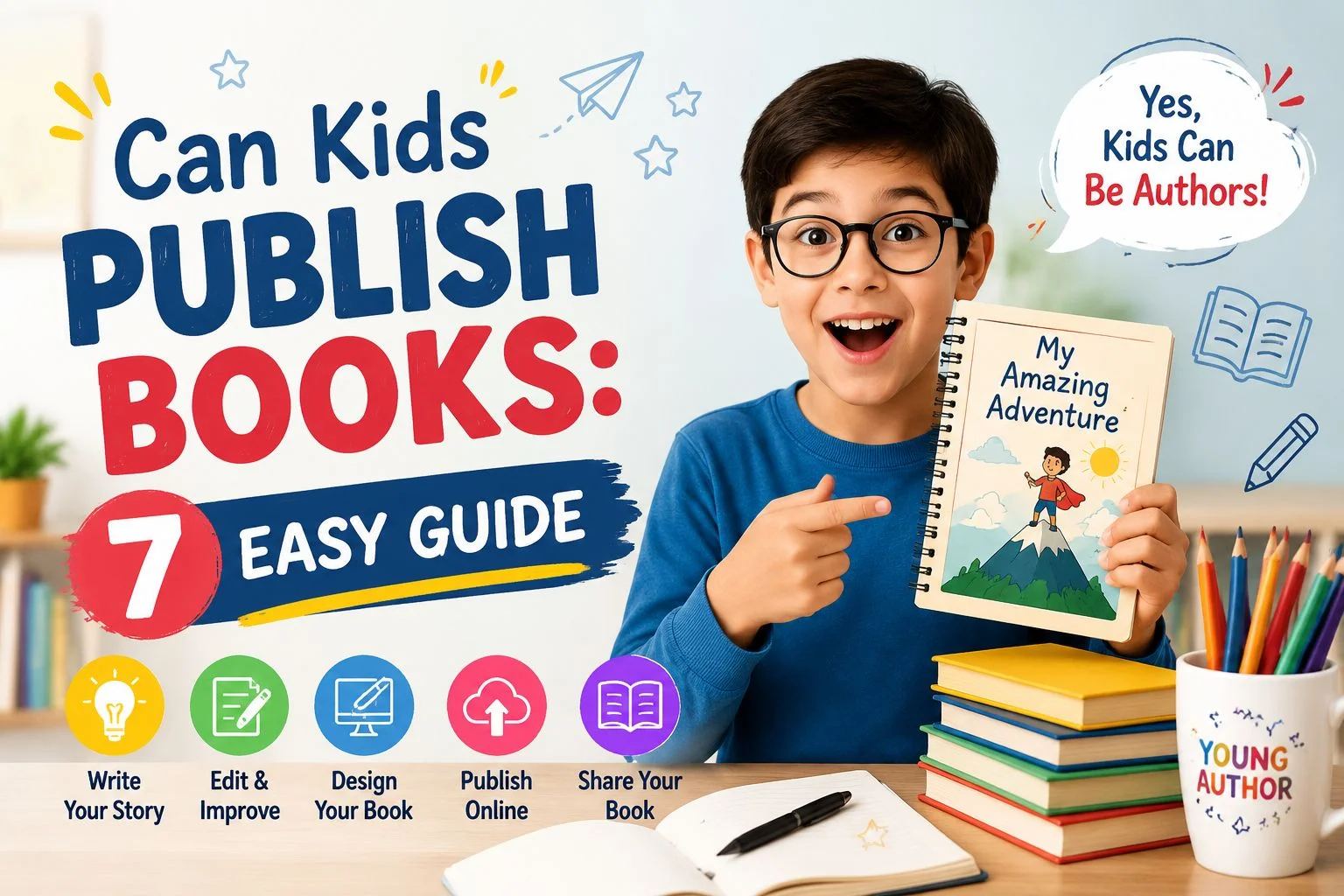
Can Kids Publish Books: 7 Easy Guide for Young Authors
Understanding the Possibilities of Kids Publishing Books
Introduction: Can Kids Publish Books?
A lot of kids enjoy writing up scenarios, making up stories, and imagining characters to draw and create their own adventures. Many parents and young writers, however, wonder: can children write a book and be real authors at a young age?
The answer is yes. Children can create their own story today using modern publishing tools, online resources, and the help of their parents or professionals. In the past, young authors had to wait till they grew up to make their ideas or works visible to the world; now they don’t have to.
Children can turn their imagination into professionally published books through services such as self-publishing, POD & digital publishing. This process enables children to acquire writing, creative, design, marketing, and entrepreneurship skills.
Child book publishing guide to help young writers get started from story concept to publication and promotion.
Can Kids Publish Books? Understanding the Possibilities
The publishing world has undergone a tremendous transformation in the last few years. Previously, it was not easy to publish a book, as it had to go through the rigorous process of traditional publishing and await approval, which could take months or years.
In today’s world, technology has made publishing easier. Children can be involved in the publishing process with adults’ support and guidance.
A child can be involved in a number of significant aspects of books, such as:
Creating a plot. Coming up with a story idea.
- Writing the manuscript
- Creating characters
- Drawing illustrations
- Reviewing edits
- Designing the book
- Inspiring the finished work
Children may create the body of the article, but parents and guardians typically handle the professional aspects, including publication, payment, copyright, and legal issues.
Children are these; that is why families are choosing child self-publishing as a great way to boost creativity and build young authors.
Yes, Kids Can Become Published Authors
For a lot of people, the time they require to become authors is years, but that’s not true. Creativity and imagination are also natural traits in children and are helpful in the storytelling process.
A young author can write books about something they don’t know or enjoy, such as:
- Friendship and school experiences
- Animal adventures
- Fantasy worlds
- Family stories
- Educational topics
- Personal experiences
Children often develop their own ideas and views, as they have different ways of thinking about the world from adults. They can make other young readers feel the excitement and relate to stories through their fresh ideas.
The main point is not to make perfection a first step. The most crucial element is to prompt children to write, to practice their writing abilities and become confident in their writing.
When kids can publish books, it shouldn’t be a question; it should be an accomplishment for young creators with proper support.
How Old Do You Have to Be to Publish a Book?

A frequent parent enquiry is: What is the minimum age for publishing a book?
The reality is that there isn’t a universal age for becoming an author. Children of various ages can write and publish books. They might require adult support with some aspects of the publishing process, though.
For example:
- Parents may create publishing accounts for younger children.
- Adults may manage contracts and financial information.
There are ways for parents to help children understand copyright and publishing rights.
A five-year-old can make his own picture book with illustrations, or a teen can write a longer novel with some independence.
The most important factors are:
- Creativity
- Commitment
- Storytelling ability
- Support from adults
It is not a requirement of a young writer to be one to begin. All they require is imagination and a desire to learn.
Can a Kid Write a Book Without Professional Experience?
A lot of children begin to ask themselves, can a child write a book without taking writing classes or writing experience?
All successful authors began by writing a first story. An idea is the starting point for a book, not work experience.
Starting with simple steps is one way to get children started.
1. Choose a Story Idea
The initial step is to choose a topic they are interested in. A child can write about anything they love, something they imagine, anything funny that happened to them, or anything that is imagined.
2. Create Interesting Characters
Characters make stories memorable. Young Writers should consider:
- Who is the main character?
- What challenges do they face?
- What is the moral of the story?
3. Write the First Draft
The first one doesn’t have to be flawless. Children should concentrate on getting their ideas across and finishing the story.
4. Improve Through Editing
Once the story has been drafted, there is an opportunity for revision, including correcting errors, clarifying language, and enhancing details.
Writing regularly enables children to build their confidence and communication skills.
Why Child Self-Publishing Is a Great Option for Young Authors
It is not easy to get traditional publishing, as publishers receive thousands of book submissions and only a few manuscripts are selected for publication.
Child self-publishing is a more straightforward process for many young writers, as it allows them to have greater control over their work.
Benefits include:
Creative Freedom
Children can select their own story, characters, artwork, and illustrations.
Faster Publishing Process
Self-publishing allows authors to publish their books without going through the traditional publishing process.
Learning Experience
Children learn great skills such as:
- Writing
- Editing
- Book design
- Marketing
- Project planning
Sharing Stories Worldwide
A child’s book can be read in another country through the use of the Internet.
Can Kids Publish Books: 7 Easy Guide for Young Authors

Writing, Editing, and Choosing the Right Publishing Path
In Part 1, we explored the possibility of becoming a published author, and the question was asked: can kids publish books? We discovered that, with creativity, children can generate ideas, and with proper guidance, they can overcome age barriers.
The next thing is to develop an idea to its completion as a book. Making a children’s book calls for planning, editing, and knowledge about various choices of publishing. This portion of the kid book guide explains to young authors how they can produce their story, improve their manuscripts, and select the best way to release their kid book.
Step 1: Create a Great Book Idea and Plan Your Story
All good books begin with a good idea. Kids can have great imaginations, but it’s a good idea to have them develop a complete story.
Young writers should take time to think about before writing:
- What type of story do they want to create?
- Who will read the book?
- What is the story’s message?
- What makes the story unique?
A complex plot is not essential to a good children’s book. Many children’s stories have simple themes such as friendship, kindness, courage, teamwork, and imagination.
A child might make up a story with the following themes:
- A stray dog looking for a family.
- A wandering puppy seeking a family.
- An adventurous young boy coming across a magical realm
- An important life lesson is taught to a child
- An animal who helps friends (friendly).
Children’s ideas of their own, in general, are the most promising for the best stories.
Find a Topic That Matches Your Interests
The writing process is thus easier and more fun when children write about what they like.
Young writers are inspired by:
Personal Experiences
Children can write about memories from school, family experiences, hobbies, or special occasions.
Imagination
In fantasy stories, children can develop their own worlds, magical characters and adventures.
Learning Experiences
Other children can learn about science, nature, history, or significant values through educational books.
Selecting a topic can help children stay motivated and keep on completing their manuscripts.
Create Characters Young Readers Love
For kids’ literature, one of the most significant aspects is the characters. Young readers relate to characters who are emotional, have issues, and are full of personality.
Children are to think about:
Character Personality
Ask questions like:
Does the character have humor, courage, curiosity, or creativity?
What is this character’s big “special” about him/her?
Character Goals
All characters should have a desire. For example:
- Finding a friend
- Solving a problem
Pupils engage in learning a new skill
- Helping others
Character Challenges
A story is more interesting if characters have some difficulty and solve it.
The characters are strong and relate to the reader.
Create a Simple Story Outline

Children should make a simple outline of the book before they start writing it.
In a basic children’s story, there are:
Beginning
Introduce:
- Main characters
- Story setting
- Main problem
Middle
Explain:
- The character’s journey
- Challenges they face
- Important events
Ending
Show:
Explain how the problem is addressed. Explain the process for solving the problem.
- What lesson the character learns
An outline is helpful for children to use to plan their thoughts and complete a story.
Step 2: Write and Edit Your First Children’s Book
Once you have developed an idea and outline, the next step is to write the first draft.
Many young writers make the mistake of trying to perfect all their sentences at once. Children, instead, should work on finishing their own story.
This first draft is a draft about creativity. Editing comes later.
Start Writing the First Draft
Children should: In writing the first draft of a book, children should:
- Write regularly
- Think about their ideas
- Enjoy the creative process
- Avoid worrying about small mistakes
It is not necessary that a child has a high level of writing ability before they start. Many successful authors have enhanced their writing by practicing and receiving feedback.
This is why the answer to the question “can a kid write a book” is yes. Children can make sense of their experiences and make stories with patience and encouragement.
Use Simple and Engaging Language
Children’s books need to be easily read.
Young authors should concentrate on:
Short Sentences
Simple sentences help to tell a story more easily.
Interesting Words
Stories are more enjoyable if they are described creatively.
Strong Emotions
You read about feelings of characters such as happiness, sadness, excitement, fear, or courage.
For example:
Instead of:
The boy went out of the house.
A more dynamic sentence would be:
So Tom opened the door and walked into the strange forest with the glowing flowers.
Children’s imagination is stimulated through good writing.
Improve Your Story Through Editing
Editing is a very crucial process before publishing any book.
First drafts are not usually perfect. Editing helps improve:
- Grammar
- Spelling
- Sentence structure
- Story flow
- Character development
Parents, teachers, or professional editors can give feedback to children.
Professional editing is particularly useful because editors know how to make children’s stories easier to understand and more fun for young readers.
Get Feedback From Parents, Teachers, and Beta Readers

Feedback provides young authors with information about what works and what doesn’t.
Kids can tell their tales to:
- Parents
- Teachers
- Friends
- Other young readers
Helpful questions include:
- Did you enjoy the story?
- Which character did you like most?
- Was anything confusing?
- What was your favorite part of the story?
- Were there any unexpected plot twists or turns?
This feedback helps a child strengthen their book before publication.
Step 3: Choose the Best Publishing Option for Kids
Once the manuscript has been written and edited, the next decision is how to publish the book.
This can be done in two ways:
- Traditional publishing
- Self-publishing
Traditional Publishing for Children’s Books
Traditional publishing is the process in which a publishing company selects a manuscript and handles the publication.
The publisher usually manages:
- Editing
- Book design
- Printing
- Distribution
- Marketing support
It isn’t always easy to get accepted by a traditional publisher, though, as there are many authors submitting their manuscripts.
Children might also require an adult to assist with negotiations over agreements and communication with publishers.
Child Self-Publishing: A Flexible Publishing Option
Child self-publishing is a means for a child and their family to publish a book without assistance from a publishing house.
This option provides additional control of:
- Story content
- Illustrations
- Book design
- Publishing timeline
- Marketing decisions
Many self-publishing websites give families the opportunity to get their kids’ book into print, whether it’s in paperback, hardcover, or digital.
The advantages of child self-publishing are:
Complete Creative Control
Young writers can choose their story ideas and designs.
Faster Publishing
Often, books can be published in less time than with traditional publishing.
Learning Opportunity
The children develop useful writing, business, and creativity skills.
Understanding Publishing Costs Before Starting
Families should think about costs before they publish, including the following:
- Editing
- Illustrations
- Formatting
- Cover design
- Printing
- Marketing
Many parents look at ways to fund their book’s publication, such as their own savings, the school program, writing competitions, or community help.
Early planning will prevent any untimely costs in the publishing process.
Can Kids Publish Books: 7 Easy Guide for Young Authors
Designing, Publishing, Marketing, and Growing as a Young Author
In Parts 1 and 2, we learned about the basics of being a young author, developing a story idea, writing a manuscript, editing, and the decision between traditional and self-publishing.
The last part of this children’s book publishing guide covers turning a completed manuscript into a children’s book. This involves the design of illustrations, book formatting, online publication, promotion, and guidance on how young authors can continue to pursue their writing careers.
Step 4: Create Illustrations and Design Your Children’s Book
Children’s books are unique in that illustration is an important component in drawing children to the pages of the book. A good book is more interesting and memorable when the story is paired with a good set of pictures.
Illustrations support children’s understanding of characters, feelings, and events in a story, particularly in picture books.
When it comes to a professional-looking book, it typically has:
A cover design that is creative and eye-catching.
- High-quality illustrations
- Proper page layout
- Easy-to-read text
A visual style that is consistent throughout.
The way readers relate to the story is greatly affected by a well-designed book.
Decide Who Will Create the Illustrations
Young authors can use various methods for generating artwork.
1. Create Your Own Illustrations
Make up illustrations for mathematical concepts. Draw pictures of mathematical ideas.
Some children like to draw and make their own artwork.
This helps to make the book more personal as the pictures are from the author’s imagination.
Benefits include:
- Unique creative expression
- The connection the student has to the story:
- Lower illustration costs
2. Hire a Professional Illustrator
Use a professional illustrator to create the images. Have the images professionally illustrated.
Families can collaborate with professional children’s book illustrators if they can’t create illustrations themselves.
There are areas where a professional illustrator can assist in creating:
- Character designs
- Story scenes
- Background artwork
- Professional-quality images
Before hiring an illustrator, authors should review:
- Previous work samples
- Illustration style
Working with children’s books. Experience in children’s books.
- Copyright ownership terms
3. Use Digital Illustration Tools Carefully
Some authors use digital tools or AI-assisted artwork. Families have to be aware of how images can be used, and ensure that all images are used within the scope of their rights.
Child self-publishing is important to the protection of creative rights.
Design an Attractive Children’s Book Cover
First impressions are crucial, and readers will notice the cover first. A good cover should give a clear indication of the book’s content.
A quality children’s book cover should contain:
- A clear title
- Attractive colors
- An interesting character or scene
- Easy-to-read text
- An illustration that matches the story
A funny animal story, for instance, can be colorful and have cartoons that are fun, and an adventure story can have exciting scenes.
A cover is a good way of making a young author’s book stand out from the other children’s books in online marketplaces.
Format Your Book for Printing and Publishing
When a book is formatted, it is ready for professional printing and digital publishing.
The following are important formatting elements:
Book Size
Popular sizes of children’s books are:
- 8.5 × 8.5 inches
- 8 × 10 inches
- 6 × 9 inches
This will vary according to the type of book and the target audience.
Page Layout
The good layout principles are:
- Create a balance between text and images
- Provide enough white space
- Make reading comfortable
Font Selection
Fonts should be:
- Large enough for children
- Easy to read
- Suitable for the book style
The professional formatting enhances the book’s quality.
Step 5: Understand the Cost and Funding for Book Publishing
When someone decides to publish a book, they have to plan for it because various services may incur expenses.
The overall cost is determined by various factors such as:
- Book length
- Number of illustrations
- Editing requirements
- Printing method
- Marketing plans
Families should understand the costs involved and develop a realistic budget for publishing.
How Much Does It Cost to Publish a Children’s Book?
Typical publishing costs are:
Editing Costs
Editors help improve:
- Grammar
- Story structure
- Sentence quality
- Reader engagement
Illustration Costs
One aspect of Children’s books that can be one of the highest costs is the illustrations; since picture books are likely to have more than one, they can cost a lot more.
Formatting and Design Costs
The book will be professionally formatted for both print and digital publication.
Printing Costs
Authors can choose:
- Print-on-demand
- Bulk printing
- Digital publishing
Funding for Book Publishing Options
When supporting a child’s book publishing, many families seek funding for the publishing.
Some possible funding sources include:
Parent or Family Support
A great number of young writers start out with parental or family support for financial reasons.
School Programs
Supporting children’s writing projects can be done by means of:
- Writing competitions
- Creative programs
- Student publishing projects
Crowdfunding
Other families use crowdfunding websites to raise money and share their journey of the child’s publication.
Writing Contests and Grants
Some groups provide awards, competitions, or educational courses for young writers.
The publishing process becomes easier when funding is planned in advance.
Step 6: Publish Your Child’s Book and Share It With Readers
Once writing, editing, design, and formatting are done, the last stage is publishing.
Nowadays, kids can have books published in a number of different formats:
- Paperback
- Hardcover
- eBook
Publishing Through Amazon KDP
Amazon Kindle Direct Publishing (KDP) is a popular avenue for individual authors.
Using KDP, authors can:
- Upload their manuscript
- Add a book description
- Choose categories and keywords
- Publish paperback and eBook versions
Typically, the publishing account is handled by the parents, and the kids are educated about it.
Amazon KDP is an excellent Amazon self-publishing option for children.
Get an ISBN for Your Children’s Book
An ISBN helps identify a book in the publishing sector.
Authors can choose to:
- Get a free ISBN as a bonus!
- Buy their own ISBN.
Well-prepared publishing data makes the book appear more professional.
Step 7: Promote Your Book and Build Young Author Success
This is only the first step towards publishing a book. Marketing assists readers in finding the story.
It is very easy to market a book as a young author.
Create a Young Author Profile
Children can share their writing process by making:
- An author biography
- A website page
Social media updates (with supervision)
- School presentations
Telling the history behind the book will help the reader relate to the writer.
Use Simple Book Marketing Strategies
Utilize simple book marketing strategies. Use simple book marketing strategies.
Some good marketing concepts are:
School Book Events
Children are able to be involved in:
- Reading sessions
- School presentations
- Writing activities
Book Reviews
To gain trust and attract new readers, reviews are useful.
Community Events
Young writers can reach more readers through local libraries, book fairs and community groups.
Online Promotion
The book is available for sharing by the families via:
- Author websites
- Social media platforms
- Publishing communities
Benefits of Publishing a Book as a Child
There are numerous advantages to publishing a book at a young age.
Builds Confidence
Having finished a book, children feel good.
Improves Writing Skills
Regular writing improves:
- Vocabulary
- Communication
- Creativity
Encourages Imagination
Children develop skills to take ideas and develop them into actual projects.
Develops Future Opportunities
If children gain publishing experience early on, they will be motivated to do more.
Common Mistakes Kids Should Avoid When Publishing Books
The most common mistakes that kids should not make when publishing books
The following are some common pitfalls for young authors:
Skipping Editing
All creative stories can benefit from some development before publication.
Poor Quality Design
Appearance is important for attracting readers.
Ignoring Marketing
However, a published book must be promoted to get its audience.
Not Understanding Copyright
The authors should be familiar with the rights of ownership of text and illustrations.
Child Book Publishing Guide: Final Checklist for Young Authors
Young writers need to do these things before publishing their work:
- Create a unique story idea
- Write the manuscript
- Make changes to the story and enhance it.
- Create illustrations
- Design the cover
The book will be professionally formatted.
- Choose a publishing platform
- Print and advertise the book
By following this children’s book publishing guide, the publishing journey can be made easier and more organized.
Frequently Asked Questions About Kids Publishing Books
What is child self-publishing?
Will a child be able to publish a book on their own?
What are the platforms for child self-publishing?
Which platforms are child self-publishing platforms?
Are children allowed to write books that they sell on Amazon?
Yes, you can have children publish books with Amazon with the help of adults.
Is it possible for a 10-year-old to write a book?
Yes, with the help of parents/guardians, a 10-year-old can write and publish a book.
Can a kid write a book?
Absolutely! It is never too late for a child to write a book. With adult guidance, children can use their imagination, experiences, and creativity to develop stories, poems, comics, or learning books.
What are the options for funding the publishing of children’s books?
Families have the opportunity to learn about personal support, school programs, crowdfunding, and writing opportunities.
What is funding for book publishing?
Which is the simplest kids’ book publishing manual for novices?
The easy way is to write the story, edit it, create illustrations, format the book, publish it, and promote it.
Child self-publishing is defined as what?
Child self-publishing refers to children who are assisted by their parents/guardians in writing and publishing their own book. It involves writing, editing, designing the cover, formatting, and preparing the book for readers.
Do children have the ability to write and publish books?
Do children have the opportunity to publish their own books without charge?
Conclusions: Can Kids Publish Books?
Therefore, can children print out books? Absolutely. Children can be published authors, using their creativity, learning about the publishing process, and having adults help them.
Child self-publishing is much more easily and readily available in today’s publishing landscape. A child can turn their ideas into a picture book, an educational story, an adventure in fantasy, or indeed anything else they want to write into a book.
With some planning, creativity, and a little assistance from a child book publishing guide, young authors can successfully share their story with readers around the world.

We help authors bring their stories to life through professional online book publishing services. From manuscript formatting and cover design to Amazon KDP publishing and global distribution, we make self-publishing simple, affordable, and successful.