
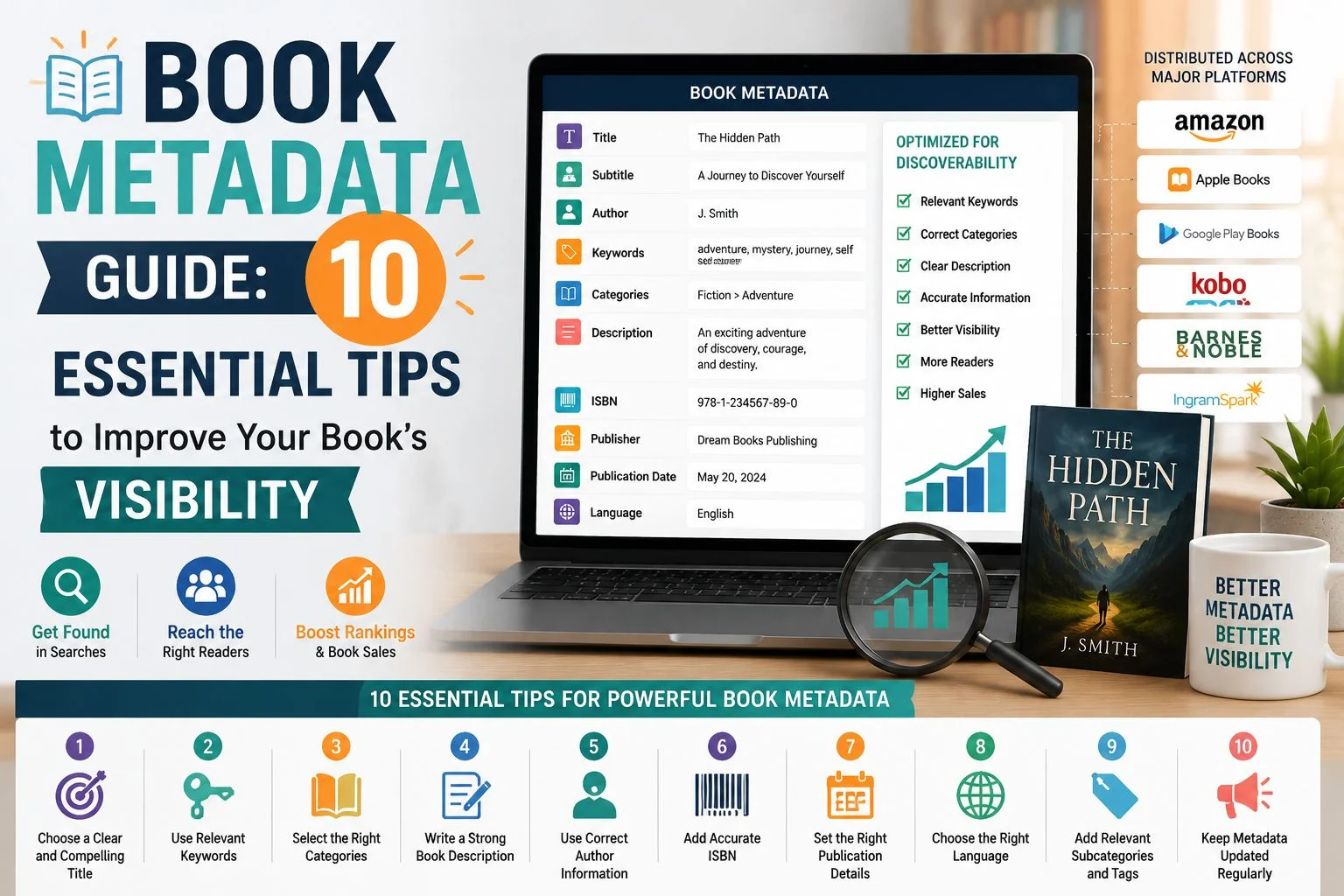
Book Metadata Guide: 10 Essential Tips to Improve Your Book’s Visibility
Introduction: The Hidden Power of Book Metadata for Authors
It is a tremendous accomplishment to write a book. Requires creativity, patience, and commitment. Once your manuscript is finished, however, it’s not done. Once your book is published, you face another hurdle: getting your audience to find it.
This is where book metadata becomes very important.
In the eyes of many authors, a good cover and a great story will suffice. These are important factors, but so is your book’s behind-the-scenes information. This information enables bookstores, search engines, and readers to know what your book is about.
Consider entering a big bookstore. A large number of books are stacked on different shelves. If a book lacked labels, one would have a hard time knowing which one to look into. Book Metadata operates in the same fashion. It ensures your book appears in the right location.
Key data for your book includes your book title, subtitle, author name, description, keywords, and categories. Such facts make your book more accessible to its audience.
It is especially important for self-published authors. A large publishing company doesn’t necessarily market your work. Thus, any element that makes it easier to find is important.
A well-designed metadata strategy can ensure that your book is found in appropriate searches. In addition, it can boost the likelihood of reaching readers who are already interested in your topic. Here are 10 book metadata tips that you need to know for this complete Book Metadata Guide. Here are some ways to make the most of your book information, book keywords, and book categories, and make publishing better.
Whether you are publishing a novel, a cookbook, a children’s book, or a nonfiction guide, knowing how to build a foundation with metadata can help.
What Is Book Metadata?
Book metadata is all the information about your book. It informs websites, libraries, and readers about your book.
In short: Your book’s digital identity is its metadata.
No reader reads your manuscript first when they look for it online. They view your metadata. They read your title, cover, description, categories, and other information.
All of this information will enable the reader to determine if your book is suitable for their needs.
Let’s say you wrote a book on starting a garden. The metadata should clearly show that your book is about gardening for the new gardener.
The topic may be part of your title.
Your description may include what readers will learn.
Phrases that relate to gardening can be included in your Book Keywords.
Your Book Categories might categorize your book in the right category.
These all work together.
Good Book Metadata = clarity. It helps readers quickly grasp your book.
Correct metadata can make a great book stand out. Even a well-written book can struggle if people don’t find it. It’s why successful writers and publishers need to work on their metadata both before and after publication.
Why Is Book Metadata Important for Book Visibility?

The eBook market is very competitive. Every day, thousands of new books are released.
Readers typically aren’t reading all the books available. Rather, they look for topics, problems, or interests.
Book metadata is where this becomes useful.
With the correct optimization, platforms can find your book.
For instance, if someone searches for “easy family recipes,” they should find cookbooks with easy-to-make family recipes.
The greater the chance that a cookbook has accurate metadata, the more likely it is to appear in these results.
Your metadata helps answer key questions, such as “What is this book about?” Who is this book for? Who will like this book? What are the themes of this book? Clear answers improve findability.
Book Metadata can also be used for your marketing activities. If your keywords, categories, and description match, your promotions are more effective.
Your book doesn’t need to catch people by surprise; it can reach readers who already have an interest in it.
The Connection Between Book Metadata and Amazon Books
Numerous authors have authorship today through online marketplaces. Amazon Books is one of the most extensive platforms to launch an independent book.
Books are found on Amazon by readers through searching and suggestions.
Metadata is crucial to this process.
When readers search for a topic, Amazon considers related book information. These are the titles, descriptions, keywords, and categories.
For instance, if a person searches for a children’s bedtime story, books with related information may be displayed.
This is not to say that after tackling a few random words you will be successful. Your metadata needs to describe your content accurately.
The goal is simple.
Briefly explain what your publication is about on Amazon Books.
Make it easier for readers to access the “right” book.
Make a more enjoyable shopping day.
Good metadata helps with all three objectives.
10 Essential Elements Included in Book Metadata
1. Book Title: The First Impression of Your Book
One of the most crucial parts of your Book Metadata is your book title.
It is typically the first place that readers will look.
A good title should be clear, memorable, and related to the topic.
In nonfiction books, it is frequently best to be clear.
For instance, if you’re writing a book on social media marketing, it should include a title that reveals what the book is all about.
A confusing title can generate some interest, but can also make your book more difficult to understand.
Your title should respond to a basic query:
What’s this book about?
A clear title also assists search systems to understand your content.
It’s important to consider your audience when you are formulating your title.
What would your ideal reader be saying?
What issue does your book address?
What is the subject of your book?
These are questions you can use to help you write your title.
Keep in mind your writing doesn’t just have to be a creative title. It’s a discovery tool, too.
2. Subtitle: Add More Information About Your Book
A subtitle gives you additional space on your book’s cover to reinforce your main title and offer extra information.
Many books are successful because their subtitles explain their value.
For instance, a title might arouse interest, and a subtitle would provide the benefit.
A subtitle should contain useful information about your audience, topic, purpose, and unique approach.
But do not have a subtitle that is too long.
People want simple and clear information.
Your subtitle should sound like natural speech.
It shouldn’t sound like a list of keywords.
A helpful subtitle enhances your Book Metadata by providing more context for your reader.
It also helps platforms better understand your publication.
3. Book Description: Your Sales Conversation With Readers
The description of your book is one of the best attributes of your Book Metadata.
It is like talking to a new reader.
A good description should be of a kind that arouses interest.
It should tell why your book is valuable.
It should motivate readers to further learning.
The mistake many writers make is to describe their book.
Rather, give attention to the reader.
Describe the benefits they will receive.
Describe the students’ findings.
Describe the significance of your book.
With fiction books, create curiosity.
For nonfiction books, explain solutions and benefits. Description needs to be in natural language.
It should use appropriate book keywords, but not intrusively.
The more you can compellingly describe your offer, the more your offer will be trusted.
It can also increase the likelihood that readers choose your book.
4. Book Keywords: The Bridge Between Your Book and Readers
Selecting the correct Book Keywords is one of the most crucial elements of successful Book Metadata.
The words and phrases readers enter into search engines on the Internet are called keywords. They help platforms understand your book’s content and connect with interested readers.
Many writers make the error of selecting keywords simply because of what seems popular. But not all keywords are necessarily the most popular ones. Choose the ones that fit your book and your reader. For instance, you’ve authored a book titled “Healthy Cooking for Beginners. Using a general term, such as “food,” is too broad. That may be the term for millions of products.
The more specific the keyword, the better. For example, if you use keywords such as “easy healthy recipes for beginners,” readers will have a clearer idea of what your book is about.
The idea is to get into your reader’s mindset.
Ask yourself:
What keywords would my audience be looking for?
What is their problem?
What topic is the best description of my book?
These questions will help you create useful Book Keywords.
Better keywords give you more information about your book, which in turn makes it easier for people to find. They also help with your title, description, and categories!
All of your book metadata should work together.
If your keywords align with your content, you’re offering readers a better experience. Apply the tenets of research to the task of identifying a book’s keywords.
How to Research Effective Book Keywords

An effective author doesn’t unthinkingly guess at the keywords. They know about their audience and how people search.
Begin with a list of words that you consider are related to the subject of your book.
Next, consider how readers might interpret the text using alternative phrases.
For example:
A fitness book can contain terms related to fitness training, health objectives, and fledgling fitness training.
Bedtime, learning, animals, and emotions are all terms that can be used in a children’s book.
These leadership, marketing, or entrepreneurship terms can be part of a business book.
These are the same types of books that you can learn from.
Examine their titles, descriptions, and categories.
This research can provide you with ideas.
But do not plagiarize another author’s metadata.
The information in your Book Metadata should pertain to the content you have created.
Trust is built with authentic information.
Common Mistakes Authors Make With Book Keywords
It is an author’s worst mistake to use the wrong keywords.
Keyword stuffing is a common error.
When people practice keyword stuffing, they include too many keywords without considering readability.
Search engines like Google and Yahoo will favor useful information.
They are not encouraged to describe unnaturally.
Another error is using keywords that are not related to the website.
For instance, including common keywords that are not relevant to your book can draw the wrong kind of readers.
This may lead to a bad reader experience.
The best way is simple.
Choose accurate keywords.
Use natural language.
Target your ideal readers.
Better to have a few quality servants than many quantity ones.
5. Book Categories: Helping Readers Find the Right Shelf
Another important element of Book Metadata is Book Categories.
Books are categorized into sections.
Provide a resource for readers looking for books on topics that interest them.
Consider a paper bookstore.
A mystery novel is shelved in the mystery section.
A cookbook is stored in the cooking area.
A child’s story is displayed in the children’s space.
The same principle applies to categories in online bookstores.
You can find the right Book Categories to ensure your book is found in the right location.
So why is it so important to have the right book categories? Why is it so important to have the right book categories?
Many authors select categories based on popularity.
They think that picking a broad category will attract more readers.
But, in large categories, there is likely to be heavy competition.
A more focused and limited category might be more visible.
For instance, a general category may have thousands of books under it, such as “Health”.
A more specific category, specifically “beginner wellness,” might resonate with a more selective audience.
The right category ensures that your book gets the right audience.
Your categories must always align with the content you have.
Accuracy creates trust.
It also enhances your overall Book Metadata.
How Categories are used in relation to other metadata elements.
Your categories should enhance other book information.
Make sure your title matches your category.
Your description should include an explanation of the category.
The audience for your Book Keywords should be the same.
If you have all the elements working in concert, your book becomes easier to comprehend.
For instance, if you are writing an animal story for kids, it should have:
- A book or article related to animals.
- A description that tells the story.
- Children and animal-themed words.
- Categories related to children’s books.
- This results in an entire metadata profile.
6. Author Information: Building Trust Through Your Metadata
Another critical aspect of Book Metadata is your author information.
Readers are not just making book selections.
They select authors whom they believe.
A professional bio is one way to build that trust with readers.
You should have the same author name on various platforms.
The same name helps readers identify your work.
Your author’s bio should also give interesting info.
It should describe your experience or background in your topic.
For instance, a cookbook writer can write about how they develop recipes.
A business writer could expound their expertise.
An author of children’s books can express their love of story.
This is in line with E.E.A.T. principles.
Google appreciates content made by people with experience and knowledge.
Your author profile helps readers know who wrote the book.
Why Author Experience Matters
Readers are looking for reassurance when purchasing a book.
They hope that the writer is aware of the subject.
This is particularly true of nonfiction books.
For any book, whether it is about health, finances, education, or business, you need to provide some trust signals.
Your author information supports that trust.
But it should be a truthful bio.
Don’t give information that is not correct.
Authenticity always generates stronger relationships.
7. Publisher Information and ISBN Details
You can also include some publisher information in your Book Metadata.
This section can be unclear to independent authors.
But knowing this can help make your publishing process easier.
A publisher name is the name that identifies the book’s publisher.
Some writers establish their own publishing house.
Other people publish their publications through established services.
ISBN information is also important, especially for print books.
The ISBN is used to help identify a particular edition of a book.
Different formats may have different ISBNs.
For example:
If a paperback is produced with a different cover design, then it will have a unique ISBN.
There may be other ISBNs for this book if it was published as a hard cover.
The identification details may vary between digital and original print editions.
Information is essential for bookstores and libraries to manage books properly.
Complete Book Metadata makes a more professional publishing history.
8. Core Metadata and Enhanced Metadata Explained
Book metadata is typically split into two categories.
Core metadata and enhanced metadata are these.
The basic info required to identify your book is core metadata.
Examples include:
- Title
- Author name
- Description
- Categories
- Keywords
- ISBN
Improved metadata contains more information, making it easier to present.
Examples include:
- Author details
- Editorial reviews
- Additional descriptions
- Marketing information
Better metadata can provide a greater connection with readers.
Core metadata is used to structure your book.
Both are good for professional publishing.
The full metadata profile provides more opportunities for your book.
Helps authors, publishers, retailers, and readers communicate.
9. Keep Your Book Metadata Updated After Publishing
There is a widespread view among writers that metadata should be completed once publication is done.
But the Book Metadata should be regularly checked.
Reader interests change.
Search trends change.
New opportunities appear.
Keeping your metadata up to date can keep your book competitive.
For instance, you can find better Book Keywords through studying reader behavior.
There may be other Categories for books that are more appropriate.
Your description can be enhanced based on reader feedback.
Positive results can be achieved with small improvements.
Growing authors work on their books after they’ve been published.
The publishing is not the end.
It’s the start of your book’s journey.
10. Create a Professional Book Metadata Optimization Process
Creating your book is a creative process. But one needs to plan and pay attention to book metadata.
Professional writers don’t post random pieces of information. They thoroughly research everything that they publish.
With a good metadata process, your book will look more professional. It also helps in reaching the right readers.
Review all key elements before publication.
Review your book title.
Review your subtitle.
Make improvements to your book description.
Confirm your author information.
Choose appropriate Book Keywords.
Choose suitable Book Categories.
Be sure to have accurate publishing information.
All the details are significant.
Your Book Metadata serves as a book’s guide for both readers and platforms online.
If your information is clear, your readers will be able to read your book more quickly.
A professionally managed metadata process also minimizes errors. Misinformation can lead to confusion and impact your book’s appearance.
Always ask yourself these questions before publishing:
- Does this information accurately capture the essence of my book?
- Will my ideal reader understand my topic?
- Do my keywords relate to my audience?
- Are my categories aligned to my content?
The following questions are designed to generate better metadata.
A study of how book metadata is distributed across the various platforms. An investigation of the distribution of book metadata across the various platforms.
How Book Metadata Is Distributed Across Different Platforms

Several authors believe that Book Metadata is limited to Amazon Books.
But metadata winds its way through numerous segments of the publishing business.
It enables other platforms to manage and present books.
Your metadata might be included in the following:
- Online bookstores.
- Library systems.
- Book databases.
- Publishing platforms.
- Search engines.
- Retail websites.
If your Book Metadata is correct, then your book data can be consistent across various channels.
This helps to develop a better online presence.
For instance, if a person types in your book title on Google, they should see the same information on every other website.
It should be the same title as the one you wrote before.
The name of your author should remain the same.
Your description should accurately reflect your book.
Consistency builds trust.
It also allows readers to feel confident that you’ve chosen your book.
The Role of Book Metadata in Amazon Books Discovery
Amazon Books is one of the biggest places where readers learn about new books.
To address this, authors must be familiar with the role metadata plays in achieving visibility.
Readers use words and phrases associated with their interests when they search on Amazon.
Amazon uses different information to understand books.
This includes:
- Book titles
- Descriptions
- Book Keywords
- Book Categories
- Author information
These details are useful for linking readers to appropriate books.
If someone is looking for a photography tutorial for newbies, they’re looking for something relevant.
A well-meta-described book will have a higher probability of matching with that search.
But metadata is no “shortcut”.
It’s not a substitute for good writing, professional design, or good marketing.
Rather, it assists these endeavors.
A good book description with rich Book Metadata will increase the chances of success.
Tools That Help Authors Manage Book Metadata

It can be daunting to deal with metadata.
Luckily, authors have tools and resources at their disposal.
These tools can assist in research, organization, and preparation for publishing.
Keyword Research Tools
A keyword research tool will give authors insight into what readers are searching on the Web.
They can help identify:
- Popular search phrases
- Related topics
- Reader interests
- Competition levels
These insights can help you enhance your Book Keywords.
Keep in mind that it’s not about picking up words that are commonly used.
The aim is to locate beneficial words relating to your book.
Publishing Platforms
Publishing platforms have sections for authors to fill out their metadata.
While the author is in the publishing process, they typically include:
- Book title
- Subtitle
- Description
- Keywords
- Categories
- Author details
Filling these fields carefully will provide a better base.
Book Data Services
Professional Book Data Services make it easier for publishers to control their data.
They structure information about books and enable information to be shared.
Accurate metadata is important for libraries and retailers.
This is why quality information is important.
Common Book Metadata Mistakes to Avoid
Having an idea of what issues may arise can help you avoid them.
Using Unclear Book Titles
The title may be unclear and confusing to readers.
Your title should grab your reader’s attention and give them a clear idea of what to expect.
Choosing Incorrect Book Categories
Your book can end up in front of the wrong readers if you use the wrong categories.
Always select categories that are relevant to your content.
Adding Unrelated Book Keywords
Some writers use seemingly popular keywords that do not match their books.
This can destroy trust.
Instead, use the relevant keywords.
Writing Weak Descriptions
If a description is too short or vague, it may not capture readers’ attention.
Your explanation of value should be a description.
It should have some interest.
It should get you in touch with your audience.
Ignoring Metadata Updates
Once you have published your book, your metadata is not done.
There is an opportunity for improvement, and regular improvements can create new opportunities.
How Book Metadata Supports Long-Term Book Marketing
Marketing doesn’t just happen on ads.
It also begins by ensuring that your book is readily available.
Your Book Metadata is crucial to your marketing because they make your book more discoverable.
For instance, your keywords can be linked to search behaviour.
Your categories are used to structure your book.
Your description helps convert visitors into buyers.
Your author information is like a trust marker.
These elements all contribute to a more robust marketing base.
A large number of successful writers use metadata along with:
- Social media promotion.
- Email marketing.
- Author websites.
- Book reviews.
- Reader communities.
One of the important components of the overall publishing strategy is metadata.
Book Metadata Best Practices for Self-Published Authors
Self-publishing allows authors to have greater control.
However, it also requires more responsibility.
With no publisher to assist, the author must make many publishing choices.
If you follow the metadata best practices, the process can be simplified.
Focus on Your Ideal Reader
Always make metadata with your audience in mind.
Consider your audience for your book.
Understand their interests.
Find out how they search.
Use Natural Language
Your metadata should sound human.
Don’t overstuff keywords throughout the site.
People want information that is easy to understand.
Search systems also desire helpful content.
Study Similar Books
Comparing with other books that are similar in content will be helpful.
Read some of the successful books in your category.
Pay attention to their presentation of information.
Use this research to get ideas.
Do not copy.
Create your own unique approach.
Keep Information Accurate
Accuracy builds trust.
Errors can mislead readers.
Do check your information before publishing.
Frequently Asked Questions About Book Metadata
What is Book Metadata?
Book Metadata: Data that describes a book.
It contains information such as title, author, description, keywords, categories, and publication information.
It helps readers and platforms understand the book.
So, why is book metadata important?
Book Metadata makes books more discoverable.
It helps readers identify books that interest them.
It also helps bookstores organize book information.
How can keywords in books help improve visibility?
Book Keywords help connect your book with reader searches.
The more people that find your book when they use keywords that match your content, the more people will find it.
Should I Update My Book Metadata After Publishing?
Yes. Updating metadata can help keep your book competitive!
Over time, readers’ interests and the nature of their searches evolve.
Is there a reason to believe that categories of books are important?
Yes. Book Categories will help categorize your book. They enhance organization and finding.
Is this a book marketing alternative to Metadata?
No. Metadata supports marketing. It complements promotion, branding and reader engagement.
Final Thoughts: Make Your Book Easier to Discover
It’s a great thing to have published a book.
But writing isn’t the only thing required for success.
Your book must have a good pathway to the reader.
That’s where good Book Metadata is going to help.
A book’s title introduces your book.
Your description explains your value.
Your Book Keywords are associated with searches.
The categories in your book help readers follow your book.
Your author information establishes trust.
Combined with the other elements, these generate a fully functional publishing platform.
Implementing a well-designed metadata approach can enhance your book’s visibility and ensure it reaches the right people.
Keep in mind that readers are not reading a book that they do not have in their possession.
The better you can improve your Book Metadata, the easier your book will be found!
You make readers’ experience better.
You also create a better future for your publishing career.
It is important to pay attention to great book metadata.
Good metadata gets the attention of the right people.

We help authors bring their stories to life through professional online book publishing services. From manuscript formatting and cover design to Amazon KDP publishing and global distribution, we make self-publishing simple, affordable, and successful.
