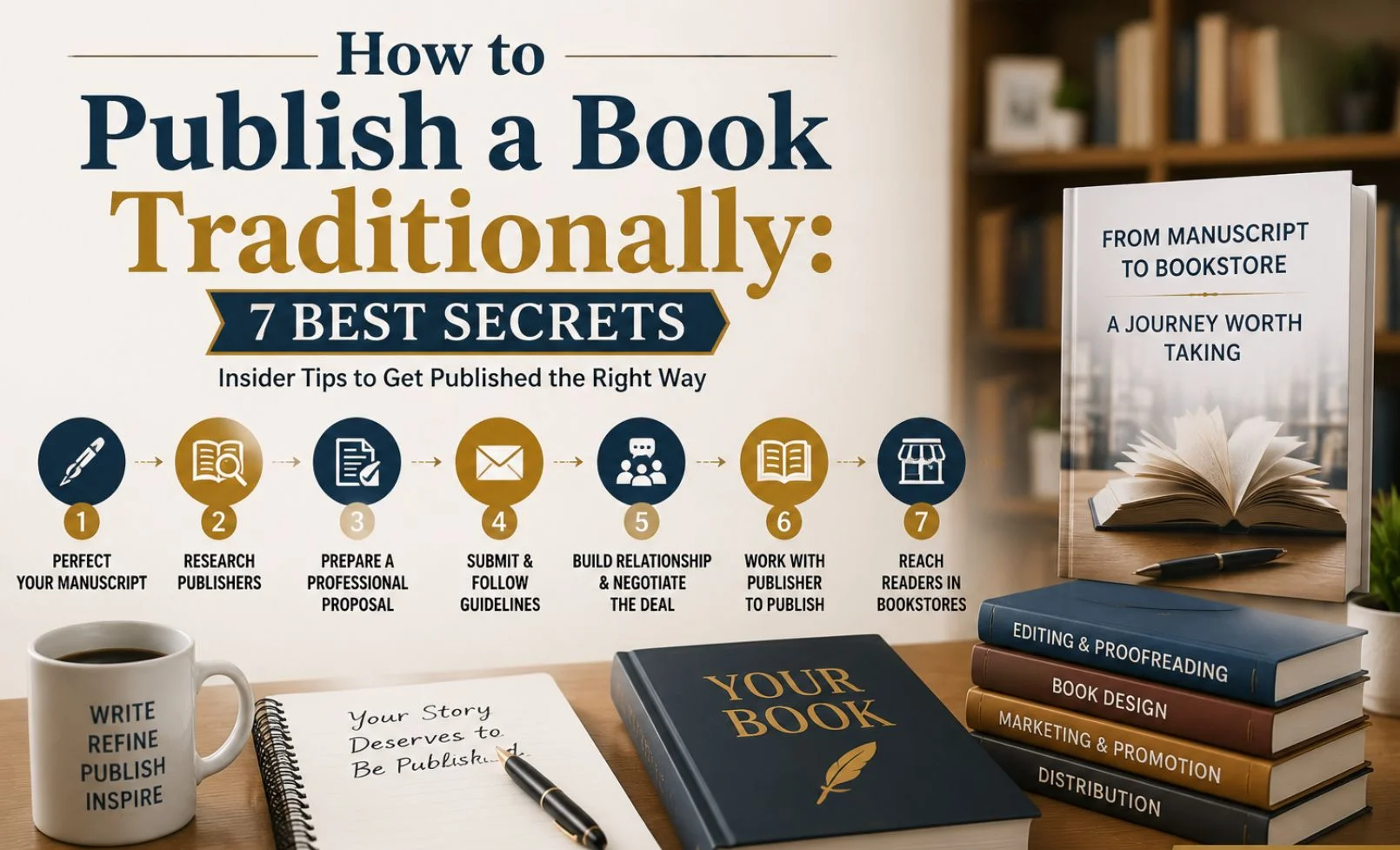
How to Publish a Book Traditionally: 7 Best Secrets
Part 1: Understanding Traditional Publishing and Preparing Your Book
Introduction: Understanding How to Publish a Book Traditionally
Many potential writers have dreamed of writing a book, but finding the right publishing company to release it can be challenging and requires some knowledge of the publishing industry. Many writers are thinking about publishing a book traditionally since traditional publishing has so many benefits, such as professional editing, expert design, bookstore distribution, and industry credibility.
Traditional publishing contrasts with self-publishing, where an author might be responsible for numerous aspects of book publishing, including production, distribution, and sometimes marketing support. But a publisher’s acceptance is a highly competitive process, and authors need to know the entire publishing process before they submit their manuscript.
That typically starts with a great manuscript followed by a professional book proposal, and finding a literary agent. A literary agent is a person who assists authors in getting their materials to appropriate publishers and negotiates contracts for the authors.
In this guide, we are going to discuss 7 important secrets that will enable writers to navigate the traditional publishing process successfully and raise the odds that their writing will become published books.
Secret 1: Understand How Traditional Publishing Works
What Is Traditional Book Publishing?
Traditional publishing refers to the method an author uses to publish their work on the bookshelf, typically via a literary agent and a publishing company. Once the publisher agrees to publish the book, the publisher becomes responsible for book production and distribution.
Typically, the publisher is responsible for:
- Professional editing
- Book cover design
- Interior formatting
- Printing
- Distribution
- Marketing support
The relationship between the sale of books to bookstores.
Payment is made to the author as an advance and royalties from the sale of books.
The first step to publishing a traditional book begins by knowing that authors don’t just send manuscripts to any publisher and then receive a publishing contract. It requires research, preparation, and perseverance.
Rather than books being sold at the whim of a publisher, traditional publishers take time to assess books according to the following criteria:
- Quality of writing
- Market demand
- Target audience
- Author platform
- Commercial potential
While the manuscript must be good, it’s also important that a book will attract readers and sell.
The Traditional Publishing Process From Manuscript to Bookstore

There are a few essential parts to the traditional publishing process.
Step 1: Write and Complete Your Manuscript
The first thing to do is to finish up your book. One common mistake made by novice writers is to send incomplete manuscripts. Professional publishers want a complete and polished manuscript from the author.
The author should ensure, before submission:
- Complete the first draft
- Make several rounds of edits to the content
- Enhance structure and readability
- Categorize the problem:
- Analyze the problem to determine its type
- Accept criticism from beta readers and/or editors
A well-written manuscript is a strong first impression to agents and Book publishing companies.
Step 2: Edit Your Book Professionally
Few things are as critical as editing before you go to publishers.
A professional editor can assist with improvements to:
- Story structure
- Character development
- Writing style
- Grammar
- Clarity
- Overall reader experience
Not all rejected manuscripts are rejected for the idea, but for the writing.
When agents receive thousands of submissions annually, it’s better to spend the time to get it professionally edited.
Step 3: Prepare a Book Proposal
A book proposal will be a pitch to agents and publishers that introduces your book.
A good proposal typically has:
Book Overview
This section explains:
- What your book is about
- Why readers need this book.
- What makes it different from similar books
Target Audience
Publishers want to know who will be purchasing the book.
Examples:
- Fiction readers
- Business professionals
- Parents
- Students
- Hobby enthusiasts
Market Analysis
Authors should explain:
- Similar successful books
- Current trends
At the same time, the book also has commercial potential, as evidenced by the following reasons:
Author Information
This section highlights:
- Writing experience
- Professional background
- Online presence
- Marketing ability
It is vital to the success of your project to have a well-prepared proposal to help the Book publishing companies understand the value of your project.
Secret 2: Prepare a Professional Manuscript Before Submission
Why Quality Matters Before Approaching Publishers

Many new writers think they have a great idea, and that is enough to get published. Ideas are important, but publishers are interested in professionally prepared books for the market.
Before turning in your work, work on:
Improving Your Writing Skills
Successful writers continually hone their skills by:
- Reading books in their genre
- Studying successful authors
- Practicing writing regularly
- Learning storytelling techniques
Understanding Your Genre
Every genre has different expectations.
For example:
- Romance readers are looking for emotional narratives.
- Mystery readers expect suspense.
- Business readers are looking for actionable items.
- Children’s books need engaging language and strong visuals.
Knowing your reader makes for a better publishing proposal.
The Importance of Researching Book Publishing Companies
Not all publishers will publish all types of books. Authors are expected to have done a publisher search based on the following:
- Publishing genre
- Previous titles
- Submission guidelines
- Reputation
- Distribution network
Before submitting, check:
- How they are published
- Whether they are open to direct submissions or not
- If they would need an agent
- Their publishing history
Teaming up with the best Book publishing companies can really make a difference in your book’s success.
Preparing for the Next Step: Finding a Literary Agent

The biggest problem in the traditional publishing world is finding a literary agent.
A literary agent serves as the liaison between authors and publishers. They are familiar with the publishing scene and know which publishers are seeking which kinds of books.
The agents assist authors with:
- Manuscript improvement
- Submission strategy
- Contract negotiation
- Protecting author interests
Agents are ideal for most big publishers because they filter professionally prepared manuscripts.
How to Publish a Book Traditionally: 7 Best Secrets
Part 2: Finding a Literary Agent, Choosing Publishers, and Understanding Rights
Secret 3: Master the Process of Finding a Literary Agent
The first thing to grasp when you want to learn how to publish a book traditionally is to know the role of a literary agent. Many successful authors have found traditional publishers via agents due to their contacts with editors and Book publishing companies.
A literary agent does more than submit your manuscript. They can assist you in your publishing path, optimize your submission approach, and negotiate the most beneficial publishing contract for your book.
Finding a literary agent is difficult for new authors because they receive many hundreds or thousands of submissions from agents they would like to work with. But with proper research and preparation, an author can improve his chances of finding the right representative.
Why Authors Need a Literary Agent
A literary agent can be a big help throughout the publishing process.
1. Agents Connect Authors With Publishers
Most big publishing companies will not accept unsolicited manuscripts. Rather, they depend on agents to find new talent in writing.
Agents know who is looking for what at various Book publishing companies and have contacts to editors.
For example:
- A fiction agent could be familiar with publishers who publish romance novels or thriller novels.
- A nonfiction agent can represent a business, health, or educational book publisher.
An agent can help spread the word about your book and keep it in front of the right pair of eyes in a crowded publishing market.
2. Agents Help Improve Your Submission
A Literary Agent might read your book before you send it to a publisher; you can submit your:
● Manuscript
● Book proposal
● Query letter
● Market strategy
They can offer advice to enhance your project and make it more attractive to publishers.
A pro agent knows what editors are looking for and can assist you in placing your book in the right hands.
3. Agents Negotiate Publishing Contracts
Many aspects of publishing contracts affect your future earnings and ownership.
Agents assist authors with negotiations:
● Advance payments
● Royalty percentages
● Publication rights
● Territory agreements
● Contract duration
It is important to understand the rights and royalties of your book because signing the rights away can impact your long-term opportunities.
How to Find the Right Literary Agent
Research is the key to finding the right agent. Since each agent has certain interests and requirements, authors need to avoid sending their manuscript to every agent.
Here are some steps for successfully finding a literary agent:
Research Agents in Your Genre
Each agent will have a particular style and niche.
Before you call an agent, review:
- The books they will read this year.
- Authors they work with
- Genres they accept
- Submission requirements
For example:
An author of children’s books should look for agents that are interested in children’s books, not business books.
Create a Professional Query List
Select and click Create Professional Query List.
Send to one agent instead; make a list of the agents that may be suitable.
The following should be included in your list:
- Agent name
- Agency name
- Genres represented
- Submission instructions
- Contact details
With a targeted approach, you have a better chance of success!
How to Write a Powerful Query Letter
Your first time meeting a literary agent is through a query letter. It should make the agent feel like your book is worth his time.
A good query letter should contain:
A Professional Opening
Make sure to begin your query letter with an engaging opening statement that briefly states:
- Your book title
- Genre
- Word count
- Main concept
Don’t have lengthy anecdotes. Agents are looking for clarity.
A Strong Book Description
In your description, you should explain:
- Main characters or ideas
The main problem or goal of the story.
- What makes your book unique
In a nonfiction book, explain:
What is the issue that your book addresses? What is the issue that your book addresses?
- Why readers need it
- Your expertise
Author Background
Provide details that enhance your credibility.
Examples:
- Professional experience
- Previous publications
- Awards
- Online audience
With a solid author platform, you can create a more appealing submission for Book publishing companies.
Secret 4: Choose the Right Book Publishing Companies
Choosing the right publisher is also a crucial aspect of traditional book publishing.
Not all publishers are right for all authors. The publisher you choose needs to know what you’re writing, who you’re writing for, and what you’re trying to achieve.
If you have a great idea for a book, but don’t have the time to produce the book, a good publisher can help you make your manuscript turn into a well-produced book.
Types of Traditional Book Publishing Companies
Large Publishing Houses
Large publishers are well-known companies with big resources.
They often provide:
- Professional editorial teams
- Strong distribution networks
- Marketing departments
- International opportunities
But these publishers are very competitive.
Numerous authors require the assistance of a literary agent before they can approach the big publishing houses.
Independent Publishing Companies
Independent publishers are also known as small presses, which publish in a certain genre or for a certain niche audience.
Benefits include:
- More personal communication
- Attention to individual authors increases. More focus on the individual authors.
- Books that focus on an unusual topic.
For authors who are looking to traditional publishing for help but have found it difficult to get the attention of larger publishers, independent publishers are an excellent alternative.
Specialty Publishers
Some publishers specialize in a specific area like:
- Photography books
- Academic books
- Children’s books
- Art books
- Educational materials
For instance, if you are interested in publishing a photo book, you need a publisher with experience in visual publishing, since it requires special skills to produce photo books.
How to Choose the Best Publisher
Do a thorough search on each publisher before sending in your manuscript.
Consider:
Publishing Reputation
Look at:
- Previously published books
- Author reviews
- Industry reputation
A reliable publisher should have a history of successful publications.
Distribution Opportunities
A solid publisher should be connected to the following:
- Bookstores
- Online retailers
- Libraries
- International markets
Distributing is a very important part of getting readers.
Publisher’s Genre Experience
Select publishers that have experience in your book’s category.
For example:
A general fiction publisher won’t have the expertise in understanding how to publish a photo book as well as a photography publisher.
Secret 5: Understand Book Rights and Royalties Before Signing
Before signing a book deal, it’s important to understand book rights and royalties.
Many new writers only think about getting published, and they forget about one of the essential components of publishing contracts: Book rights and royalties.
These terms help authors safeguard their rights and earn the maximum possible income in the future.
What Are Book Rights?
Book rights control the use, distribution, and sale of your book.
Common rights include:
Print Rights
These enable the publishers to create hard copies of your book.
Examples:
- Hardcover editions
- Paperback editions
Digital Rights
Digital rights enable publishers to publish your book digitally.
Examples:
- eBooks
- Digital platforms
Audio Rights
Audio rights enable your book to be read into an audio recording.
Audiobooks are an integral component of the publishing business today.
Translation Rights
Translation rights enable your book to be translated to other languages.
This can open up international opportunities.
How Book Royalties Work
Royalties: money a writer earns from book sales.
Typical income from traditional publications typically consists of:
Advance Payment
An advance is a sum of money paid out to an author ahead of their royalties.
After the advance on royalties has been recovered from sales, the author receives further royalties.
Royalty Percentage
The authors get a portion of every book sold.
The percentage is based on:
- Publisher
- Contract terms
- Format
- Market
The knowledge of Book rights and royalties enables writers to make informed choices when publishing.
Negotiating a Publishing Contract
Authors must ensure they read carefully before signing a contract:
- Rights being transferred
- Royalty rates
- Payment schedules
- Contract length
- Copyright ownership
A literary agent will be able to help negotiate better terms and protect the author’s interests.
How to Publish a Book Traditionally: 7 Best Secrets
Part 3: Publishing Special Formats, Building Your Author Brand, Marketing, and Final Steps
Secret 6: Learn How Publishers Handle Special Book Formats
It’s not just novels and regular nonfiction books that can be published traditionally. Many authors want to publish a niche book like a photography book, art book, cookbook, and an illustrated book. These projects are more comprehensive, depend on visual presentation and production quality, and thus need further planning.
How to Publish a Photo Book Traditionally
A photo book is a mix of narration, photography, and professional design. Publishing companies seek projects with a distinct visual brand and marketability.
Create a Strong Photo Book Concept
If an author is interested in publishing a photo book, they should be aware that it is not a book of text. Publishers look at more than the writing; they look at the image quality, design, audience needs, and production needs.
Authors need to have a concept before approaching a publisher.
The key elements of a successful photo book are to ask:
- What is the book’s message?
- Who is the target audience?
- Why is this collection unique?
- What makes the images valuable?
Some ideas for photo book concepts are:
- Travel photography collections
- Wildlife photography
- Historical photo collections
- Cultural documentation
- Artistic photography projects
A clear concept enables Book publishing companies to grasp the potential of the project.
Prepare High-Quality Images
When you learn to publish a photo book, one of the most vital factors is the quality of the photos.
The authors should concentrate on:
- High-resolution images
- Professional editing
- Consistent visual style
- Strong image selection
Publishers are looking for images that evoke an emotional response from readers.
Create a Professional Proposal for a Photo Book

Some of the following elements should be included in a photo book proposal:
Project Overview
Explain:
- The purpose of the book
The origins of the pictures.
- The intended audience
Sample Images
Combine the best images to show high quality.
Market Research
Explain:
- Other books in the same vein with similar success
- Why readers would purchase your book
- Potential sales opportunities
Solid proposals give you a greater chance with specialized Book publishing companies.
Working With Designers and Production Teams
Typically, traditional publishers handle the production process such as:
- Interior layout
- Image placement
- Typography
- Cover design
- Printing decisions
For visual books, professional design is crucial as substandard formatting can diminish the impact of great images.
Secret 7: Build a Strong Author Platform Before Publication
Many writers think that the publishers take care of all the rest once they accept a manuscript. Publishers offer writers great assistance, but the expectation is that authors take an active role in marketing and/or audience building.
An author platform is a crucial aspect of traditional publishing, and publishers will look favorably upon authors who have one.
Why Publishers Care About Author Platforms
Publishers will know that you can engage readers if you have a strong author platform.
An author platform can contain:
- Professional website
- Email newsletter
- Social media presence
- Online community
- Speaking opportunities
- Previous audience engagement
A solid platform can help your book be more appealing to Book publishing companies.
How to Build Your Author Brand
Create a Professional Author Website
The following features should be included in your website:
- Author biography
- Book information
- Contact page
- Blog content
- Newsletter signup
Your readers will find your work through a professional website, and it will create credibility.
Grow an Email List
Email marketing is still one of the best methods for authors to reach their readers directly.
Newsletters can be used by authors to share:
- Writing updates
- Behind-the-scenes content
- Book announcements
- Reader resources
Readers can assist with book launches and sales.
Use Social Media Strategically
Authors don’t have to be active in all places. Select the platforms that your readers visit.
Examples:
- Instagram for visual books
- LinkedIn for business books
- Group chat rooms on Facebook
Use YouTube for educative content.
The objective is to create real relationships instead of a follower base.
Marketing Strategies for Traditionally Published Authors
Authors can even get the support of traditional publishing, and still need to get involved in marketing.
Successful promotion can encompass:
Book Launch Campaigns
Book launch can generate excitement around the publication.
Strategies include:
- Advance reader copies
- Reviews
- Online events
- Author interviews
- Social media campaigns
Media and Public Relations
Authors can find themselves more visible through:
- Podcast interviews
- Guest articles
- News features
- Industry events
Media exposure is valuable in introducing books to new readers.
Reader Reviews
Reviews have an impact on purchasing choices.
Authors can invite their readers to:
- Share honest reviews
- Recommend books
- Discuss books online
Reader feedback on positive reviews can increase discoverability.
Common Mistakes Authors Make in Traditional Publishing
Mistake 1: Submitting an Unfinished Manuscript
The most common mistake is to send work before it is ready.
Authors should complete:
- Editing
- Proofreading
- Revisions
- Formatting checks
A well-formulated manuscript is more likely to impress agents and publishers.
Mistake 2: Choosing the Wrong Literary Agent
Finding a literary agent will be beneficial, but the wrong agent can cause some issues.
There are certain agents to whom the authors should never turn, including the following:
- Not having any work experience in the No experience in the industry.
- Request upfront payments that are not required. Require payment of unnecessary fees up front.
- Do not understand their genre
- Never agree on any deal with agents without doing some investigation first.
Mistake 3: Ignoring Book Rights and Royalties
A lot of authors only think about getting published and neglect any information about the contract.
Knowing the rights and royalties of books will help authors protect:
- Future earnings
- Translation opportunities
- Digital rights
- Audio rights
Never sign a publishing contract without knowing what rights you’re waiving.
Mistake 4: Expecting Publishers to Handle All Marketing
Traditional Publishers offer support, and authors MUST be involved.
As a successful author, you can assist in the following ways:
- Online promotion
- Reader engagement
- Events
- Interviews
A long-term successful approach is developing a relationship with readers.
Conclusions: How to Publish Your Book Traditionally
Traditional book publishing takes patience, preparation, and an understanding of the publishing industry. Every step from writing a professional manuscript to finding a suitable literary agent, choosing an appropriate Book publishing company, and understanding book rights and royalties plays an important role in achieving success for an author.
The traditional publishing route provides a professional support network, industry legitimacy, and greater exposure for authors. But it takes more than just a manuscript to be successful. It is up to the authors to develop their platform and understand publishing contracts so they can be actively involved in promoting their books.
If you wish to write a novel, a nonfiction guide, or learn how you can publish a photo book, here are seven secrets that can get you one step closer to the path of traditionally published authors.
Frequently Asked Questions About How to Publish a Book Traditionally
What is the time required to go through traditional publishing?
Getting a book published is a process that can take months to years. The timeline involves locating an agent, obtaining a publisher, editing, production, and marketing preparation.
It is a slower process than self-publishing because many professionals are involved.
As a published author, do I need a literary agent?
Many publishing companies require authors to go through an agent. But a few smaller book publishing companies will take direct submissions from the author.
Check the instructions for research submission before submitting your manuscript.
What are the earnings of traditional authors?
Income depends on:
- Book sales
- Contract terms
- Royalty percentage
- Advance payment
Book rights and royalties are key factors that help authors determine how much money they may make.
Is it possible to publish a photo book traditionally?
Yes, but the authors need to know how to make the photo book a success.
Having a well-crafted idea and images of your work, along with a proposal, will help increase the likelihood of acceptance.
How to pick the top publication company?
The research publishers are based on:
- Genre experience
- Reputation
- Distribution ability
- Previous successful titles
Choosing the right publisher is an important part of how to publish a book traditionally.

We help authors bring their stories to life through professional online book publishing services. From manuscript formatting and cover design to Amazon KDP publishing and global distribution, we make self-publishing simple, affordable, and successful.
