
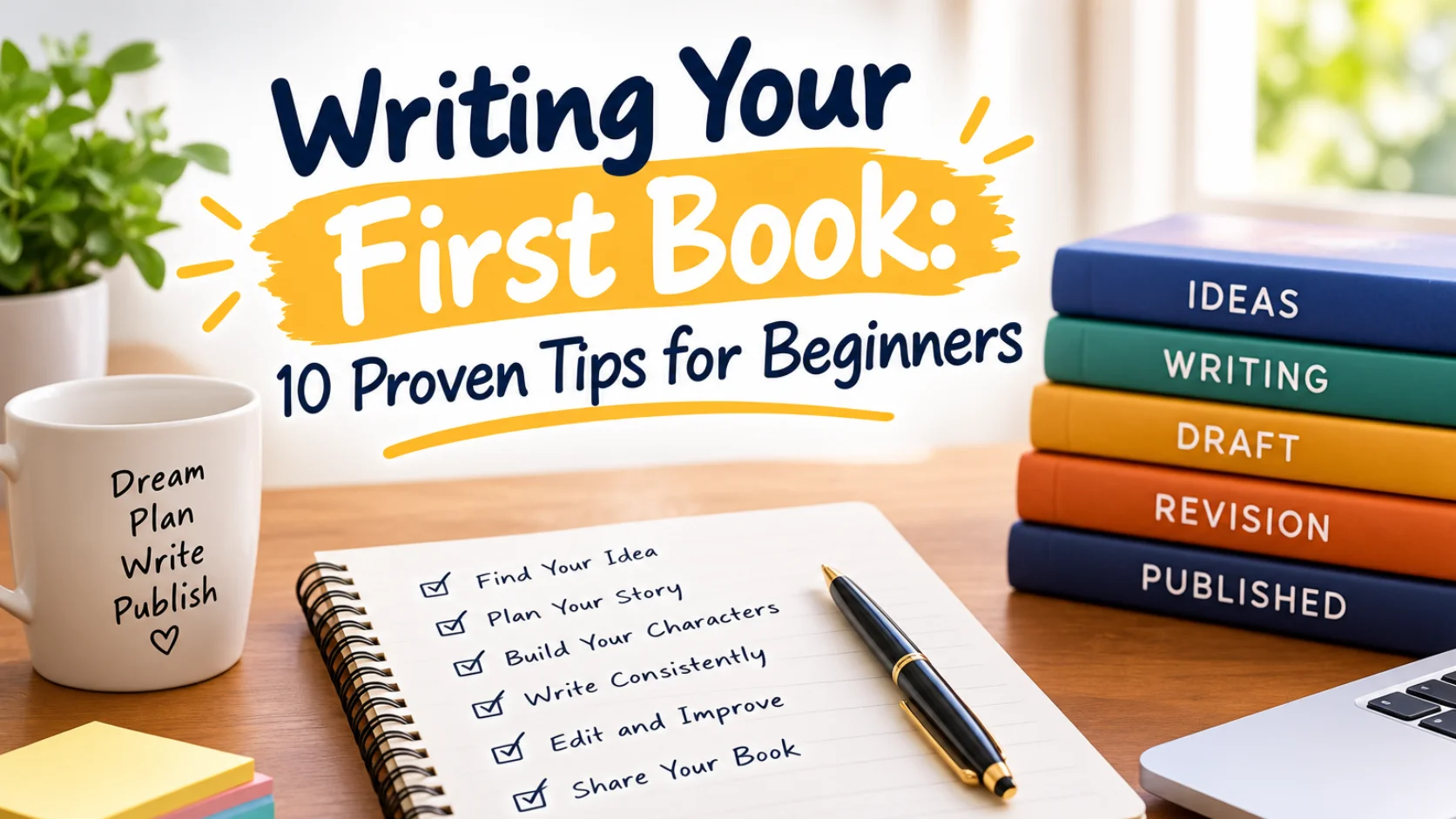
Writing Your First Book: 10 Proven Tips for Beginners
Writing your first book can feel exciting and overwhelming at the same time. You may have a great idea in your mind. However, you may not know how to turn that idea into a real book. This is common among new writers. You do not need to know everything before you begin. You only need a clear idea and a simple plan. Writing becomes easier when you take one step at a time. Your first draft does not need to be perfect. It only needs to get started. In this guide, you will learn practical tips for writing your first book. These tips can help you develop your idea and build a steady writing routine.
Writing Your First Book
Writing your first book starts with an idea that matters to you. That idea can be simple or complex. You may want to share your personal experience with readers. You may also want to teach a useful skill or tell a fictional story. Whatever your reason, start by writing down your main idea. Do not worry about making it sound perfect. Write it in the same way you would explain it to a friend. This simple approach can help you understand your own book better.
Many beginners make one common mistake at the start. They think about the entire book before writing anything. This can make the project feel much bigger than it really is. Instead, break your book into smaller tasks. Think about one chapter, one scene, or one topic at a time. This makes the writing process easier to manage. You can also create small goals for each writing session. For example, you could aim to write 500 words. You could also finish one short section before taking a break.
Before you begin, think about your reason for writing. Your purpose can keep you motivated when writing becomes difficult. Some writers want to entertain readers with a good story. Others want to solve a problem through useful information. Some writers simply want to turn an idea into something real. There is no wrong reason to write a book. Your reason should be meaningful to you. Keep it somewhere you can see while working. It can remind you why you started.
Writing Your First Novel
Writing your first novel requires a little more planning. Fiction usually includes characters, settings, conflict, and a clear story direction. You do not need every detail before writing your first chapter. Start with the basic idea behind your story. Ask yourself what happens to the main character. Then think about what problem they must solve. Consider what they want and what stands in their way. These questions can give your novel a strong starting point.
Your main character should have a clear goal. Readers need a reason to care about what happens next. Give your character something they strongly want to achieve. Then create challenges that make the goal harder to reach. These challenges create tension and keep the story moving. Your character can also have fears, weaknesses, and personal struggles. These details can make the character feel more natural. You do not need to explain everything at once. Let readers discover your character as the story develops.
The setting can also make your novel more interesting. Think about where and when your story takes place. It could happen in a busy modern city. It could also happen in a small village or imaginary world. Describe the setting without making every paragraph too detailed. Give readers enough information to imagine the scene. Focus on details that support the mood or story. A good setting should feel connected to what happens around it.
How to Write My First Novel
If you are asking how to write my first novel, begin with a basic story plan. You do not need a complicated writing system. Start by writing three simple sections. Write what happens at the beginning, middle, and end. This gives you a basic direction before you start drafting. You can then divide each section into smaller events. These events can become your chapters or scenes.
A simple outline can save you a lot of time later. It can also help when you suddenly feel stuck. When you do not know what to write next, check your outline. It can remind you about the next important event. Your outline does not have to stay the same. You can change it whenever your story develops. New ideas often appear during the writing process. Allow yourself to make changes when they improve the s tory.
Do not spend too much time planning every detail. Some new writers spend months creating notes without writing the actual novel. Planning is useful, but writing is still the main goal. Give yourself enough information to begin. Then let the story grow as you write. You may discover new characters or better ideas along the way. This is a normal part of writing fiction. Your first plan is simply a starting point.
How to Write Your First Book

Learning how to write your first book becomes easier when you understand your reader. Think about who you want to reach with your book. Your audience can affect your language, examples, and overall tone. A children’s book needs a different approach than a business book. A personal memoir also needs a different style. Knowing your audience gives your writing a clear direction.
Start by writing a simple description of your ideal reader. You do not need detailed information about them. Just think about what they may want from your book. Ask what problem your book can solve for them. If you are writing fiction, think about what your readers enjoy. Consider the emotions and experiences you want them to have. These questions can help you make better writing decisions.
Creating a chapter outline is another helpful step. Write down the main purpose of every chapter. Then add a few points you want to cover. If you are writing fiction, list the important events. If you are writing nonfiction, list the main lessons. Keep your outline simple and flexible. You can add, remove, or rearrange sections later. The goal is to make writing easier, not more complicated.
Another important rule is to separate writing from editing. Many beginners try to correct every sentence immediately. This can interrupt their creative flow. It can also make a simple writing session take much longer. Try to finish your thoughts before making major corrections. You can return to those sections during your editing stage. This approach allows you to focus on creating content first.
I Want to Write a Book Where Do I Start?
If you are thinking, “I want to write a book where do I start,” begin with your main idea. Take a blank page and write everything you know about it. Do not worry about grammar or sentence structure. You can use short notes and simple phrases. Write down questions, ideas, characters, topics, or possible chapters. This process can help you understand what you really want to write.
Once you have your ideas, organize them into groups. Similar ideas can become part of the same chapter. Important topics should receive more attention. Smaller points can support the main topics. If you are writing a novel, group related events into scenes. You can then arrange those scenes into chapters. This simple process turns scattered thoughts into a basic book structure.
Next, choose a realistic writing goal. You do not need to write thousands of words every day. Even a few hundred words can create steady progress. Choose a goal that fits your daily schedule. You may write before work, after dinner, or early in the morning. The important thing is consistency. A small writing habit can eventually produce a complete manuscript.
Try to remove distractions during your writing time. Put your phone away if it keeps interrupting you. Close unnecessary browser tabs and social media pages. Give yourself a quiet space where possible. You do not need a perfect writing environment. You simply need enough time to focus. Even thirty focused minutes can make a real difference.
Tip 1: Start With a Clear Idea
A clear idea gives your book a strong starting point. You should know what you want to say or explore. Your idea does not need to be completely developed. It only needs enough direction to help you begin. Write your main idea in one or two simple sentences. Then ask yourself what makes this idea worth sharing.
For fiction, think about the basic story problem. Who is the main character? What do they want? What prevents them from getting it? What could happen if they fail? These questions can help you build a stronger story. For nonfiction, think about the main value of your book. What will readers learn after finishing it? What problem will your book help them understand or solve?
Do not worry if your idea changes later. Many books develop during the writing process. You may discover a better direction after writing several chapters. That does not mean your original idea was bad. It means your understanding of the book has grown. Stay open to useful changes while keeping your main purpose clear.
Tip 2: Know Your Target Reader

Knowing your target reader can make your writing much stronger. When you understand your audience, your words become more focused. You can choose examples that feel useful and familiar. You can also avoid information that does not support your purpose. Think about what your reader expects from your book. Then try to meet those expectations in a natural way.
For a novel, think about the type of reader who enjoys your genre. Consider the stories they usually read. Think about their favorite themes, characters, and story styles. This does not mean copying another writer. It simply helps you understand reader expectations. You can then create something original within your chosen genre.
For a nonfiction book, reader needs are even more important. Your readers may have a question or problem. Your book should provide useful information in an easy way. Avoid using complicated words when simple ones work better. Explain difficult ideas with clear examples. Always ask yourself whether each section helps your reader.
Tip 3: Create a Simple Outline
A simple outline can become your roadmap during the writing process. It helps you understand what should come next. Start by listing the main sections of your book. Then add the chapters under each section. You can write one or two sentences about each chapter. This is enough to give you direction.
Do not make your outline too complicated. A long outline can sometimes feel like another writing project. Keep it practical and easy to change. Your outline should support your creativity instead of controlling it. If a better idea appears, update your plan. There is nothing wrong with changing your outline while writing.
An outline can also help you maintain a smooth flow. Each chapter should connect naturally with the next one. Readers should understand why they are moving forward. If a chapter does not support your main purpose, review it carefully. You may need to move it, shorten it, or remove it. A clear structure can make the finished book easier to read.
Tip 4: Set a Writing Schedule
A writing schedule helps turn your goal into a regular habit. Choose a time when you can focus without too many interruptions. Some writers prefer mornings because their minds feel fresh. Others write better at night after finishing daily tasks. There is no single perfect writing time. Choose the time that works best for your routine.
Start with a goal that feels achievable. You could write for twenty minutes each day. You could also set a small word target. Avoid setting a huge goal that becomes difficult to maintain. Missing your goal repeatedly can make you lose motivation. A smaller goal can help you build consistency. Once the habit becomes easier, you can increase your writing time.
Try to protect your writing schedule as much as possible. Treat it like an important appointment with yourself. Turn off notifications during your writing session. Keep your writing materials ready before you begin. These small actions reduce distractions and save time. Most importantly, return to your manuscript regularly.
Tip 5: Write Your First Draft Quickly

Your first draft does not need to be perfect. Its main purpose is to get your ideas onto the page. Many beginners slow themselves down by editing every sentence. They stop after a few lines because something does not sound perfect. This can make finishing a book extremely difficult. Instead, keep moving forward whenever possible.
You will have plenty of time to improve your writing later. During your first draft, focus on ideas, scenes, characters, and information. If you notice a problem, make a quick note and continue. You can return to that section during revision. This method keeps your writing momentum strong.
Remember that every finished manuscript begins with a first draft. Some sections may be weak at first. Some sentences may need complete rewriting. That is completely normal. Do not judge the quality of your final book from the first draft. Your job at this stage is simple. Write the story or information that you want to share.
Tip 6: Avoid Comparing Yourself With Other Writers
Every writer has a different writing journey. Some people write quickly, while others need more time. Avoid comparing your first draft with a published book. Published books have usually gone through many revisions. Instead, focus on improving your own writing. Read other writers to learn useful techniques. Use those lessons to develop your own writing style.
Tip 7: Read Books in Your Genre
Reading can help you become a better writer. Read books that are similar to your project. Notice their chapter structure and writing style. Pay attention to how authors keep readers interested. If you are writing a novel, study characters and story pacing. For nonfiction, study explanations, examples, and chapter organization. Do not copy other writers. Learn from their techniques and create your own work.
Tip 8: Take Useful Breaks
Writing for long periods can make you tired. Short breaks can help you return with fresh attention. Walk around, drink water, or step away from your screen. If you feel stuck, stop forcing the words. Take a short break and return later. A fresh mind can often find a better solution.
Tip 9: Edit After Finishing Your Draft
Your first draft does not need to be perfect. Finish your ideas before focusing on detailed editing. After completing the draft, read it from beginning to end. Check the structure, clarity, grammar, and repeated ideas. Remove sections that do not support your main topic. You can also ask a trusted reader for honest feedback.
Tip 10: Keep Going Until You Finish
Finishing your book should be your main goal. Some days will produce many words, while others may produce very few. That is normal. Set small writing goals that fit your schedule. Even a few hundred words can create steady progress. If you miss a few days, simply start again. Do not let one break stop your entire project.
Improve Your Book Through Revision

Finishing the first draft is only one step. Revision gives you a chance to make the manuscript stronger. Check whether your chapters have a clear purpose. Remove unnecessary information and improve weak sections. Look for confusing sentences and repeated ideas. Read your work aloud to find awkward wording. Several simple editing rounds can make your book much better.
Build Confidence as a New Writer
Confidence grows through practice and experience. You do not need to feel confident before starting. Each completed chapter gives you more experience. Each revision teaches you something new. Keep reading, writing, and learning. Your first book is also a valuable learning experience. Give yourself time to improve.
Final Thoughts
Writing your first book does not have to happen all at once. Start with one idea and create a simple plan. Write regularly and focus on completing your draft. Do not worry about perfection during the first stage. Give yourself time to revise and improve your work. Most importantly, keep going when the process feels difficult.
If you are thinking, “I want to write a book where do I start,” begin with your main idea. Write a few sentences about it today. Then choose a small writing goal. One page can become a chapter, and chapters can become a complete book. With patience and consistent effort, your idea can become a finished manuscript.
Frequently Asked Questions
How do I start writing my first book?
Start with your main idea and write it in a few simple sentences. Then create a basic outline and set a small writing goal.
How long does it take to write a first book?
The time depends on your writing speed, book length, and daily schedule. Some writers finish within months, while others take longer.
Can I write a book without writing experience?
Yes, you can. Writing improves through practice, reading, revision, and feedback.
How many words should my first book have?
There is no fixed word count for every book. A novel may need more words than a short guide or children’s book.
Should I outline my book before writing?
An outline can make writing easier. It gives you direction while still allowing changes during the writing process.
How do I stay motivated while writing?
Set small and realistic writing goals. Completing a few hundred words regularly can help you maintain steady progress.
Should I edit while writing my first draft?
It is usually easier to finish the first draft before detailed editing. You can revise structure, wording, and grammar afterward.
What should I do after finishing my first book?
Read through your manuscript and revise it carefully. You can then get feedback, proofread it, format it, and prepare it for publishing.
How do I choose a topic for my first book?
Choose a topic you understand, enjoy, or strongly want to explore. Your interest can help you stay motivated while writing.
What if I get stuck while writing my book?
Take a short break and return later. You can also skip the difficult section and continue with another chapter.
Can I write my first book on my phone?
Yes, you can write using a phone, tablet, or computer. Choose the device that feels comfortable and easy to use.

We help authors bring their stories to life through professional online book publishing services. From manuscript formatting and cover design to Amazon KDP publishing and global distribution, we make self-publishing simple, affordable, and successful.
