
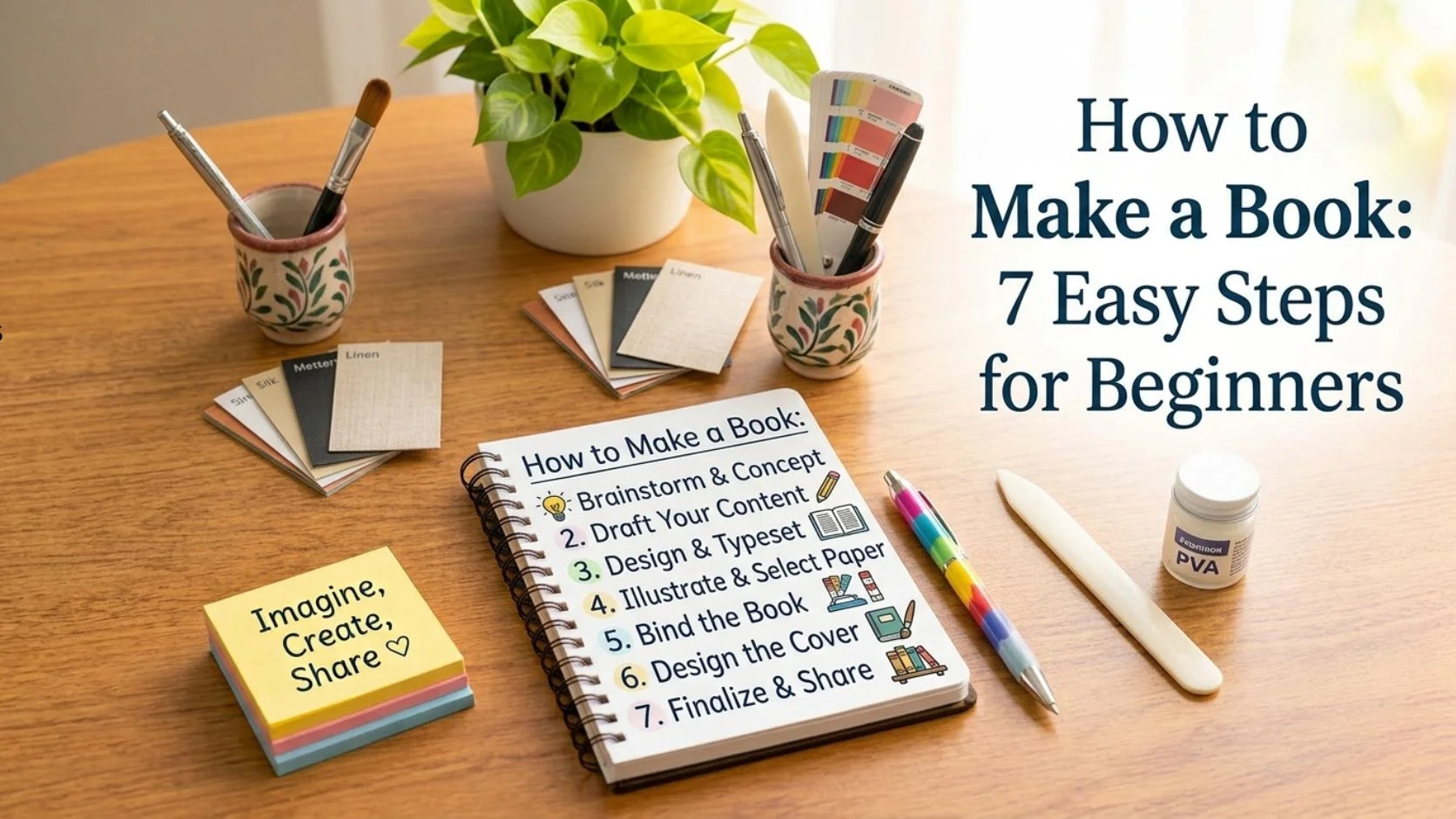
How to Make a Book: 7 Easy Steps for Beginners
Have you ever wanted to turn your ideas into a real book? Maybe you have a story sitting in your notebook. Perhaps you have useful knowledge that could help other people. You may even have an idea for a children’s book. Whatever your reason, starting can feel confusing. You may wonder where to begin and what comes next. The good news is that learning how to make a book is easier when you break the process into simple steps. You need a clear idea, a basic plan, and enough patience to finish each stage.
How to Make a Book: Start With a Great Idea
Every book begins with an idea. Your idea could come from personal experience, a story, a problem you want to solve, or something you know well. Before you start writing, think about the purpose of your book. Decide whether you want to teach, entertain, inspire, or tell a story. A clear purpose will help you stay focused throughout the writing process.
Find the Main Topic
Choose one main topic for your book. A focused topic makes your writing easier and helps readers understand your message.
Decide What Your Reader Should Get
Think about what readers should learn, feel, or understand after reading your book. This will give your content a clear direction.
Understand Your Target Audience
Knowing your readers is an important part of how to make a book successfully. Think about their age, interests, knowledge, and needs. A children’s book needs simple words and colorful visuals, while a business book may need a more professional style. When you understand your audience, you can choose better words, examples, illustrations, and even the right book size.
Choose the Right Reading Level
Use language your readers can understand easily. Simple writing often makes a book more enjoyable.
Think About Your Reader’s Questions
Think about what your readers may want to know. Answering their questions can make your book more helpful and engaging.
Create a Simple Book Outline

An outline is like a roadmap for your book. It helps you organize your ideas before writing. You can list your chapters and briefly explain what each chapter will cover. This makes the writing process easier because you already know what comes next. A good outline also helps prevent repeated ideas and keeps your book focused.
Plan Your Chapters
Put your ideas in a logical order. Each chapter should have a clear purpose.
Use Clear Chapter Titles
Simple chapter titles help readers understand what each section is about.
Start Writing Your First Draft
Now it is time to write your first draft. Do not worry about making every sentence perfect. Your first goal is to get your ideas onto the page. You can fix grammar, improve sentences, and remove weak sections later. Try setting a small writing goal each day. Even a few hundred words can help you make steady progress.
Write Like You Are Talking to Someone
Use a natural and friendly writing style. Imagine you are explaining your topic to one person.
Do Not Worry About the Perfect Opening
Your opening can always be improved later. Focus on finishing the draft first.
The Process of Creating a Book by Hand

The process of creating a book by hand can be a fun project for beginners, children, and creative people. You can use paper, pencils, cardstock, glue, thread, or staples to create a simple handmade book. Handmade books can become journals, notebooks, storybooks, sketchbooks, or thoughtful gifts. You do not need expensive equipment. Start with a small number of pages and experiment with different covers and binding methods.
Choose Paper for Your Handmade Book
Choose paper based on how you plan to use the book. Thicker paper works well for drawings, while regular paper is suitable for writing.
Arrange Your Pages Correctly
Before binding your book, check the page order carefully. Make sure everything is positioned correctly.
DIY Book Making for Beginners
DIY book making is a simple way to understand how books are created. Start with a small project instead of making a large book. You could create a personal journal, recipe book, photo book, sketchbook, or short storybook. Once you understand the basic process, you can try more creative designs.
How to Make a Book at Home
Learning how to make a book at home does not require complicated tools. You can prepare your pages by writing or printing them, arrange them in order, create a cover, and bind everything together. Depending on your project, you can use staples, glue, thread, or another simple binding method. You can also decorate your cover with drawings, patterns, or simple lettering to give the book a personal touch.
Materials You May Need
You may need paper, cardstock, scissors, glue, a ruler, pencil, hole punch, and thread or staples.
How to Make a Book for Kids

If you want to learn how to make a book for kids, begin by choosing an age group. Young children usually enjoy simple stories, colorful pictures, repetition, and fun characters. Create a clear beginning, middle, and ending. Give the main character a small problem or goal, then show how it is solved. Keep the story easy to follow and make sure the illustrations support the words.
Choose an Age Group
The child’s age will help you choose suitable words, story length, and illustrations.
Create Memorable Characters
Give your characters simple personalities and recognizable features. Fun characters can keep children interested.
Build a Writing Routine
A writing routine can help you finish your book. Choose a regular time when you can write without too many distractions. You do not need to write for hours every day. Even a short writing session can help when you stay consistent.
What to Do After the First Draft
When your first draft is finished, take a short break before editing. Then read the manuscript from beginning to end. Look for repeated ideas, confusing sections, missing information, and weak parts. It can also help to ask someone you trust to read the book and provide honest feedback. Fresh eyes can often find problems you may not notice yourself.
After finishing your first draft, the next stage is turning it into a polished book. Editing, formatting, cover design, printing, and publishing all play an important role in the final result.
Step 4: Edit and Improve Your Manuscript
Editing helps make your book clear, useful, and enjoyable. Start with larger problems before worrying about small grammar mistakes. Check the chapter order, remove repeated information, and simplify confusing sections. Reading the manuscript several times can help you catch different types of problems.
Read Your Book Out Loud
Reading aloud can help you notice awkward sentences and repeated words.
Check Facts and Important Details
Double-check names, dates, numbers, quotes, and other important information.
Step 5: Format Your Book
Good book formatting makes your content easier to read. Choose readable fonts, suitable spacing, proper margins, and consistent headings. Keep the design clean and make sure every page follows the same style. If you plan to publish through a specific platform, check its formatting requirements before preparing your final file.
Choose the Right Book Size
Common sizes include 6 × 9 inches, 8.5 × 11 inches, and different children’s book sizes.
Set Proper Margins
Leave enough space around the text so pages do not feel crowded.
Add Page Numbers
Page numbers make longer books easier to navigate.
Step 6: Design Your Book Cover
Your cover creates the first impression. It should clearly show the title and match the subject of your book. A good cover should also remain easy to understand when shown as a small thumbnail online. Avoid adding too many design elements. A clean and professional cover is usually more effective.
Create a Front Cover
Use readable text and a strong visual idea that fits your book.
Prepare the Full Cover
For printed books, the full cover usually includes the front, spine, and back. The exact dimensions depend on your book’s size and page count.
Step 7: Prepare Your Book for Printing
Before printing, check the final file carefully. Save the interior as a print-ready PDF and follow the printer’s specifications. Check the page order, margins, images, colors, and cover. A final review can help prevent expensive printing mistakes.
Order a Proof Copy
A proof copy lets you inspect the actual printed book before ordering more copies.
Check Image Quality
Make sure images have enough resolution for printing. Low-quality images may appear blurry.
Printing Options for Your Book

You can use a local printer, online printing service, or print-on-demand company. Your choice depends on your budget, quantity, and publishing goals.
Paperback Printing
Paperback printing is a practical option for novels, guides, workbooks, and many self-published books.
Hardcover Printing
Hardcover printing gives a stronger and more premium feel. It works well for gift books, children’s books, and special editions.
Publishing Your Finished Book
Once your book is ready, you can choose traditional publishing or self-publishing. Self-publishing gives authors more control over the design, pricing, and publishing process.
Prepare Your Book Metadata
Prepare your title, author name, description, categories, keywords, and other important publishing information.
Consider an ISBN
An ISBN helps identify a book within the publishing and bookselling system. Requirements can vary by country and publishing method.
How to Make a Book at Home for Personal Use
For personal projects, you do not need professional equipment. You can write or print your pages, create a simple cover, and use staples, glue, or thread for binding. This works well for journals, family storybooks, notebooks, and small creative projects.
DIY Book Making for Children and Families
Making books together can be a fun family activity. Children can write short stories, draw pictures, and help decorate the cover. Keep the project simple and let children make creative choices.
How to Make a Book for Kids That They Enjoy
A good children’s book should be easy to follow and fun to read. Use simple sentences, colorful illustrations, interesting characters, and a clear story. Repetition, humor, and interactive moments can also help keep young readers interested.
The Process of Creating a Book by Hand
The process of creating a book by hand gives you the freedom to experiment with paper, covers, binding, and decoration. It is especially useful for handmade journals, creative projects, and personal gifts. You can start with a basic design and improve your skills as you practice.
Common Mistakes to Avoid When Making a Book
Avoid trying to make your first draft perfect. Do not skip editing or rush the formatting stage. Poor-quality images, inconsistent fonts, incorrect page order, and weak cover design can also affect the final book. Take time to review everything before printing or publishing.
How Much Does It Cost to Make a Book?
The cost depends on the book size, page count, paper, binding, cover type, and printing quantity. A simple handmade book can cost very little, while professional design and printing can cost more. Compare your options before choosing a final method.
How Long Does It Take to Make a Book?
There is no fixed timeline. A short book may take a few weeks, while a detailed book can take several months. Writing speed, editing, design, and publishing requirements all affect the process.
Can Beginners Really Make Their Own Books?
Yes. Beginners can make books with simple tools and a clear plan. You do not need to know everything before starting. Begin with a small project, learn each step, and improve with practice.
Final Checklist Before Publishing
Before publishing or printing, review your entire book one final time. Check the text, page order, formatting, images, cover, and metadata. Make sure your final PDF follows the printer or publishing platform’s requirements. If possible, order a proof copy before placing a large printing order.
Making a book may seem difficult at first, but breaking the process into simple steps makes it much easier. Start with a strong idea, write your draft, edit carefully, format the pages, create a good cover, and choose the right printing or publishing option. With patience and practice, you can turn your idea into a finished book.
Frequently Asked Questions About How to Make a Book
What is the easiest way to make a book?
Start with a simple idea and clear outline. Write your first draft, then edit it. Format the pages and create a clean cover. Finally, prepare the files for printing or publishing. Focus on one step at a time.
Can I make a book without a computer?
Yes, you can make a simple handmade book. Write or draw on paper, arrange the pages, and bind them together. This works well for journals, children’s projects, and personal keepsakes.
How to make a book at home without expensive supplies?
Use paper, cardboard, scissors, and basic binding materials. You can use staples, thread, or glue to hold the pages together. Keep the design simple and focus on neat assembly.
How to make a book for kids at home?
Choose a simple story and suitable age group. Create a fun character and an easy-to-follow plot. Add drawings and short sentences. Let children help with writing and decorating.
What should I do after writing my book?
Edit the manuscript carefully and check its structure. Then format the pages and design the cover. Review everything before preparing your files for printing or publishing.
Should I print my book or use print-on-demand?
Both options can work well. Traditional printing suits larger orders, while print-on-demand reduces the need for inventory. Compare costs, quality, and your publishing goals before deciding.
Do I need professional book formatting?
Not always. Beginners can format simple books themselves. However, professional formatting can improve complex or illustrated books. The main goal is a clean and readable layout.
Final Thoughts: How to Make a Book Successfully
Learning how to make a book is a process, not one single task. You begin with an idea and develop it through careful planning. Then you write your first draft without demanding perfection. Editing turns those rough ideas into clearer content. Formatting gives your words a professional structure. Cover design gives the book its visual identity. Printing turns your digital work into a physical product. Publishing finally makes your work available to readers.
You can also choose a simple handmade approach. The process of creating a book by hand can be enjoyable and personal. DIY book making works especially well for families and children. Learning how to make a book at home can also save money. For commercial projects, professional printing and publishing may be better choices. The right method depends on your goals, budget, and audience.
Most importantly, do not let the process intimidate you. Every experienced author once created a first book. Your first project is also an opportunity to learn. Take one step at a time and review your work carefully. Ask for feedback when you need another perspective. Keep improving your writing and design skills. With patience and practice, you can turn an idea into a finished book. The most important step is simply starting.

We help authors bring their stories to life through professional online book publishing services. From manuscript formatting and cover design to Amazon KDP publishing and global distribution, we make self-publishing simple, affordable, and successful.
