
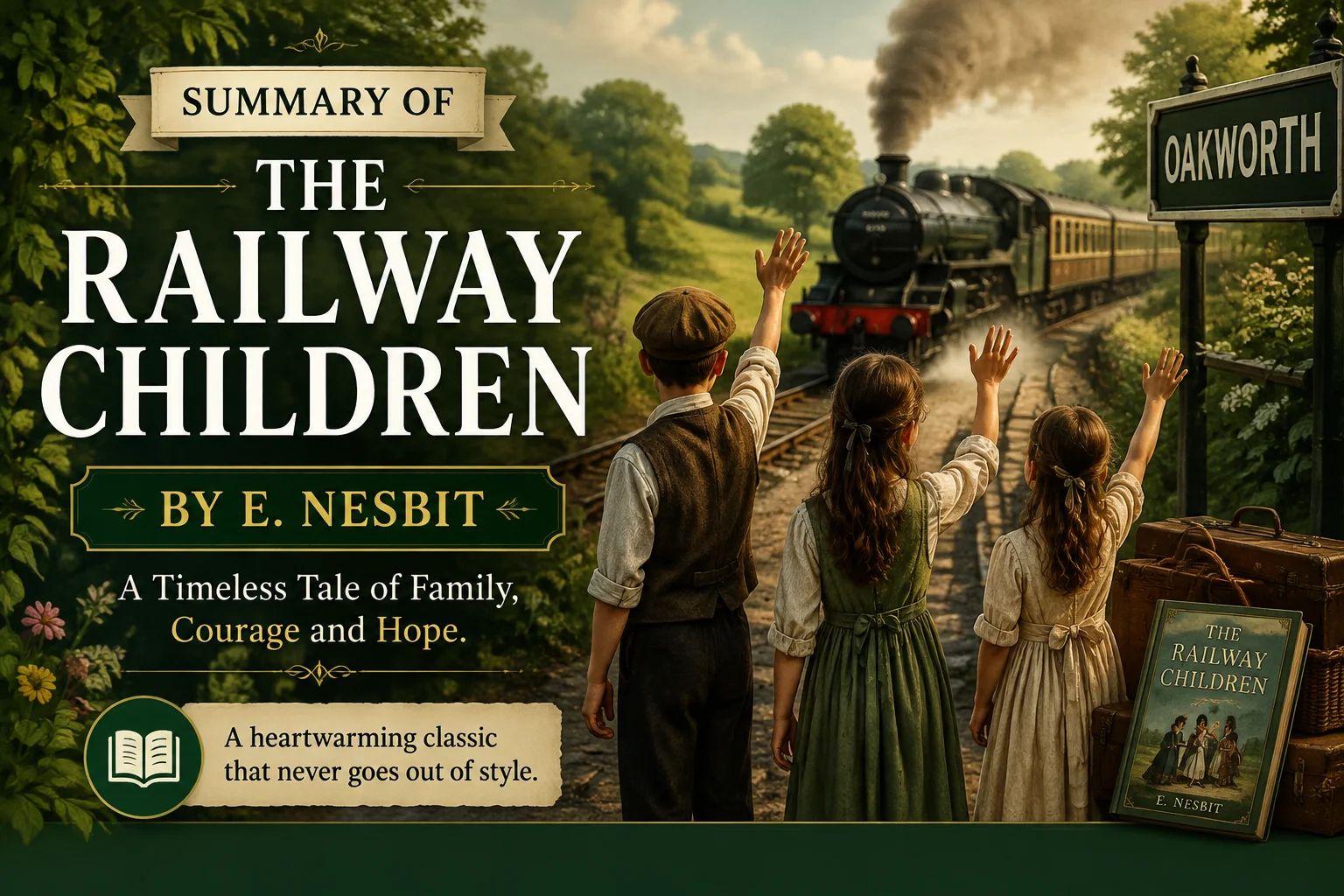
Summary of The Railway Children by E. Nesbit
The Railway Children, written by E. Nesbit and first published in 1906, is a beloved children’s novel about three siblings—Roberta, Peter, and Phyllis—whose comfortable life changes suddenly when their father disappears. Forced to leave their London home and move with their mother to a small house near a railway line, the children gradually adjust to their new circumstances.
Although they face financial difficulties and uncertainty, the children find happiness through friendship, kindness, adventure, and helping others. Their lives become closely connected with the railway and the people who travel along it. Through their experiences, they learn important lessons about generosity, courage, loyalty, patience, and compassion.
At its heart, the novel is a story about family and hope. It shows how children can remain optimistic during difficult circumstances and how small acts of kindness can have a lasting effect on other people’s lives.
The Children’s Happy Life in London
The story begins with Roberta, Peter, and Phyllis living comfortably with their parents in a pleasant London home. Their father is loving and respected, and the children enjoy a happy family life.
Roberta, usually called Bobbie, is the eldest. She is thoughtful, responsible, and sensitive. Peter is adventurous and confident, while Phyllis is cheerful, energetic, and sometimes impulsive.
The children have everything they need and spend their days playing together and enjoying their father’s company. They do not yet understand the financial and social difficulties that exist outside their comfortable home.
Their peaceful life changes suddenly when their father is taken away.
The Father’s Disappearance
One evening, the children’s father leaves home unexpectedly and does not return.
The children are not initially told the full truth. Their mother explains that their father has gone away and that they must leave London.
The family moves to a modest house called Three Chimneys in the countryside.
The children are confused and unhappy because they do not understand why their father is absent. Their mother also refuses to explain everything, choosing to protect them from painful information.
The sudden change teaches the children that life can change without warning.
Moving to Three Chimneys
Three Chimneys is a simple house located near a railway line.
At first, the children are disappointed by their new home. They miss their father and their previous lifestyle. However, they soon discover that the countryside provides opportunities for exploration and adventure.
The railway becomes one of the most important parts of their new life.
The children watch trains passing every day and begin waving to passengers. Eventually, some passengers notice them and begin waving back.
The railway becomes a source of excitement and connection with the outside world.
The Children’s Friendship with the Old Gentleman
The children eventually notice an elderly gentleman who regularly travels on the railway.
He often sits in a train carriage and reads a newspaper while passing their home.
The children begin waving to him, and he becomes familiar with them.
Although they do not know his name, they think of him as the “Old Gentleman.”
This simple relationship becomes important because the Old Gentleman eventually becomes connected with several important events in the children’s lives.
The children’s friendliness and natural kindness help create a bond with someone they initially know only from a distance.
The Railway as Part of Their Lives
The railway provides the children with constant opportunities for adventure.
They watch trains arrive and depart, learn about railway signals, and become interested in the workers who keep the railway operating.
They also learn to recognize different trains and develop relationships with railway workers.
The railway represents more than transportation. It becomes a symbol of connection between the children and the wider world.
Although their father is absent, the railway continually brings new people and experiences into their lives.
Peter’s Coal Incident
Peter becomes interested in the railway and decides that he would like to help the family financially.
He believes that selling coal might provide some money.
Peter’s plan does not work exactly as he expects, and the children become involved in an adventure involving railway materials.
Although Peter’s intentions are good, the incident teaches the children that good intentions do not always lead to good decisions.
Their experiences help them become more responsible and thoughtful.
Helping the Russian Gentleman
One of the most memorable episodes occurs when the children encounter a foreign gentleman who is unable to communicate easily in English.
The children discover that he is ill and needs help.
They become determined to assist him.
Eventually, they learn that he is a Russian exile named Mr. Szczepansky, who is searching for his family.
The children show him kindness even though he is a stranger.
Their actions demonstrate one of the novel’s central themes: compassion should not depend on someone’s wealth, nationality, or social position.
The Children’s Courage
The children frequently find themselves in situations where they must act bravely.
They do not have the resources or authority of adults, but they use their intelligence, determination, and teamwork to solve problems.
Bobbie, in particular, becomes increasingly responsible.
Although she is still a child, she often thinks about her mother’s well-being and tries to protect her younger brother and sister.
The children’s courage is not presented as fearlessness. Instead, they often feel frightened but choose to help anyway.
The Train Accident
One of the most dramatic moments occurs when the children discover that a landslide has created a dangerous situation near the railway.
They realize that a train could be approaching the dangerous section of track.
The children immediately understand that they must warn the train.
They use red flags to signal danger and run toward the railway.
Their quick thinking and courage help prevent a serious accident.
The event demonstrates that children can make an important difference when they recognize a problem and act decisively.
Bobbie and the Old Gentleman
Bobbie gradually develops a particularly important relationship with the Old Gentleman.
She discovers that he is kind and generous and that he is willing to help people in need.
The children eventually tell him about their family’s difficulties.
The Old Gentleman becomes interested in their situation and begins helping their mother.
His kindness provides the family with support during a difficult period.
The children’s earlier friendliness toward him eventually leads to a meaningful relationship.
The Children’s Mother
The children’s mother is an important figure throughout the story.
After the father’s disappearance, she must support the family while raising three children.
She writes stories and other material to earn money, but the family remains financially insecure.
The children gradually realize that their mother is struggling.
Instead of demanding things from her, they begin trying to help.
Their growing awareness of their mother’s difficulties demonstrates their emotional maturity.
Jim and the Tunnel
Another important adventure involves Jim, a young boy who becomes trapped in a railway tunnel.
The children discover that Jim has been injured.
They seek help and do everything they can to make sure he receives assistance.
The incident reinforces the children’s willingness to help people in danger.
It also demonstrates the importance of cooperation. The children cannot solve every problem themselves, but they know when they need to seek help from adults.
The Children’s Growing Responsibility
As the story continues, Roberta, Peter, and Phyllis become more mature.
At the beginning, they are mostly concerned with games and adventures.
After their father’s disappearance, they gradually become aware of money, illness, work, responsibility, and the difficulties faced by their mother.
They begin thinking about how their actions affect other people.
Their experiences teach them that being helpful does not require wealth or authority.
Sometimes a small action—such as giving food, warning someone about danger, or offering friendship—can make a major difference.
The Mystery of the Father
Throughout much of the novel, the children remain uncertain about what happened to their father.
Their mother knows more than she tells them, but she tries to protect them from the truth.
Bobbie eventually becomes determined to understand what happened.
She continues to hope that her father will return.
The mystery creates an emotional thread that continues throughout the story.
Despite the uncertainty, the children refuse to give up hope.
Bobbie’s Discovery
Eventually, Bobbie learns important information about her father’s situation.
She discovers that he has not abandoned the family.
Instead, he has been imprisoned because of a misunderstanding and circumstances beyond the children’s understanding.
This revelation changes the family’s situation.
Bobbie realizes that her father has not forgotten them and that the separation has not been his choice.
Her discovery brings both sadness and hope.
The Old Gentleman’s Help
The Old Gentleman plays an important role in helping resolve the family’s difficulties.
Because of his connections and willingness to investigate, he is able to discover information about the children’s father.
His actions help bring the truth to light.
The children learn that kindness shown to strangers can eventually create unexpected relationships and opportunities.
The Old Gentleman becomes an example of generosity and compassion.
The Father’s Return
The story eventually reaches its emotional conclusion when the children’s father returns.
The children have spent a long time waiting for him, and his return is a moment of great happiness.
Bobbie, especially, has never stopped hoping that her father would come home.
The reunion restores the family and brings an end to the uncertainty that has shaped their lives.
The children’s difficult experiences have changed them, however.
They are no longer the same carefree children who lived in London at the beginning of the story.
Themes of Family and Love
Family is one of the strongest themes in The Railway Children.
Although the children’s father is absent for much of the story, the family remains united.
The children support their mother and one another during difficult times.
Their experiences demonstrate that family relationships can provide strength during periods of uncertainty.
The novel also shows that love does not disappear simply because people are separated.
The children continue to love and remember their father throughout his absence.
Kindness and Generosity
Another central theme is kindness.
The children repeatedly help people who need assistance.
They do not expect financial rewards for their actions.
Their generosity includes helping strangers, comforting people, sharing what they have, and responding quickly when someone is in danger.
The novel suggests that kindness can create connections between people who would otherwise never meet.
Courage and Responsibility
The children learn that courage often means taking action despite fear.
Their experiences around the railway require them to make decisions quickly and responsibly.
Bobbie’s character develops particularly strongly because she becomes increasingly aware of her family’s problems.
The novel shows children becoming more responsible through real-life experiences rather than simply being told what to do.
Hope During Difficult Times
Despite their father’s disappearance and financial difficulties, the children remain hopeful.
They find happiness in simple things: watching trains, exploring the countryside, making friends, helping others, and spending time together.
Their optimism helps them cope with uncertainty.
The story therefore presents hope as an important source of strength.
Conclusion
The Railway Children is a heartwarming story about family, friendship, courage, kindness, and hope.
Roberta, Peter, and Phyllis begin the novel as children living a comfortable life in London. When their father suddenly disappears, their family is forced to move to the countryside and live a much simpler life.
At first, the children struggle to understand what has happened. However, their new surroundings introduce them to the railway and to a variety of people who become important parts of their lives.
Through their adventures, the children learn to become more responsible and compassionate. They help strangers, assist people in danger, form friendships, and discover that even children can make a meaningful difference.
Their relationship with the Old Gentleman becomes particularly important, eventually helping reveal the truth about their father’s situation.
The return of their father provides the story with a joyful conclusion, but the children have changed during their time apart from him. They have learned that happiness does not depend entirely on wealth or comfort. Friendship, family, kindness, courage, and hope can provide strength even during difficult circumstances.
Ultimately, The Railway Children reminds readers that difficult situations can bring unexpected opportunities for growth. The children discover that helping others can bring happiness, and that small acts of courage and kindness can have consequences far beyond what they expect.
The novel remains a beloved children's classic because its themes are simple and enduring: love your family, help others when you can, remain hopeful during difficult times, and treat people with kindness and compassion. (Project Gutenberg )

We help authors bring their stories to life through professional online book publishing services. From manuscript formatting and cover design to Amazon KDP publishing and global distribution, we make self-publishing simple, affordable, and successful.
