
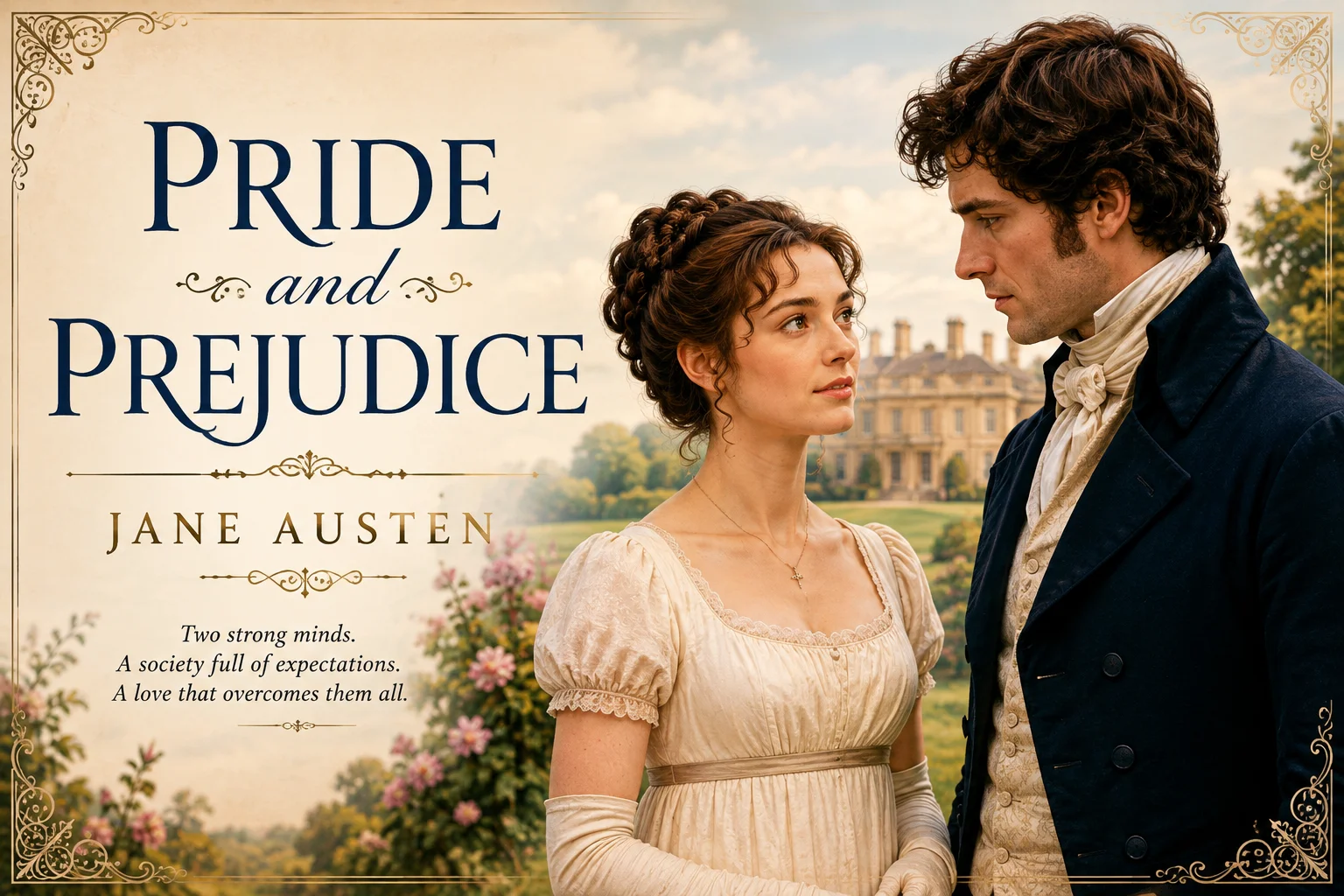
Summary of Pride and Prejudice by Jane Austen
Pride and Prejudice, written by Jane Austen and first published in 1813, is one of the best-known novels of English literature. The story centers on Elizabeth Bennet, the second of five daughters in the Bennet family, and Fitzwilliam Darcy, a wealthy and socially respected gentleman. Their relationship develops through misunderstandings, social expectations, family difficulties, and personal growth. At its heart, the novel explores love, marriage, class, reputation, pride, prejudice, and the danger of judging people too quickly.
The Bennet Family and the Importance of Marriage
The story begins in the English countryside, where Mr. and Mrs. Bennet live at Longbourn with their five daughters: Jane, Elizabeth, Mary, Kitty, and Lydia. The family has a serious financial problem. Their estate is legally tied to a male heir, meaning that after Mr. Bennet’s death, Longbourn will pass to his cousin, Mr. Collins, rather than to one of his daughters. Because the daughters cannot inherit the family estate, their future security depends largely on marriage.
Mrs. Bennet is extremely anxious to see her daughters married. Her greatest excitement comes when she learns that a wealthy young bachelor named Charles Bingley has rented Netherfield Park, a nearby estate. She immediately hopes that he will marry one of her daughters. Her obsession with marriage provides much of the novel’s comedy, but it also reflects the difficult position of women in Austen’s society. For women with limited money and no independent inheritance, a financially secure marriage could be essential for their future.
Mr. Bingley soon attends a public ball with his friend Mr. Darcy. Bingley is friendly, cheerful, and approachable, while Darcy is wealthy, reserved, and proud. Bingley immediately takes an interest in Jane Bennet, the eldest Bennet daughter, who is beautiful, gentle, and kind. Darcy, however, makes a poor first impression. When he refuses to dance with Elizabeth, saying that she is not attractive enough to interest him, Elizabeth overhears his comment. She is amused rather than deeply hurt, but from that moment she develops a strong dislike for him.
This first meeting establishes the central conflict of the novel. Darcy’s pride makes him appear arrogant and superior, while Elizabeth’s first impression of him creates a prejudice that prevents her from seeing his true character.
Elizabeth and Darcy
Elizabeth Bennet is intelligent, independent-minded, witty, and confident in expressing her opinions. Unlike her mother, she does not want to marry simply because a man is wealthy. She wants a marriage based on genuine affection and respect.
As Elizabeth and Darcy meet repeatedly, their feelings become increasingly complicated. Darcy gradually becomes attracted to Elizabeth because of her intelligence, humor, liveliness, and independence. Elizabeth, however, continues to believe that Darcy is arrogant and unpleasant.
At the same time, Elizabeth meets George Wickham, a handsome young officer. Wickham is charming and immediately gains Elizabeth’s sympathy. He tells her that Darcy treated him cruelly and deprived him of an opportunity that Darcy’s father had promised him. Elizabeth believes Wickham’s story because it agrees with her existing opinion of Darcy. Her prejudice therefore becomes even stronger.
Meanwhile, Jane and Bingley grow closer. Bingley clearly admires Jane, and Jane returns his feelings. Jane, however, is naturally reserved and does not openly express her emotions. Darcy interprets her behavior as a lack of genuine interest in Bingley.
When Jane becomes ill after traveling to Netherfield, Elizabeth walks several miles through muddy roads to care for her. She stays at Netherfield for several days, where Darcy’s attraction to her becomes stronger. Caroline Bingley, Bingley’s sister, is jealous of Elizabeth because she hopes to marry Darcy herself. She therefore treats Elizabeth with condescension.
The relationship between Jane and Bingley appears promising, but problems soon arise.
Mr. Collins and Charlotte Lucas
Another important character enters the story: Mr. Collins, a distant cousin of Mr. Bennet. Because of the inheritance laws, Mr. Collins will inherit Longbourn after Mr. Bennet’s death.
Mr. Collins is pompous, foolish, and obsessed with pleasing his wealthy patron, Lady Catherine de Bourgh. He decides that marrying one of the Bennet daughters would be appropriate. He first chooses Elizabeth and proposes to her.
Elizabeth firmly rejects him. Her mother is furious because she believes Elizabeth has thrown away an important opportunity. Mr. Bennet, however, supports Elizabeth’s decision.
After Elizabeth rejects Mr. Collins, he quickly proposes to Elizabeth’s friend Charlotte Lucas. Surprisingly, Charlotte accepts him.
Elizabeth is shocked because Charlotte does not love Mr. Collins. Charlotte explains that she is primarily concerned with obtaining financial security and a respectable home. She believes that marriage is necessary for a woman in her position.
This marriage provides an important contrast to the relationship Elizabeth eventually has with Darcy. Charlotte chooses security without romantic love, while Elizabeth refuses to sacrifice her happiness simply for financial advantage.
Jane’s Disappointment
Soon afterward, Bingley suddenly leaves Netherfield and returns to London. Jane is deeply disappointed. Caroline Bingley also makes it clear that the family does not expect Bingley to marry Jane.
Elizabeth becomes convinced that Darcy is responsible for separating Jane and Bingley. Her dislike of Darcy becomes even stronger.
Elizabeth later visits Charlotte, who is now married to Mr. Collins and living in Kent. There she meets Lady Catherine de Bourgh, Darcy’s wealthy and controlling aunt. Lady Catherine is extremely proud of her social position and believes that people from lower social backgrounds should know their place.
Darcy is also visiting his aunt. Elizabeth repeatedly encounters him, and Darcy’s feelings for her become impossible for him to ignore.
Darcy’s First Proposal
Eventually, Darcy makes an unexpected marriage proposal to Elizabeth.
His proposal is not romantic in the way Elizabeth expects. Although he tells her that he loves her, he also emphasizes the social obstacles he has had to overcome because of her family and social position. Elizabeth is offended.
She rejects him.
Elizabeth tells Darcy that she could never marry a man whom she considers arrogant and selfish. She accuses him of separating Jane from Bingley and of treating Wickham unfairly.
Darcy is deeply affected by her rejection.
The next day, he gives Elizabeth a letter explaining the truth behind the two accusations. He admits that he encouraged Bingley to leave Jane because he believed Jane did not genuinely care for him and because he was concerned about the Bennet family’s behavior. However, he also explains the truth about Wickham.
Elizabeth discovers that Wickham has lied to her.
Darcy’s father had treated Wickham generously, but Wickham wasted opportunities and behaved irresponsibly. He later attempted to elope with Darcy’s young sister, Georgiana, largely because of her fortune. Darcy had protected his sister from Wickham’s intentions.
Elizabeth is shocked by these revelations. She begins to realize that she has been wrong about Darcy.
Her change of opinion is one of the most important turning points in the novel. She recognizes that she allowed her dislike of Darcy to influence her judgment and that she trusted Wickham simply because his personality was pleasant.
Elizabeth Visits Pemberley
Later, Elizabeth travels through Derbyshire with her aunt and uncle, Mr. and Mrs. Gardiner. During the trip, they visit Pemberley, Darcy’s magnificent estate.
Elizabeth initially agrees to visit because she believes Darcy is away. However, Darcy unexpectedly returns.
Elizabeth is surprised by his behavior. Instead of being rude or arrogant, Darcy is polite, generous, and respectful toward Elizabeth and her relatives. She also hears positive things about him from his housekeeper, who describes him as a kind and responsible master.
Elizabeth begins to see Darcy in a completely different way.
She realizes that the man she believed to be proud and cruel is capable of generosity and genuine affection. She also starts to regret rejecting his first proposal.
At this point, however, a terrible event threatens the Bennet family.
Lydia and Wickham
Elizabeth receives news that her youngest sister, Lydia, has run away with Wickham.
Lydia is young, immature, and careless. She has followed Wickham because she believes that he loves her. However, Wickham has no intention of marrying her. Lydia’s behavior threatens the reputation of the entire Bennet family because an unmarried woman running away with a man would create a serious social scandal.
Mr. Bennet travels to London to search for Lydia and Wickham but is unsuccessful. The family’s situation appears hopeless.
Eventually, Mr. Gardiner finds the couple. Wickham agrees to marry Lydia, but only after his debts and financial difficulties are dealt with.
The Bennets assume that Mr. Gardiner has paid the necessary money.
Later, however, Elizabeth discovers the truth: Darcy was responsible.
Darcy had secretly found Wickham, paid his debts, arranged financial assistance, and ensured that he married Lydia. He did this because he loved Elizabeth and wanted to protect her family from disgrace.
Elizabeth is deeply moved. Darcy’s actions prove that he is not the selfish and heartless man she once believed him to be.
Jane and Bingley Reunite
After Lydia’s marriage, Bingley returns to Netherfield with Darcy.
Bingley still loves Jane, and this time he proposes to her. Jane happily accepts.
Their relationship is a contrast to Elizabeth and Darcy’s. Jane and Bingley are naturally affectionate and good-natured, but they are easily influenced by other people. Darcy had separated them because he believed Jane did not love Bingley, while Bingley’s sisters also opposed the match.
Eventually, however, their genuine affection survives these obstacles.
Jane’s engagement brings great happiness to the Bennet family.
Lady Catherine’s Intervention
Lady Catherine de Bourgh soon learns that Darcy may intend to marry Elizabeth. She considers such a marriage completely unacceptable because Elizabeth’s family is socially inferior to Darcy’s.
Lady Catherine visits Elizabeth and demands that she promise never to marry Darcy.
Elizabeth refuses.
She explains that she is not engaged to Darcy, but she will not promise to reject him simply to satisfy Lady Catherine. Elizabeth’s refusal demonstrates how much she has changed. She is no longer willing to allow social pressure or another person’s authority to control her decisions.
Lady Catherine’s confrontation indirectly helps Elizabeth. When she tells Darcy about Lady Catherine’s visit, Darcy realizes that Elizabeth’s feelings toward him may have changed.
Darcy and Elizabeth’s Second Proposal
Darcy and Elizabeth finally meet again and discuss their feelings.
Darcy tells Elizabeth that his feelings for her have not changed. Elizabeth, having learned the truth about his character and having recognized her own mistakes, accepts his proposal.
The two are now able to marry because they have overcome the personal flaws that initially separated them.
Darcy has learned to control his pride and become more open, generous, and respectful. Elizabeth has learned that intelligence and confidence do not make a person immune to prejudice. She realizes that she judged Darcy too quickly and trusted appearances without sufficient evidence.
Their relationship therefore becomes a partnership based on mutual respect and understanding rather than wealth or social convenience.
Conclusion
For read public domain book visit us
At the end of Pride and Prejudice, Jane marries Bingley and Elizabeth marries Darcy. The marriages provide the happy conclusion expected of a romantic novel, but Austen’s message goes much deeper than simply finding a wealthy husband.
The novel shows that marriage should ideally involve love, respect, understanding, and compatibility. Through Charlotte’s marriage to Mr. Collins, Austen shows the limitations of marrying only for security. Through Lydia’s relationship with Wickham, she demonstrates the dangers of impulsive attraction without judgment or responsibility. Through Jane and Bingley, she presents a loving relationship that is threatened by outside interference. Finally, through Elizabeth and Darcy, she presents a relationship in which both individuals must change before they can truly be happy together.
The title Pride and Prejudice refers particularly to Darcy and Elizabeth. Darcy’s pride initially causes him to look down on Elizabeth’s family and behave arrogantly toward her. Elizabeth’s prejudice causes her to interpret Darcy’s actions unfairly and believe Wickham’s false story. Both characters must overcome these weaknesses.
Elizabeth’s greatest lesson is that first impressions can be misleading. A charming appearance does not necessarily indicate a good character, while an unpleasant first impression does not necessarily reveal someone’s true nature. Darcy, meanwhile, learns that wealth, education, and social position do not give a person the right to treat others with arrogance.
The novel also provides a sharp picture of early nineteenth-century English society. Women with limited wealth had few opportunities to secure their futures independently, making marriage an important economic and social issue. Austen uses characters such as Mrs. Bennet, Mr. Collins, Lady Catherine, Wickham, and Lydia to humorously expose vanity, foolishness, social prejudice, and selfishness. At the same time, she gives Elizabeth a strong voice and allows her to insist on marrying for genuine affection rather than simply accepting the safest financial opportunity. (
Ultimately, Pride and Prejudice is a story about learning to understand other people—and oneself. Elizabeth and Darcy begin their relationship with mutual dislike because both judge each other incorrectly. Through painful experiences and honest self-reflection, they gradually recognize their own mistakes. Their eventual marriage represents not merely the triumph of romance, but the reward for personal growth, humility, and mutual respect.
Jane Austen’s novel remains powerful because its central ideas are still recognizable. People can be influenced by first impressions, social status, reputation, and appearances. They can misunderstand others and become attached to opinions that are difficult to change. Pride and Prejudice reminds readers that genuine understanding requires looking beyond appearances and being willing to admit when one’s judgment has been wrong. (Project Gutenberg)

We help authors bring their stories to life through professional online book publishing services. From manuscript formatting and cover design to Amazon KDP publishing and global distribution, we make self-publishing simple, affordable, and successful.
