
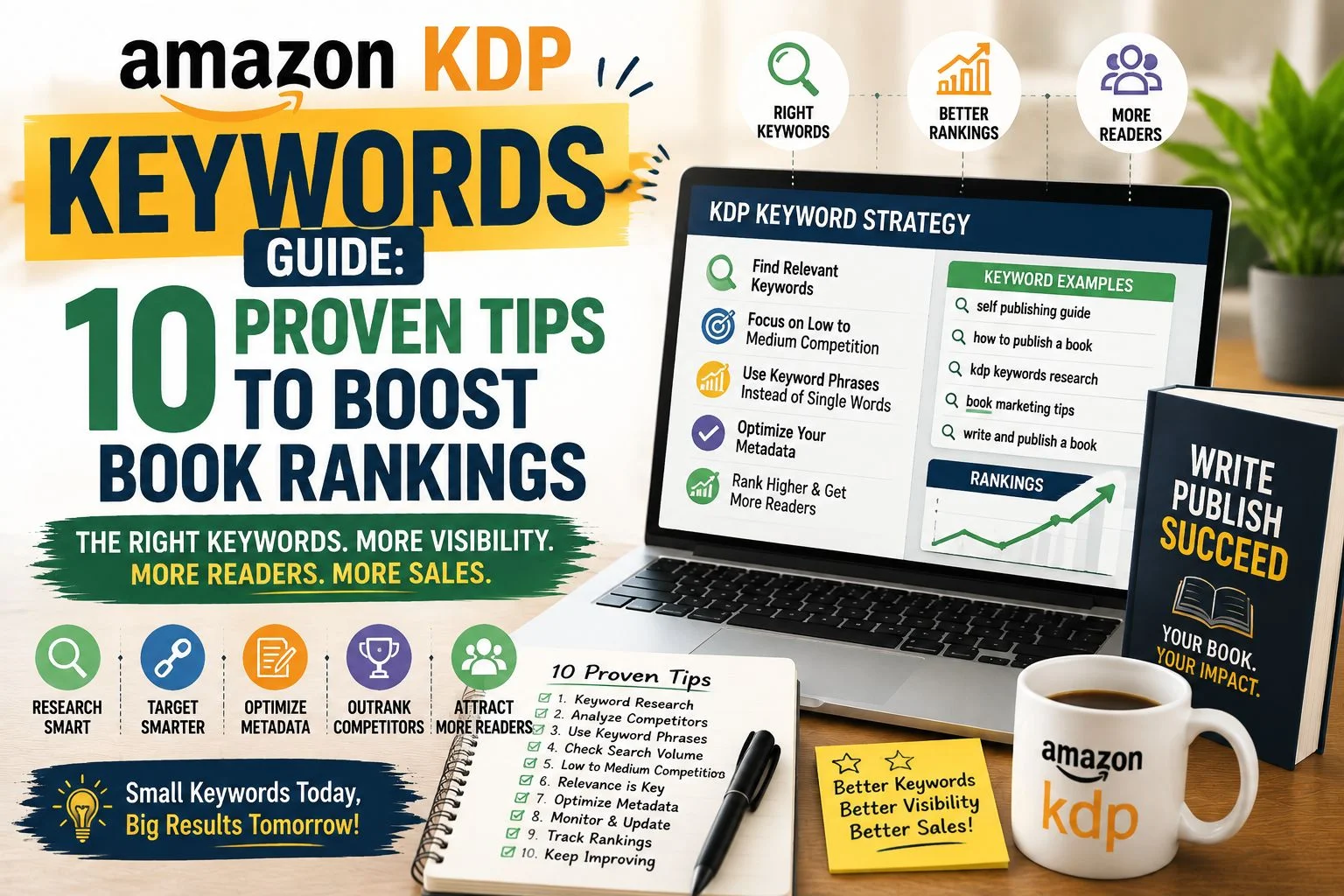
Amazon KDP Keywords Guide: 10 Proven Tips to Boost Book Rankings
Introduction: Why KDP Keywords Matter for Your Book Success
It’s easier than ever to publish a book on Amazon today. Finding readers for your book, however, can still be a challenge. Thousands of new books appear on Amazon every day. Even the best of books can remain undiscovered if a proper strategy is not implemented.
This is where having a good KDP Keywords Guide can help authors. Keywords are used to let Amazon know what your book is about. They also help readers find your book in search results when they are looking for topics, solutions, or stories.
Many new authors only consider the nuts and bolts of writing a great book. Quality of writing is crucial, but so is the discovery of it. People can’t buy a book if it’s not seen. The right keywords establish a link between your book and your target audience.
Amazon is similar to a search engine. Users enter a word in the search box. Amazon then displays books that correspond to those searches. This process is connected with Amazon SEO and proper keyword optimization.
By choosing keywords wisely, you can boost your chances of book visibility in search results. It can also help Amazon categorize your book. This guide will outline some practical approaches that authors could pursue today.
Keywords are important in publishing fiction, nonfiction, journals, and children’s books. If you use the right method, you can get your book read by more potential readers.
What Are KDP Keywords and Why Are They Important?
KDP keywords are words or phrases that describe your book’s main topics. These keywords are placed in the writer’s Amazon KDP publishing panel. These terms aid Amazon in understanding your content.
Amazon is doing a search when readers are searching for something, Amazon compares the readers’ search words with book information. This includes your title, subtitle, description, categories, and keyword fields.
Suppose you wrote a first-time gardening book, for instance. Readers can search:
- beginner gardening tips
- home vegetable garden
- organic gardening guide
These phrases may turn into advantageous Book Keywords for your publication.
A great KDP Keywords Guide educates writers about the fact that KDP keywords are not random words. This should match what readers are actually looking for.
When choosing keywords, many authors get it wrong by picking the keywords that they think. But profitable keyword research is all about the reader.
Put audience first.
Ask yourself:
- What problem does my book solve?
- What words would readers type?
- What are the three words that capture my book?
- What topics are connected to my content?
These questions can be used to help build better keywords.
Tip 1: Understand Your Ideal Reader Before Choosing Keywords
Research Your Audience First
The first step to choosing keywords is to get a feel for your readers. There are many authors who start keyword research too early. They select words that sound like they make sense, but don’t necessarily reflect what people are looking for.
Effective writers are buyers!
Suppose you have to look for your own book. What would you search for on Amazon?
For instance, meditation is an example of this, and a book on meditation might include:
- meditation for beginners
- stress relief meditation
- mindfulness exercises
The following phrases are reader needs.
The first and most important step in creating a strong KDP Keywords Guide is conducting audience research. Knowing your reader will allow you to make more informed keyword selections.
Language is important to your audience. Professional terms are not allowed for readers. Usually, they use simple phrases to search.
For example:
A fitness profile can be written by a fitness expert.
“cardiovascular training program”
A novice reader can look up:
This will outline a series of easy workouts you can do at home.
The second sentence might yield better results since it is representative of actual queries.
Find Problems Your Book Solves

All good books have value. Your keywords should convey that value.
Readers are typically looking for something.
They may want:
- Information
- Entertainment
- Advice
- Inspiration
- Solutions
These needs should relate to your keywords.
For example:
A parenting book could address issues such as:
- toddler discipline tips
- positive parenting guide
Parents’ tips for new parents
A finance book may be aimed at:
- money saving tips
- beginner investing guide
- personal finance basics
Here are some Book Keywords that focus on the reader.
Don’t forget that keywords aren’t just about your book subject; they’re about your readers.
Tip 2: Use Amazon Search Suggestions for Keyword Ideas
Explore Amazon Autocomplete
One of the best free keyword research tools is Amazon’s search bar.
If you type in a word to Amazon, it can make suggestions about popular searches.
These are ideas based on actual customer searches.
For example, type:
“children books”
Amazon may suggest:
- kindness children’s books
- Children’s Book for babies
- children books ages 5-7
These tips can give you some great keyword suggestions.
Amazon auto-complete research is always included in a detailed KDP Keywords Guide as it provides real customer interest.
There is no need to use expensive tools in the beginning. Amazon offers informative information.
Create Long-Tail Keywords
Long-tail keywords are longer search terms. Typically, they are three words or longer.
Examples:
Short keyword:
- Cooking
Long-tail keyword:
- Easy Air Fryer Recipes for Newbies
Short keywords tend to be more competitive. Long-tail keywords can bring in more specific visitors.
Long-tail Book Keywords can be easier to compete for for new authors.
They are also more likely to have a buying intention.
A reader looking for:
“fantasy”
may only browse.
A reader who is looking for:
“dark fantasy romance e-book”
may have an idea of what they are looking for.
The difference here is crucial for Kindle SEO.
Tip 3: Choose Keywords Based on Search Intent
Understand What Readers Want
To grasp the purpose behind a search is what search intent is.
All keywords are not equal.
Help authors choose the right keywords with the aid of a useful KDP Keywords Guide.
Using the wrong keywords can attract visitors who don’t purchase your book.
Right keywords attract readers who are interested.
Match Keywords With Your Book Content

Amazon values relevance. Your keywords should accurately describe your book.
Don’t include common words unrelated to the material.
For example:
A romance novel should NOT contain:
- business success
- weight loss
- investing tips
Because those are the topics that are popular.
Spamming irrelevant keywords can lead to Amazon’s system getting confused.
The key to achieving good Amazon SEO is to ensure that it is accurate and satisfies the reader.
Your keywords should make a clear message about your book.
Advanced Keyword Research Strategies for Better Visibility
Popular words are not the only way to pick keywords. Successful writers know about the competition, reader dynamics, and search trends. A good KDP Keywords Guide will assist you in making sensible choices prior to publishing your book.
There are many writers who take months to write their books. They only take a few minutes to select keywords, though. This can limit their access to the right audience.
Your keyword strategy should be just as carefully thought out as your cover, title, and description. Well-chosen keywords are more discoverable. They assist Amazon in linking your book to readers who are interested in it.
In this part, we will discuss some of the more sophisticated techniques. These methods can help improve your Amazon SEO strategy. They can also help with increased visibility with Kindle SEO techniques.
Tip 4: Find Low Competition Keywords
Why Competition Matters for KDP Keywords
There’s one mistake that many authors make. These are the words they select on the basis of very high monthly search volume.
It seems like a good thing to have a high search volume. These keywords typically are highly competitive, however.
For example:
“healthy recipes”
There are a lot of books that are in competition to have.
It may be difficult for a newer author to get noticed.
You might want to use a more specific keyword:
Healthy Air Fryer Recipes for Seniors.
This phrase has a smaller audience because it is not as popular. Those readers are more targeted, though.
The Complete KDP Keywords Guide is a course for authors that will help them understand how to find the balance between demand and competition.
It’s not always about the largest keyword.
The objective is to determine the proper keyword.
Focus on Low to Medium Competition Phrases

New authors have a better chance of getting a larger proportion of low-competition keywords.
These keywords usually have:
- Specific reader interest
- Less competition
- Better matching audiences
- Higher purchase intent
Examples:
Broad keyword:
- Fitness
Better keyword:
Fitness program for novice people at home. Beginner’s fitness plan at home.
Broad keyword:
- Gardening
Better keyword:
For the very first time, learn the basics of organic vegetable gardening in this course.
Phrases are used that readers are looking for.
This will help in the selection of Book Keywords.
Analyze Competing Books
You can get ideas from books that are similar to it.
Look for your keyword on Amazon.
Look at:
- Book titles
- Subtitles
- Categories
- Descriptions
- Common phrases
Please do not plagiarize other writers.
Instead, understand patterns.
Ask yourself:
- Which words appear often?
- What are readers’ interests?
What are some words that describe books like the one you have?
This research can assist you with generating special keyword ideas.
Competitor analysis is used by many seasoned SEOs during the Amazon SEO process.
Tip 5: Use Keyword Research Tools for Better Results
Why Keyword Tools Can Help Authors
Amazon gives free keyword suggestions. There are other tools that can give more information, though.
Keyword tools can help you discover:
- Search popularity
- Competition level
- Related phrases
- Market trends
- Reader interests
There should be free and Paid Research Methods included in a detailed KDP Keywords Guide.
Using free research can be helpful to beginners.
Paid tools can help experienced publishers save time.
Popular Keyword Research Options
There are many different tools that authors use in order to find keywords.
Some options include:
- Amazon search suggestions
- Publisher Rocket
- Keyword research platforms
- Competitor analysis tools
These types of tools can aid in identifying potential Book Keywords.
But the tools should facilitate your research.
They should not be used as a substitute for readers’ understanding.
Do cross-check whether or not a keyword is suitable for your book.
Tip 6: Optimize Your Seven KDP Keyword Boxes
Understand the Seven Keyword Fields
Amazon KDP offers 7 keyword boxes when publishing.
With each box, authors are provided an opportunity to describe their book.
These spaces are lost by many beginners.
Repeat the same words over and over.
Instead, however, make the use of each field purposeful.
Using different combinations of keywords is recommended by a good KDP Keywords Guide.
For instance, rather than:
Box 1:
- dog training
Box 2:
- dog training
Box 3:
- dog training
Try:
Box 1:
Putting your puppy on the right path. How to do puppy training for beginners.
Box 2:
- Positive dog training techniques
Box 3:
- Easy puppy obedience guide
This provides Amazon with more data.
Use Keyword Phrases Instead of Single Words

Single words tend to be too general.
For example:
“love”
can have many meanings.
But:
Self Love Journal For Women.
has a definite connotation.
Longer phrases make it easier for Amazon to comprehend your content.
They also help to promote better Kindle SEO.
Typical phrases searched by readers are “natural search terms.
Your keywords need to reflect that.
Tip 7: Use Keywords Naturally in Your Book Metadata
What Is Book Metadata?
Metadata includes information that describes your book.
It includes:
- Title
- Subtitle
- Description
- Categories
- Author information
- Keywords
Great metadata can make the difference for Amazon to comprehend your publication.
All parts of your keyword strategy should be joined together.
A good KDP Keywords Guide will provide information about how metadata functions as a complete system.
Tip 8: Avoid Amazon Keyword Mistakes
Do Not Use Misleading Keywords
Other authors attempt to use popular keywords that are not related to the text.
This strategy can cause issues.
Avoid:
- Famous author names
- Competitor book titles
- Unrelated trending topics
- False claims
Your keywords need to be accurate and true to your book.
Amazon’s business is about the customer experience.
When it comes to long-term results, it’s important to have accurate keywords.
Avoid Excessive Keyword Stuffing
Keyword stuffing involves the excessive use of keywords.
This makes for poor reading experiences.
Your title and description should take on a human voice.
Readers purchase books from authors they feel good about.
Content is always, always first.
The balanced KDP Keywords Guide focuses on useful optimization.
Tip 9: Update Keywords After Publishing
Track Your Book Performance
As an editor, you should assume that keyword research doesn’t end once you’ve published.
Effective writers analyze their work.
They check:
- Sales changes
- Ranking movement
- Reader feedback
- Search visibility
If a keyword isn’t working, change it.
Using different keywords can help make it easier to find.
Create a Keyword Improvement Plan
A simple process:
Step 1:
Check the existing keywords.
Step 2:
Identify or create additional keywords.
Step 3:
Replace weak keywords.
Step 4:
Monitor changes.
Little adjustments will make for great outcomes in the long run.
This will make for better Kindle SEO.
Tip 10: Combine Keywords With Categories
Keywords and Categories Work Together
There are numerous writers who concentrate on keywords.
But it’s also important to have categories.
Categories enable Amazon to get your book in the right place.
The keywords help Amazon grasp search relevance.
When combined, they make for better visibility.
Your Metadata should be able to support both sides.
Choose Categories Carefully
The right category can help you rank.
Identify categories that:
- Match your topic
- Have interested readers
- Are not extremely competitive
Sometimes it is better to have a smaller category so that you get better visibility.
This is a good strategy to use along with smart Book Keywords.
Final Keyword Strategies, FAQs, and Expert Tips
Writing a book is just the first step in your author’s journey. The true challenge is to get your book noticed in a sea of thousands of books.
A good KDP Keywords Guide introduces authors to the concept that keyword research is a continuous effort.
Build a Long-Term KDP Keyword Strategy
Do Not Treat Keywords as a One-Time Task
Numerous authors select words prior to publishing. After that, they don’t go back to them.
This is a lost opportunity.
The places that readers look vary over time. New trends appear. Words of popular usage can change after several months.
A successful KDP Keywords Guide instructs authors to regularly analyze keywords.
You should analyze:
In which keywords do impressions happen? In which keywords do impressions occur?
- What are the keywords that drive sales
Identify the keywords that need replacing. List the words that must be changed.
- Which topics are growing
Optimizing for keywords is comparable to enhancing your marketing strategy.
The little things can make a big difference.
Test Different Keyword Combinations
You can get a feel for what’s working by conducting keyword testing.
Don’t have to do everything at once.
Test the substitution of some of the words.
Then watch the results!
For example:
Old keyword:
“healthy cooking”
New keyword:
Cooking that is easy and healthy. Easy healthy cooking recipes.
The second phrase might better correspond to reader searches.
Testing is an aid to the selection of your Book Keywords.
All books are unique.
One strategy that is successful for one author may not be successful for another.
Common KDP Keyword Mistakes Authors Should Avoid
Choosing Keywords Without Research
There are many people who start guessing keywords.
They select words that they like.
Readers might search differently, however.
Always do keyword research before choosing keywords.
While you’re entitled to have your opinion, reader behaviour is more important.
Using Extremely Broad Keywords
Longer keywords tend to be more competitive.
Examples:
- Business
- Health
- Love
- Success
These words are used for very large concepts.
Specific words and phrases generally work better.
Examples:
- how to market a small business for beginners
- healthy meal plans for families
Self- Love Journal Prompts
Targeted readers can be attracted by certain keywords.
Ignoring Reader Intent
The keyword should be as close as possible to what is sought by the readers.
For example:
“weight loss”
and
“low calorie diet for weight loss for beginners”
have different audiences.
In the second phrase, there is an obvious objective.
To choose the right keywords, it’s important to know what readers are looking for.
Final Thoughts: Create a Smarter Keyword Plan
The right keywords will enable Amazon to match your book with those who are interested in it.
This thorough guide to KDP Keywords, however, proves that keyword research doesn’t have to be complicated. It involves knowing readers, researching the competition, and making informed enhancements.
Remember these important points:
Do keyword research to choose keywords.
- Use reader-focused phrases.
- Use the right long-tail keywords.
- Avoid keyword stuffing.
- Make sure to review and refine your strategy often.
Use keyword phrases with good metadata.
Your keywords are a connection between your book and your audience.
If you select them wisely, your book will have improved prospects of being discovered in search results.
A well-planned keyword strategy, along with engaging content, can help with long-term growth on Amazon.
Continue learning and testing, and continue to refine your publishing process.
Your next reader could be looking for your book already.
Here are some frequently asked questions about Amazon KDP Keywords.
What are KDP Keywords?
KDP keywords are those words and phrases you use to describe your book’s topic, genre, and your target audience. They assist Amazon in grasping the content of your book and bring readers looking for similar content to your book.
What is the maximum number of keywords I can use for my KDP book?
Amazon KDP offers each book 7 fields of keywords. These spaces should be used intelligently, and the authors should include keywords or phrases rather than the same words over and over.
Are the keywords on KDP editable after publication?
Yes, you can update your KDP keywords even after publishing your book. There are lots of authors who look at and refine their keywords over time to identify better opportunities.
Are book rankings better with KDP Keywords?
Using the right keywords in your book can help it rank higher in Amazon search results. But there are other things that determine rankings, such as book quality, reviews, sales track, book categories, and reader engagement.
How To Create a Good KDP Keyword?
A good KDP keyword is relevant, specific, and related to reader searches. Long-tail keywords can be effective as they will appeal to readers who are interested in a specific topic.

We help authors bring their stories to life through professional online book publishing services. From manuscript formatting and cover design to Amazon KDP publishing and global distribution, we make self-publishing simple, affordable, and successful.
