How to Find a Publisher for Your Book: 7 Complete Tips
Many aspiring entrepreneurs wonder how to start a book publishing company.
As an author, one of the most crucial choices is finding the right publisher. From novels, children’s books, and memoirs to business books, knowing how to find a publisher for your book can determine how successfully your work reaches readers. There are thousands of publishers worldwide to choose from, and finding the right one takes research, preparation, and patience.
First-time authors often wonder what book publishing entails and what the publishing process is. In other words, book publishing involves taking a manuscript and making it into a book that’s printed and sold to readers in book stores, online vendors, libraries, and elsewhere. Publishers can be a valuable ally in an author’s career, providing editing services, cover design, printing, distribution, and sometimes marketing.
Many readers and bookstore owners also search for how to buy books wholesale from publishers to purchase books at discounted prices for resale or educational purposes.
Meanwhile, many aspiring entrepreneurs have a question about how to start a book publishing company, as they wish to help others publish their writings. It’s not just the author who can benefit from understanding how publishers work; it’s anyone who wants to get some insight into the publishing business.
This detailed booklet provides you with seven proven tips that will help you find a publisher for your book, steer clear of common pitfalls, get your work into a format suitable for a publisher, and increase your odds of being accepted by a reputable publisher.
Key Takeaways
To get the most out of the detailed steps, here are the most important lessons you’ll learn in this guide:
- Before sending your manuscript, gain an understanding of the workings of the publishing industry.
- Go through the publishers that specialize in the genre of books your book falls into.
- Compose a manuscript that is well edited and formatted.
- Write a persuasive query and book synopsis.
- If appropriate, enlist the services of a literary agent.
- Carefully adhere to each publisher’s guidelines for submission.
- Don’t get discouraged by rejection and keep trying to improve one’s submissions.
These rules can significantly increase your odds of finding a publisher for your book.
Interestingly, people researching how to start a book publishing company often discover that these production services form the foundation of a successful publishing business. Understanding what is book publishing is important before working with any publisher. The role of a book publisher is to cover the costs of books. A book publisher’s job is to pay for books.
What Does a Book Publisher Actually Do?

While many first-time authors are only concerned about writing, it’s essential to understand what book publishing is. A publisher is more than just a printer of books. They are in charge of the whole production process and make your manuscript a professional work that readers desire to purchase.
Understanding how publishers operate also helps explain how to buy books wholesale from publishers and establish long-term purchasing relationships.
How Publishers Help Authors
There are many reasons a professional publisher can help authors save time and money. When a manuscript is accepted, it is usually given to experienced editors to edit for grammar, sentence structure, pacing, consistency, readability, and to retain the author’s voice.
Designers edit and create an attractive cover that appeals to the target audience. Interior designers digitally format the manuscript for print and publication. Marketing experts can also help prepare promotions, press releases, reach out to reviewers, and encourage initial sales.
Publishers also print, distribute, register for ISBNs, optimize metadata, and get books onto the big online retailers and bookstores. The services enable authors to focus on the writing task and professionals to handle the technicalities of publishing.
What’s fascinating is that those who are reading about how to create a book publishing company find out that these production services are the backbone of a publishing venture.
Types of Books Publishers Accept
Each publisher has specific genres it is looking for, so it’s crucial that you get the right match.
These are some of the more common types of publication:
• Fiction
• Non-fiction
• Children’s books
• Self-help books
• Business books
• Cookbooks
• Academic books
• Religious books
• Memoirs
• Poetry
Thoroughly examine each publisher’s catalogue before sending your manuscript. Submitting a children’s picture book to them, since they mainly publish mystery novels, will probably be rejected.
In fact, Amulet Books publisher is well known for its kids’ books, middle-grade books, and young adult titles. Amulet Books publisher help authors to find out which companies are actively publishing books similar to their own. Learning what is book publishing helps authors choose the right publisher. Researching publishers by genre is also useful if you’re learning how to buy books wholesale from publishers for schools, libraries, or bookstores.
One of the most essential things that you can do to learn how to find a publisher for your book is to conduct thorough research on publishers.
What Publishers Expect From New Authors
There are thousands of other submissions to publishers every year, and the competition is fierce. In order to be noticed, you have to be professional from the start of your manuscript.
The following are some of the things most publishers search for:
- A polished manuscript
- Original ideas
- Strong storytelling
- Clear market potential
- Professional formatting
- Error-free writing
- An intriguing subject line
- A brief overview of the book.
They also determine if your book can be marketed. This involves knowing who your audience is, which similar books to recommend, and which marketing opportunities to pursue.
Once authors understand what book publishing entails, they can realize that publishers invest significant resources in each accepted book. As a result of this investment, they take the time to review each proposed submission before granting a publishing contract. Researching publishers carefully is one of the most important steps in learning how to find a publisher for your book.
Traditional Publishing vs Self-Publishing vs Hybrid Publishing

Choosing the right path for a publishing career is one of the greatest decisions that every author can make. When choosing how to find a publisher for your book, it is essential to understand the three main ways to publish a book today. Before deciding, many authors first understand what is book publishing in detail.
Traditional Publishing Explained
For many authors, traditional publishing is still a dream, since most production costs are borne by the publisher. Once you’ve submitted your book for publication, the publisher will typically edit the work, design the cover, print, distribute, and sometimes market it.
There are a number of things to consider in favor of traditional publishing:
- No advance publication fees
- Professional editorial team
- Industry credibility
- Wide bookstore distribution
- Potential advance payments
- Experienced marketing assistance
However, competition is extremely fierce. The acceptance rate is low, and it can take months or years to get published.
If you know what book publishing is, you’ll see why traditional publishers are quite picky.traditional publishers invest a lot of time and money in every book that is published.
Self-Publishing Explained
Self-publishing allows authors to control all aspects of the publication process. Amazon Kindle Direct Publishing (KDP) is one such platform that lets writers publish without getting a publisher’s approval.
Benefits include:
- Faster publication
- Higher royalty percentages
- Full creative control
- Flexible pricing
- Worldwide distribution
- The right to publish the work.
While a self-publishing path does involve the author in editing, designing the cover art, and formatting the book, or hiring professionals to do these tasks, it’s one of the fastest-growing paths for new authors.
Many individuals researching how to start a book publishing company first gain experience through self-publishing before launching their own publishing businesses.
Before starting their own publishing company, many people do so in a trial-and-error fashion by first publishing their own books.
Hybrid Publishing Explained
Hybrid publishing is a blend of traditional and self-publishing. In this arrangement, the author usually covers a portion of the publishing expenses while still enjoying professional services such as book design, editing, formatting, printing, distribution, and marketing assistance from the publisher.
The financial investment in hybrid publishers is distributed, making them generally more open to new authors than traditional publishers. That’s what makes hybrid publishing an appealing choice for writers who would like a professional guiding hand without waiting several years for a traditional publishing contract.
Be sure to check the reputation of any hybrid publisher, read reviews, explore previous books, and carefully read the contract before signing. A good hybrid publisher will communicate with you about pricing, royalties, copyright, and the services it provides.
Knowing what book publishing also involves knowing the difference between the two types of hybrid publishers and vanity presses. A vanity press makes money for the author more than the books; a reputable hybrid publisher will give you real publishing skills.
Which Publishing Method Is Best for You?

Deciding on a publishing approach involves considering your objectives, budget, and timeframe.
If you have a complex, detailed product, a large number of images or features, or a product that will be available for a long time.
You want to be known in your industry.
- You’re willing to wait for acceptance.
- You’d like professionals to handle the publishing process.
- You don’t want to ante up publishing costs.
Self-publishing might be a good choice if:
- You prefer to have absolute creative freedom.
- You want to publish quickly.
- You have a good grasp of marketing operations.
- You prefer to receive higher royalties.
Hybrid publishing might be suitable when:
- You’re looking for expert help.
- You’re willing to make an investment in your book.
- You are looking for a quicker publication than standard publishing.
- You would like to be more involved in making the creations.
Whether you decide how to find a publisher for your book or you’d prefer to opt for self-publishing, it’s crucial to have a clear idea of the publishing model that’s right for you for the long haul.
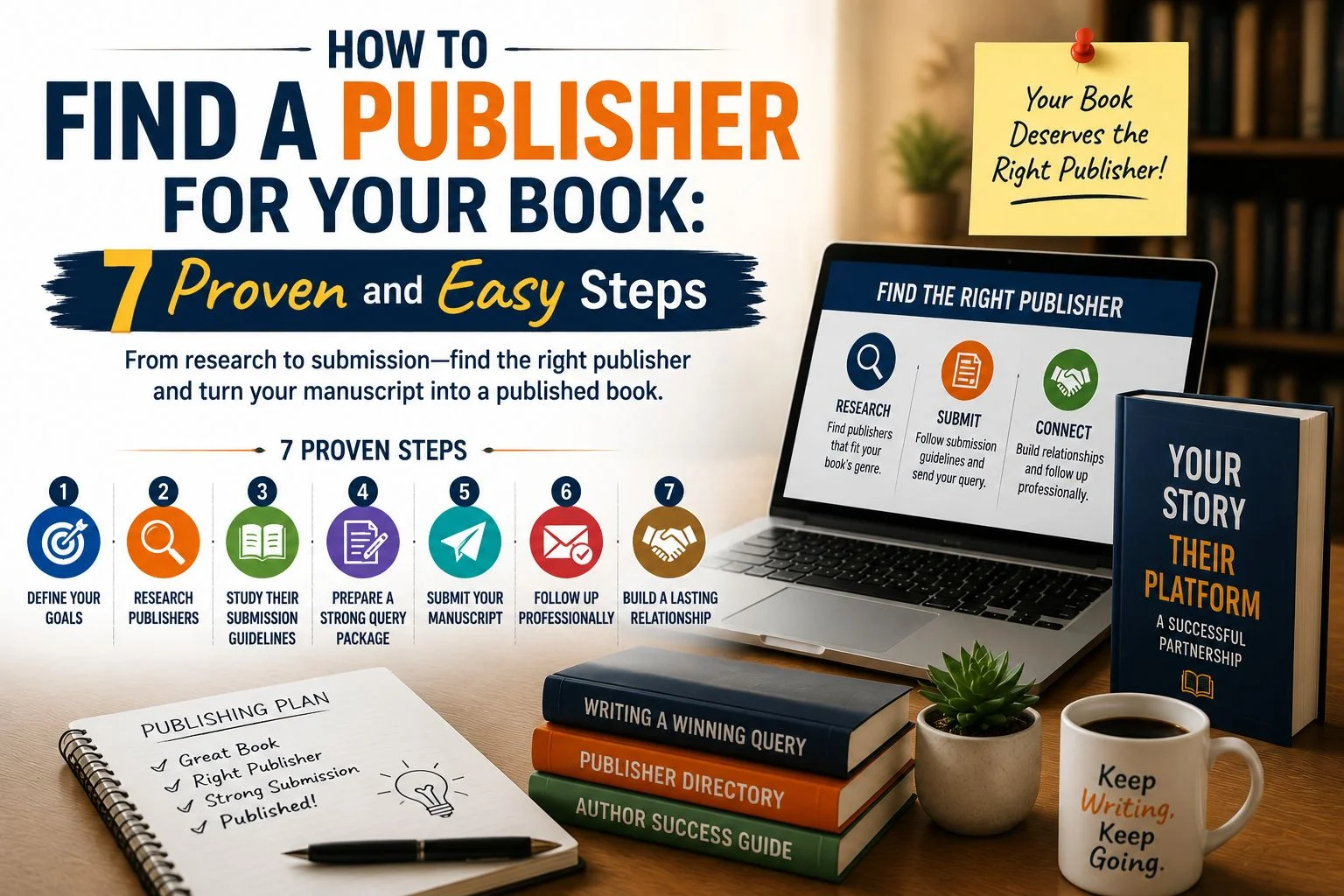
7 Complete Tips on How to Find a Publisher for Your Book
Choosing a publisher isn’t simply a matter of sending your manuscript out to dozens of companies. Good writers do research, put together professional submission materials, and do research. The following seven tips will explain how to find a publisher for your book and greatly enhance your chances of success.
As you begin to look for a book, the first thing you need to do is determine your genre.
Tip 1: Identify Your Book Genre Before Searching
The first thing you should know how to find a publisher for your book is to determine exactly which genre your book falls into.
Publishers are niche-oriented. Some specialize in children’s books, and others publish romance, thrillers, business books, educational books, or memoirs. It’s a waste of time and rarely gets published to get your manuscript into an out-of-the-way publisher that doesn’t publish in your genre.
Ask yourself:
- Who will be reading my book?
- What books do I have similar to mine?
- Which publishers did they publish with?
- What aged audience is my book for?
When you study books that are selling well in your niche, you will be able to find publishers who are looking for more books like yours.
If you have written a middle-grade or young adult novel, for instance, you can learn how successful children’s publishing companies position and market books in their category by researching Amulet Books’ publisher.
Your first research step before submitting your manuscript should be to make a list of genre-specific publishers.
Tip 2: Research Publishers That Publish Similar Books
Many new authors make the biggest of errors when submitting their work to publishers without doing proper research. Publisher websites often provide wholesale ordering information, making them the best place to learn how to buy books wholesale from publishers.
Rather, take the time to analyze each publisher by reading about:
• Their published titles
• Submission guidelines
• Author success stories
• Genres they will consider for future entries
• Distribution channels
• Marketing capabilities
Good sources of information include publisher websites, which may include submission guidelines and details on the kinds of books they are looking for.
Additionally, you will need to look at some web-based bookstores and bestseller lists to find publishers that publish books like yours.
If you are writing a children’s novel, for instance, reading books from Amulet Books’ publisher will give you a good idea of what publishers expect for the genre, what sort of cover design you’d need to have, and the quality you should strive for in your novel.
This type of research will give you not only an idea of how to find a publisher for your book, but will also help you fine-tune your submission to each publisher’s particular interests.
Tip 3: Prepare a Professional Manuscript
If you’re interested in how to start a book publishing company, you’ll quickly realize that quality editing is one of the most valuable services publishers provide to authors.
The best story can be turned down simply because the manuscript is not professional-looking.
Before you submit your manuscript to any publisher, make sure it’s revised, edited, and proofread. Publishers want manuscripts that are well written and require very little editing. Understanding what is book publishing helps authors realize why formatting matters.
The following is the structure of a professional manuscript:
- Proper formatting
- Consistent fonts and spacing
- Correct grammar and punctuation
- Clear chapter headings
- Page numbers
- Title page with your contact information.
If it’s possible, use a professional editor. New eyes can spot problems that may go unnoticed by the author after many edits.
If you have a deeper understanding of what book publishing entails, you will better recognize the importance publishers place on professionalism. Each manuscript is an investment; publishers prefer publication-ready submissions.
When you want to know how to begin a book publishing company, you’ll discover that one of the most beneficial services that publishers supply to authors is quality editing.
Authors and retailers alike benefit from understanding how to buy books wholesale from publishers, especially when ordering books in bulk.
Tip 4: Write an Outstanding Query Letter
The letter you send with your query is your first impression and part of your entire submission package.
A good query letter should introduce:
- Your book title
- Genre
- Word count
- Target audience
- Short story summary
- Author backgroundGive reasons for choosing that particular publisher.
Maintain a business-like, brief, and personalized letter. Don’t send out the same letter to all publishers.
Rather, refer to the reasons you think your manuscript will make an appearance in their catalogue.
For example:
I feel that my middle-grade fantasy novel fits in with your current catalogue because you have succeeded in publishing children’s fiction that is engaging.
Differentiate your letters, and you’ll stand out as a professional and boost your odds of a positive reply.
Among the best of all the skills you can learn is how to find a publisher for your book, which is writing an effective query letter.
Tip 5: Consider Working With a Literary Agent
Literary agents can help many large traditional publishers with their submissions.
An experienced literary agent can:
- Enhance your query package.
- Submit manuscripts straight to the editors.
- Negotiate publishing contracts.
- Ensure you retain your publishing rights.
- Help maximize royalties.
Another benefit of agents is that they are aware of what publishers are seeking out in new authors, so when you send your manuscript, it will have a better chance of being accepted.
Do background checks on agents before signing a contract with them, including their publishing history, clients, and recent clients. Do not pay literary agents any upfront fees; a quality literary agent will not require an author to pay in advance, but will only collect a commission when the book gets published.
A good literary agent can make a world of difference, whether you’re looking for a traditional publisher or you want to know how to find a publisher for your book.
Tip 6: Follow Every Submission Guideline
Learning what is book publishing also means learning professional submission standards.
The quickest way to get rejected is to not follow a publisher’s guidelines when submitting a book. If you do not do so, you will never get even the best manuscript considered. Self-publishing is learning how to submit your book in a business-like manner.
The submission criteria of most publishers are easily understood on their websites. These guidelines may feature:
- Accepted genres
- File size (800K or smaller)
- Number of sample chapters
- Synopsis length
- Query letter requirements
- Deadlines (including when to submit and when the information must be available)
Check the publisher’s guidelines before clicking “Submit. If you send them attachments containing pasted text, more than the requested number of chapters, or when they request things that you don’t have, it can lead to automatic rejection.
Create a submission checklist for each publisher to ensure all requested items are submitted. This is an easy, pro tip that will help you make a good first impression and show professionalism.
Whether you’ve come up with the question, ‘What is book publishing?,’ You will soon find that publishers receive hundreds or even thousands of submissions each month. If you follow their instructions, they’ll be easier to read through, and you will be showing them respect for the time they took in their review.
Tip 7: Stay Patient and Keep Submitting
Authors who understand what is book publishing know rejection is normal.
Rejection letters are normal for every author, and it is not even painful to receive. Rejection letters are part and parcel of any author’s life, and they are not even a bother. Dozens of popular authors were rejected by publishers before landing with the one that published their books.
If your book has been rejected, do not assume that it is not good! Manuscripts are rejected by publishers for numerous reasons, such as:
- They have a very busy publication schedule.
- Your book is not part of their existing book list.
- There is a change in Market demand.
- They’re playing various genres.
- Budget limitations.
Take each rejection as an opportunity to improve your manuscript and submission package.
Maintain a spreadsheet to record:
- Publisher name
- Submission date
- Response received
- Feedback provided
- Follow-up dates
An overnight sensation won’t often occur, and persistence is one of the keys that separates authors who get publishing contracts from those who give up too soon.
The process of finding a publisher for your book will require patience, professionalism, and a desire to improve.
Prepare Your Manuscript Before Contacting Publishers
Having a manuscript prepared by a professional boosts your chances of getting it published. Don’t submit a book that hasn’t been thoroughly cleaned up.
Finish and Edit Your Manuscript
Once the manuscript is complete, run the spell and grammar check, then edit it.
Do not turn in your first draft! Read your manuscript several times and make revisions until all chapters flow easily. Identify problems in the plot, dialogue, repetition, and pacing.
Many authors go through multiple rounds of self-editing before sending it to a professional editor.
Get Professional Proofreading
Even professionals write grammatically and spell correctly. By hiring a professional proofreader, you can make sure your manuscript is ready to be polished and free of distracting errors.
A clean manuscript will present a professional image and will allow your story to be read without having to focus on your many typos.
Format Your Book Correctly
Your manuscript will be easier to read and to review if it is correctly formatted.
Most publishers prefer:
• Double-spaced
• Double spacing
• One-inch margins
• Page numbers
• Clearly labeled chapters
Professional formatting demonstrates your knowledge of what it entails to be a book publisher and that you are a serious writer.
Create a Strong Book Synopsis
A synopsis is one or two pages that give an overview of your entire story.
Unlike the description on the back cover, the synopsis should be more revealing. It should give the full story, including the ending.
This document is intended for use by publishers to assess the structure and general interest of a story.
Write a Winning Query Letter
Your letter of inquiry should present yourself and your book and motivate the publisher to take a closer look at your full manuscript.
Include:
- Book title
- Genre
- Word count
- Brief story summary
- Author biography
- Reason for contacting that publisher
A brevity and personal touch in a query letter can make a far greater impression than a lengthy one.
Understanding Book Publishing Contracts
Knowing the inner workings of book publishing contracts. Knowing the workings of book publishing contracts.
It’s wonderful to be offered a publishing deal, but don’t sign a contract until you know what it contains.
Royalties Explained
Royalties are the percentage that you get each time someone buys a book.
Royalty rates are different in different cases and are subject to the following considerations:
• Print books
• eBooks
• Audiobooks
• Publishing model
Be careful when making any decisions about royalties.
Book Advances
In some cases, traditional publishers will advance royalties to the author for future books.
This “advance” enables authors to receive money before the book’s publication. Most of the future royalties, however, are only received after the advance has been recouped from book sales.
Copyright Ownership
If possible, keep your copyright.
The publishing contract will allow the publisher to publish and distribute your work, but will not transfer ownership of your work.
Be sure to know what rights you are granting when you sign the license.
Limited rights that you don’t want to be restricted to yielding.
Rights You Should Never Give Away
When agreements require:
• Worldwide rights
• Film rights
• Translation rights
• Audiobook rights
• Merchandising rights
If these rights are unnecessary, discuss with the other party to keep them for other situations.
Before signing a contract, many writers seek advice from publishing attorneys or literary agents.
Best Alternatives If Traditional Publishers Reject Your Book

When traditional publishers decline your book, you have to find some alternatives.
It’s not all about traditional publishing. Numerous successful authors have achieved success through alternative routes to publication.
Amazon Kindle Direct Publishing (KDP)
Through Amazon KDP, authors have complete creative control and earn higher royalties for publishing their print books and eBooks worldwide.
IngramSpark
IngramSpark provides extensive worldwide distribution, ensuring that books are available in bookstores, libraries, and online retailers worldwide.
Print-on-Demand Publishing
The need for massive print runs is eliminated with print-on-demand, as books are only printed when customers order them.
This will minimize financial risk and help authors keep their books available indefinitely.
Professional Publishing Services
Some entrepreneurs interested in how to start a book publishing company begin by offering these professional services to independent authors.
Many writers opt to use a business publishing company to edit, format, create covers, register an ISBN, and market their book while still retaining the rights to their book.
Some business owners interested in a book publishing company start by providing such expert services to self-published authors.
12 Common Mistakes Authors Make When Looking for a Publisher
The 12 Mistakes Writers Make When They’re Searching for a Publishing Company.
Be careful not to make the following common mistakes that can hurt your publishing success:
1.Presenting an incomplete manuscript.
2. Skipping professional editing.
3. Ignoring submission guidelines.
4. Sending out general query letters.
5. Getting in touch with publishers who are not in your genre.
6. Failing to research publishers.
7. Paying vanity publishers without doing research.
8. Having unrealistic expectations.
9. abandoning after a first rejection.
10. Neglecting book marketing.
11. Not protecting copyright.
12. Not creating an author platform.
By avoiding these pitfalls, you’ll reinforce your knowledge of how to find a publisher for your book and improve your chances of success.
Expert Tips to Increase Your Chances of Getting Published
From the experts themselves, here are some tips to raise your chances of getting published.
Their professional authors are committed to their careers.
To increase your likelihood of being published:
- Create a professional author website.
- Have active social media accounts.
- Develop an e-Newsletter.
- Attend writing conferences.
- Join author organizations.
- Connect with editors/ literary agents.
- Continue improving your writing skills.
Read books in your genre to know what is going on in the world.
Your author brand will get more appealing the more professional you become.
Step-by-Step Checklist to Find a Publisher
When preparing your document for submission, check this list:
- Finish your manuscript.
- Thoroughly edit and proofread.
- Publishers that align with your genre.
- Create a business letter of inquiry.
- Write a compelling synopsis.
- Ensure that each publisher’s submission guidelines are followed.
- Track every submission.
- Read publishing contracts very carefully.
These steps will help you get more organized and effective in finding a publisher for your book.
Final Thoughts
If your long-term goal is how to start a book publishing company, studying the publishing process as an author provides valuable real-world experience.
It takes time, research, and persistence to find a publisher for your book, but it is worth it. In any case of publishing, whether traditional, hybrid, or self-publishing, the key is having a clean and tidy manuscript, researching the publisher thoroughly, and preparing the appropriate submission documents.
Whether you’re an author or bookseller, knowing how to buy books wholesale from publishers can create additional opportunities in the publishing industry.
When you know what you are looking for, reading book publishing examples like Amulet Books makes it easier to find publishers in your genre. As an author, you get valuable on-the-job experience in the publishing process, which will help you understand how to start a book publishing company.
Keep in mind that failure is not rejection: it’s just a part of the process. Keep refining submissions, improving the manuscript, and gaining knowledge of the publishing industry. But if you’re patient, persistent, and strategic, you’ll improve your odds of discovering the perfect publishing partner and reaching worldwide readers.
Frequently Asked Questions
Where can I find a first book publisher?
Identify your genre book, find publishers that publish similar books, edit your book, and be careful to follow each publisher’s submission guidelines.
Is it possible to contact publishers without an agent?
Yes. Many small and independent publishers accept direct submissions of manuscripts, while many larger traditional publishers require submissions through a literary agent.
What is the initial rate of pay for publishers to authors?
Compensation is dependent on the publisher, book type, and contract. There are traditional publishers that pay advances and some others that pay royalties on book sales.
What is the time frame for publication?
The process of traditional publishing can take 12–24 months from manuscript acceptance to publication. If your book is ready, self-publishing can take as few as a few weeks.
Which is the simplest and fastest method to publish a book?
Generally, self-publishing is the quickest and easiest way to publish a book, as no publisher approval is required.
How to check if a publisher is a legitimate company?
Do some research on the reputation of the publisher, check their books, read comments from authors, check royalty rates, and steer clear of publishers that will publish your book for a high fee.
What’s the content of a query letter?
State the book title, genre, word count, short summary, your author bio, and a unique message about why you are writing this book to this particular publisher.
Is self-publishing the superior approach to publishing over traditional publishing?
There is no right or wrong answer to either option. Traditional publishing provides industry support and credibility, while self-publishing offers greater control, a quicker book-to-market timeline, and greater royalty potential. You will need to decide on the best option depending on your goals and publishing plan.
How do I buy books wholesale from publishers?
To learn how to buy books wholesale from publishers, contact publishers directly, review their wholesale terms, meet minimum order requirements, and provide resale documentation if required. Many publishers also work with wholesale distributors for bulk orders .

We help authors bring their stories to life through professional online book publishing services. From manuscript formatting and cover design to Amazon KDP publishing and global distribution, we make self-publishing simple, affordable, and successful.